

Applying for a UK degree online while managing a full-time job presents unique challenges. Missing critical deadlines or submitting incomplete documents can derail your plans entirely. This guide provides everything you need to navigate the application process successfully, balance your career commitments, and secure your place in an accredited UK program without unnecessary delays or stress.
Table of Contents
- Prerequisites And Requirements For UK Degree Online Applications
- Step-By-Step Application Process For UK Degrees Online
- Timelines, Deadlines, And Costs For UK Online Degree Applications
- Common Mistakes And How To Avoid Them When Applying Online
- Alternative Accelerated Online Degree Options For International Professionals
- Expected Outcomes And Next Steps After Applying For UK Online Degrees
- Boost Your Career With Seekstudy’s Accelerated UK Online Degrees
- Frequently Asked Questions
Key Takeaways
| Point | Details |
|---|---|
| UCAS centralizes undergraduate applications | Single platform handles up to five course choices with fixed deadlines |
| English proficiency is mandatory | IELTS scores of 6.0 to 7.0 required depending on program level |
| Document preparation determines success | Accurate transcripts, statements, and references significantly improve acceptance rates |
| Accelerated programs save time | Complete bachelor’s degrees in 2 years or MBAs in 1 year online |
| Prompt offer responses secure enrollment | Meeting conditional offer requirements quickly ensures your spot |
Prerequisites and Requirements for UK Degree Online Applications
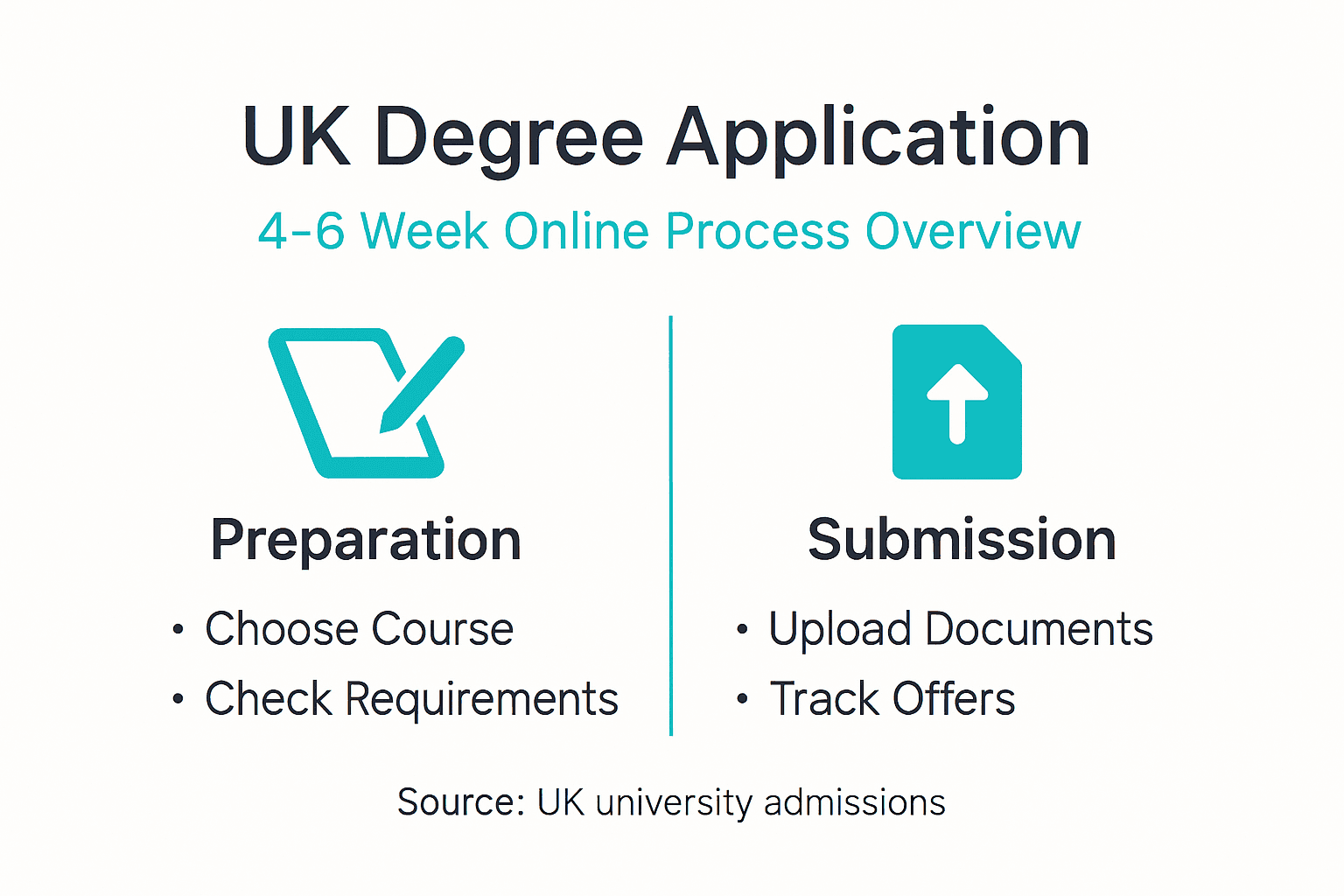
Before starting your application, you need to understand what UK universities expect from international applicants. Undergraduate programs typically require completion of secondary education equivalent to UK A-levels, while postgraduate applicants need a relevant bachelor’s degree or substantial professional experience.
English language proficiency stands as a non-negotiable requirement. Most institutions accept IELTS Academic scores ranging from 6.0 to 7.0 depending on your chosen program. TOEFL iBT and PTE Academic serve as acceptable alternatives with equivalent score thresholds.
Your document checklist must include:
- Official academic transcripts from all institutions attended
- Tailored personal statement explaining your motivation and career goals
- Two professional or academic reference letters
- Valid English proficiency test scores
- Copy of passport or national ID
- CV or resume highlighting relevant experience
Access requirements differ by level. Undergraduates apply through the UCAS portal, which streamlines applications to multiple universities. Postgraduate candidates typically submit applications directly via individual university portals. Understanding the value of UK degrees helps you choose programs aligned with your career objectives.
Essential Documents Overview
| Document Type | Undergraduate | Postgraduate | Notes |
|---|---|---|---|
| Academic Transcripts | Required | Required | Must be official and translated if not in English |
| Personal Statement | Required | Required | Tailor to each course application |
| References | 1-2 required | 2 required | Academic preferred, professional acceptable |
| English Test | IELTS 6.0-6.5 | IELTS 6.5-7.0 | Scores valid for 2 years |
| Work Experience | Optional | Often required | Especially for MBA programs |
Pro Tip: Scan and save digital copies of all documents in PDF format at least two months before application deadlines. This eliminates last-minute scrambling and allows time to request replacements if originals are damaged or lost.
Many working professionals find business management diploma programs provide foundational knowledge before pursuing full degree programs.
Step-by-Step Application Process for UK Degrees Online
Navigating the application process becomes manageable when broken into clear sequential steps. Here’s exactly what you need to do.
1. Research and shortlist programs
Identify 3 to 5 universities offering courses matching your career goals. Compare curriculum content, accreditation status, and graduate outcomes. Online programs provide flexibility but verify they carry the same accreditation as on-campus equivalents.

2. Verify eligibility requirements
Each program lists specific entry criteria. Check minimum grades, prerequisite subjects, and work experience expectations. Don’t waste time applying to programs where you don’t meet baseline requirements.
3. Prepare application materials
Draft your personal statement specifically for each course, highlighting why that particular program aligns with your goals. Request reference letters at least three weeks before deadlines. Gather all academic documents and ensure English test scores are current.
4. Complete UCAS application (undergraduates)
Register on the UCAS platform, which allows one application covering up to five course choices. Fill in personal details, education history, employment record, and upload your statement. Pay the application fee and submit before the deadline.
5. Submit direct applications (postgraduates)
Visit each university’s admissions portal and complete their online application form. Upload required documents, pay any application fees, and submit. Some institutions allow multiple program applications within a single submission.
6. Monitor and respond to offers
Universities send conditional offers requiring you to meet specific criteria like achieving certain grades or submitting final transcripts. Unconditional offers grant immediate acceptance. Respond within the timeframe specified, typically 2 to 4 weeks. Accept your firm choice and decline others promptly.
Pro Tip: Create a spreadsheet tracking each application’s deadline, required documents, submission date, and offer response deadline. Set phone reminders one week before each critical date to avoid missing opportunities.
Working professionals often benefit from online MBA programs designed specifically for career advancement without career interruption. Understanding UK degree recognition ensures your qualification carries weight internationally. Preparing properly for fast-track programs maximizes your success chances.
Timelines, Deadlines, and Costs for UK Online Degree Applications
Timing makes or breaks your application success. UCAS operates on strict deadlines that vary by program type.
The primary UCAS deadline falls on 15 January for most undergraduate courses. Applications for Oxford, Cambridge, and most medicine, veterinary, and dentistry programs close much earlier on 15 October. Postgraduate programs often accept rolling applications but competitive courses fill quickly.
After submission, expect 4 to 6 weeks for universities to review your application and issue offers. Conditional offers require additional time to fulfill requirements like submitting final transcripts or achieving specific test scores.
Critical Timeline Milestones
| Milestone | Undergraduate | Postgraduate | Action Required |
|---|---|---|---|
| Application Opens | Early September | Varies by university | Begin preparation |
| Early Deadline | 15 October | N/A | Oxbridge, medicine only |
| Main Deadline | 15 January | Varies | Most courses |
| Offer Response | 2-4 weeks | 2-4 weeks | Accept or decline |
| Conditional Requirements | By August | Varies | Submit final documents |
Financial planning requires understanding fee structures:
- UCAS application fee: £22 for one course, £26 for multiple courses
- University application fees: £0 to £100 per application (varies by institution)
- Tuition fees: £6,000 to £20,000+ annually depending on program and university
- Online accelerated programs: Often 20% to 40% less than traditional on-campus equivalents
Scholarship opportunities exist specifically for international online learners. Many universities offer merit-based reductions, and some professional organizations provide funding for members pursuing advanced qualifications. Research options early as application deadlines often precede course deadlines by several months.
Fast-track degree programs compress traditional timelines, allowing you to complete credentials faster while often reducing total costs through shorter study duration.
Common Mistakes and How to Avoid Them When Applying Online
Even strong candidates sabotage their chances through preventable errors. Here’s what goes wrong and how to fix it.
Missing deadlines represents the most common failure point. UCAS and universities reject late applications outright or defer them to the next intake cycle, costing you an entire year. Set multiple reminders and aim to submit at least one week early to handle technical issues.
Incomplete documentation stalls applications indefinitely. Missing transcripts, unsigned reference letters, or expired English test scores prevent admissions officers from evaluating your candidacy. They won’t chase you for missing items.
Underestimating English proficiency requirements creates barriers. Taking IELTS without adequate preparation often results in scores below threshold, forcing retakes that delay your application. Book tests 2 to 3 months before deadlines allowing time for potential retakes.
Generic personal statements fail to differentiate you from hundreds of other applicants. Admissions officers spot templated content immediately. Each statement must specifically address why you chose that particular course at that specific university and how it serves your unique career trajectory.
Delaying responses to conditional offers risks losing your place. Universities set firm deadlines for accepting offers and meeting conditions. Other candidates on waiting lists will claim spots you forfeit through inaction.
Submit accurate, complete applications well before deadlines. Proactive preparation and attention to detail separate successful applicants from rejected ones.
Fix these issues by:
- Using application tracking spreadsheets with automated deadline reminders
- Preparing document packages 6 to 8 weeks before deadlines
- Taking English proficiency tests 3 to 4 months early
- Writing unique personal statements for each application
- Responding to all university communications within 48 hours
Applying for MBA programs requires particular attention to demonstrating professional experience and leadership potential in your application materials.
Alternative Accelerated Online Degree Options for International Professionals
Traditional UK bachelor’s degrees require three to four years of full-time study with physical campus attendance. Master’s programs typically demand one to two years on campus. Working professionals often cannot afford this time investment or relocation.
Accelerated online degree programs solve this problem. Reputable institutions now offer fully accredited UK bachelor’s degrees completable in two years and MBAs achievable in one year, all delivered entirely online.
Traditional vs Accelerated Online Programs
| Factor | Traditional On-Campus | Accelerated Online |
|---|---|---|
| Bachelor’s Duration | 3-4 years | 2 years |
| Master’s Duration | 1-2 years | 1 year |
| Location Requirement | Campus attendance mandatory | Fully remote |
| Schedule Flexibility | Fixed class times | Study around work commitments |
| Total Cost | Higher (accommodation, travel) | Lower (no relocation) |
| Career Interruption | Often required | Maintain current job |
Key benefits of accelerated online programs include:
- Time efficiency allowing faster career advancement and earning potential
- Cost savings from eliminated accommodation, travel, and opportunity costs
- Geographic freedom to study from anywhere without visa complications
- Schedule flexibility fitting study around work and family commitments
- Career relevance through immediate application of learning to current roles
Pro Tip: Verify that accelerated programs carry proper UK accreditation from Ofqual or recognized awarding bodies. Check if partner universities appear on official UK government lists. This ensures your degree gains international recognition and supports career mobility.
Online MBA programs deliver particular value for working professionals seeking leadership roles. Fast-track degrees support career advancement by reducing time out of the workforce. Exploring accelerated UK online degrees reveals options fitting diverse professional circumstances.
Expected Outcomes and Next Steps After Applying for UK Online Degrees
After submitting applications, understanding what happens next reduces anxiety and helps you prepare appropriately.
Universities issue two offer types. Conditional offers accept you pending fulfillment of specific requirements such as achieving certain final grades, submitting outstanding transcripts, or providing updated English test scores. Unconditional offers grant immediate acceptance with no further requirements.
The timeline from offer acceptance to enrollment typically spans four to twelve weeks depending on when you receive the offer relative to course start dates. Use this period productively.
Students must complete several preparatory actions:
- Submit any outstanding documentation required by conditional offers immediately
- Arrange payment of tuition deposits or first installments by specified deadlines
- Complete university registration and orientation modules online
- Verify technology requirements and test access to learning platforms
- Review course syllabi and prepare any prerequisite reading
- Connect with future classmates through university social channels
Online students studying remotely from their home countries typically don’t require UK student visas. However, verify this with your specific institution as some programs include short intensive periods requiring brief UK visits.
Prepare your technology setup early. Most programs require reliable internet, webcam, microphone, and access to video conferencing tools. Download required software and familiarize yourself with learning management systems before course commencement.
Review fast-track program structures to understand how accelerated pacing differs from traditional semester systems and plan your work schedule accordingly.
Boost Your Career with Seekstudy’s Accelerated UK Online Degrees
Navigating traditional application processes while working full time creates unnecessary barriers to career advancement. Seekstudy eliminates these obstacles with accelerated degree programs specifically designed for international working professionals.
Complete accredited UK bachelor’s degrees in just two years or earn your MBA in one year through fully online delivery. Flexible scheduling allows you to maintain your current job while building qualifications that drive career advancement.
Simplified application support and rolling admissions remove the stress of fixed deadlines and complex portal navigation. Apply for business degrees with confidence knowing your credentials will carry full UK recognition without requiring relocation or career interruption.
Frequently Asked Questions
What is the UCAS application system and do I need it for postgraduate studies?
UCAS serves as the centralized application platform for UK undergraduate programs, allowing you to apply to up to five courses through one submission. Postgraduate applicants typically bypass UCAS and apply directly through individual university portals. Each university maintains its own postgraduate application system with unique requirements and deadlines.
How do I prove my English language proficiency for a UK online degree?
Most UK universities accept IELTS Academic, TOEFL iBT, or PTE Academic scores as proof of English proficiency. Undergraduate programs generally require IELTS scores of 6.0 to 6.5, while postgraduate courses demand 6.5 to 7.0. Test scores must be less than two years old at application time and meet minimum thresholds before universities issue unconditional offers.
Can I complete an accredited UK degree entirely online without relocating?
Yes, numerous UK universities now offer fully online degree programs that carry identical accreditation to their on-campus equivalents. Seekstudy provides completely remote accelerated bachelor’s and master’s programs delivering internationally recognized UK qualifications. You can earn your degree without visa applications, relocation costs, or career interruption while maintaining full academic rigor.
What should I do if I miss the UCAS application deadline?
Missing the 15 January UCAS deadline severely limits your options as most competitive courses reject late applications. Some universities accept applications through UCAS Extra or Clearing, but choices become restricted. Your best option involves preparing a stronger application for the next intake cycle, using extra time to improve your grades or gain relevant experience. Alternatively, consider accelerated online programs offering rolling admissions throughout the year.