

TL;DR:
- Managing global business involves navigating cultural, regulatory, supply chain, and geopolitical complexities.
- Few companies are truly global; most operate regionally due to cultural and legal barriers.
- Success requires cross-cultural leadership, strategic framework application, and adapting to emerging international challenges.
Most people assume global business management is simply about selling products in multiple countries. That assumption misses about 90% of what the discipline actually involves. Managing across borders means navigating cultural friction, regulatory complexity, supply chain risk, and geopolitical uncertainty, all at once. This article breaks down a precise definition of global business management, introduces the strategic frameworks professionals rely on, examines the surprising reality of how few companies are truly global, and connects it all to concrete career outcomes. Whether you’re a student choosing a degree path or a professional planning your next move, this guide gives you the clarity to act.
Table of Contents
- What is global business management? Key concepts explained
- Essential frameworks in global business management
- Regional vs truly global: The reality behind the term
- Career impact: Why global business management matters for you
- Advanced challenges and emerging trends in global management
- Our perspective: What most guides miss about global business management
- Explore your global business management journey
- Frequently asked questions
Key Takeaways
| Point | Details |
|---|---|
| Comprehensive definition | Global business management integrates strategy, operations, culture, and compliance across borders. |
| Strategic frameworks | Tools like CAGE and AAA guide decision-making for market entry and adaptation. |
| Practical career value | Skills in global management increase employability in multinational and cross-cultural roles. |
| Regional reality | Most multinationals operate regionally with only a minority truly global in all aspects. |
| Resilience in complexity | Success depends on adaptability to geopolitical risks, regulations, and emerging trends. |
What is global business management? Key concepts explained
Let’s get precise about what global business management really means, because the surface-level understanding falls short fast.
Understanding business management basics is a good starting point, but global business management goes several layers deeper. It is the strategic planning, execution, and oversight of business operations across international borders, involving management of employees, resources, supply chains, cultural differences, economic environments, and compliance with global regulations. That definition alone signals how wide the scope really is.
The discipline pulls from strategy, operations, organizational behavior, economics, and law. No single function owns it. A manager working in this space must think simultaneously about profit margins, workforce dynamics in three time zones, and whether a new regulation in one market invalidates a contract in another.
Here are the core areas any global business management practitioner must actively manage:
- Employees and talent: Recruiting, retaining, and leading teams across different labor markets and cultural norms
- Resources and capital: Allocating financial and physical assets across borders with different tax and currency environments
- Supply chains: Coordinating procurement, production, and logistics across multiple countries
- Local cultures: Adapting communication styles, leadership approaches, and product offerings to local expectations
- Economic climates: Monitoring inflation, exchange rates, and GDP shifts that affect operational costs and pricing
- Global regulations: Staying compliant with trade laws, data privacy rules, and industry-specific legislation in every market
“Global business management is the strategic planning, execution, and oversight of business operations across international borders, involving management of employees, resources, supply chains, cultural differences, economic environments, and compliance with global regulations.”
For further definition details, this multidisciplinary scope is what separates global management from simply having an international business degree overview. One is a credential; the other is a living practice.
Essential frameworks in global business management
With a clear definition in hand, it’s crucial to see how leaders structure their approach. Strategic frameworks give managers a repeatable way to analyze complex decisions.
Key mechanics and methodologies include four frameworks that appear consistently in both academic programs and boardroom strategy sessions: CAGE Distance, Integration-Responsiveness, AAA, and OLI/Eclectic Paradigm. Each one answers a different question.
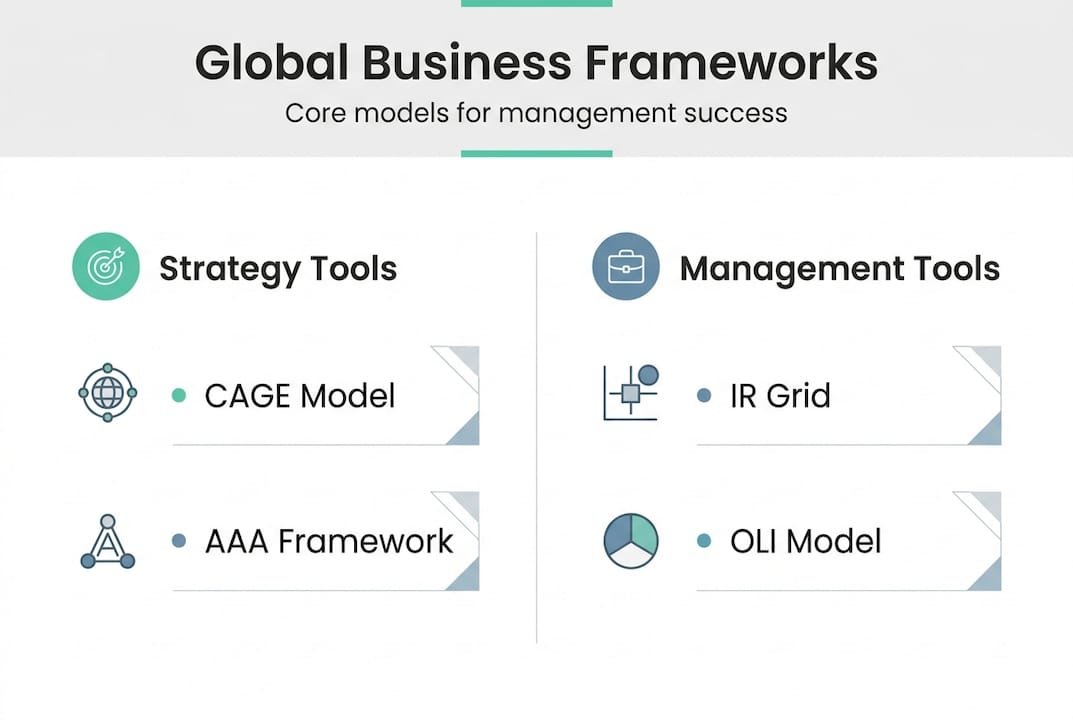
| Framework | Core question | Best used for |
|---|---|---|
| CAGE Distance | How different is this market from ours? | Market entry decisions |
| Integration-Responsiveness | Standardize globally or adapt locally? | Organizational structure |
| AAA framework | Arbitrage, Adaptation, or Aggregation? | Value creation strategy |
| OLI/Eclectic Paradigm | Why and how should we expand abroad? | Foreign direct investment |
Here’s a practical sequence for using a framework in real decision-making:
- Define the decision: Are you entering a new market, restructuring operations, or evaluating a partnership?
- Select the matching framework: Use CAGE for market comparison, OLI for investment rationale, AAA for value strategy.
- Gather the relevant data: Cultural distance, regulatory gaps, cost differentials, competitive intensity.
- Run the analysis: Map your findings against the framework’s variables to surface trade-offs.
- Test your conclusion: Challenge your output with a second framework to catch blind spots.
Pro Tip: Don’t default to one framework because it’s familiar. The CAGE model is excellent for screening markets, but if your core question is about how to create value once you’re in a market, the AAA framework gives you sharper answers.
When choosing a management program, check whether the curriculum teaches these frameworks with real case applications, not just theory. That practical exposure is what makes the difference in job interviews and on the job.
Regional vs truly global: The reality behind the term
Understanding frameworks is essential, but the way real companies operate isn’t as clean as theory suggests.
Here’s a number that surprises most students: only 21.1% of Swiss MNEs earn truly global sales, meaning most multinationals, even sophisticated ones, remain home-regional or bi-regional in their actual revenue distribution. Fewer than 25% of even advanced multinationals qualify as truly global by either sales or employee distribution.

| Company orientation | Description | Typical share of MNEs |
|---|---|---|
| Home-regional | Over 50% of sales in home region | Majority |
| Bi-regional | Significant presence in two regions | Minority |
| Truly global | Balanced sales across all major regions | Under 25% |
Why do so few companies reach true global status? Several barriers consistently block full geographic diversification:
- Cultural distance: Consumer preferences, communication norms, and trust-building practices vary enormously across regions
- Regulatory fragmentation: Different legal systems, data laws, and trade policies make uniform operations costly
- Operational complexity: Managing logistics, talent, and quality control across dozens of markets strains even the largest organizations
- Political risk: Geopolitical instability can make long-term investment in certain regions untenable
This doesn’t mean regional strategies are inferior. In many cases, management practices research shows that deep regional expertise generates stronger returns than a thin global presence spread across too many markets.
For professionals, this insight is actionable. Mastering one or two regions deeply, while understanding how to connect them, is often more valuable than a vague claim to global experience. An executive MBA for a global edge can help you build exactly that kind of focused, credible expertise.
Career impact: Why global business management matters for you
If only a minority of companies are truly global, why does it pay to study this field? The answer lies in the versatile skills you’ll gain.
Global business management enhances career prospects through skills in cross-cultural team leadership, strategic frameworks, and risk management. These capabilities transfer across industries and company sizes, which is rare in any discipline.
Here are the key skills you build through formal study or practice in this field:
- Leading cross-border teams: Managing people with different cultural expectations, communication styles, and professional norms
- Applying strategic frameworks: Using tools like CAGE and AAA to make defensible, data-backed decisions
- Risk assessment: Identifying political, financial, and operational risks before they become crises
- Regulatory navigation: Understanding how to operate legally and efficiently across multiple jurisdictions
- Stakeholder management: Building trust with partners, governments, and customers in unfamiliar contexts
These skills open doors in corporate strategy, management consulting, international trade, and entrepreneurship. Harvard’s global management courses consistently emphasize that the highest-value managers combine analytical rigor with cross-cultural fluency.
Pro Tip: When updating your resume or LinkedIn profile, don’t just list “international experience.” Name the specific markets, the frameworks you applied, and the measurable outcomes. Recruiters respond to specifics, not adjectives.
Whether you pursue management studies for careers online or on campus, the goal is the same: build a skill set that works in any market. A bachelor’s in business management with a global focus is one of the most efficient ways to start building that foundation.
Advanced challenges and emerging trends in global management
Beyond foundational skills and research, what are the edge cases and current realities that separate top managers from the rest?
The edge cases in practice include geopolitical risks, intellectual property leakage in arbitrage strategies, and the tension between over-centralization and excessive localization. These aren’t hypothetical. They show up in real decisions every week.
Advanced practitioners deal with a specific set of challenges that textbooks often underplay:
- Geopolitical shocks: Trade wars, sanctions, and political instability can invalidate a market entry strategy overnight
- Regulatory changes: New data privacy laws, tariff structures, or labor regulations can require rapid operational restructuring
- Supply chain disruptions: Single-source dependencies and logistics bottlenecks expose companies to cascading failures
- Intellectual property risks: Expanding into markets with weaker IP enforcement can erode competitive advantage quickly
The response to these challenges isn’t to avoid complexity. It’s to build hybrid strategies that blend global standardization with local flexibility, and to maintain human oversight at key decision points rather than relying entirely on automated or algorithmic systems.
Studying abroad, like the Singapore and UK combination offered through programs at Seekstudy, gives you direct exposure to how different regulatory and cultural environments operate in practice. That lived experience accelerates your ability to recognize and respond to these edge cases.
Pro Tip: Build relationships with local experts in every key market you operate in. No framework replaces the insight of someone who understands the ground-level dynamics of a specific region. Use the AAA framework for adaptation as your analytical backbone, but let local knowledge inform the judgment calls.
Our perspective: What most guides miss about global business management
Most textbooks and online guides imply there’s a formula for global management success. Follow the frameworks, earn the degree, land the role. That framing is incomplete.
What we’ve seen consistently is that the managers who perform best internationally are not the ones who memorize the most frameworks. They’re the ones who can read ambiguity, adjust their leadership style across cultural contexts, and make decisions when the data is incomplete. Frameworks are tools, not answers.
Management practices explain roughly 25% of cross-country productivity gaps, with the US acting as the managerial frontier. That statistic tells you something important: management quality is measurable, and it varies enormously. The gap between a good global manager and an average one is not just about credentials.
The real work happens at the intersection of cultural intelligence, operational discipline, and strategic clarity. That’s what we try to build into every program at Seekstudy. The frameworks give you a language. The experience gives you judgment. You need both.
Explore your global business management journey
After considering what truly drives success in this field, here’s how you can take concrete steps for your own global business management education.

At Seekstudy, we’ve designed accelerated pathways that give you both the analytical foundation and the international exposure that employers value. Our Bachelor in Business Management delivers a UK-recognized degree in two years, combining online learning with international study experiences in Singapore and the UK. For professionals ready to move faster, the Executive MBA program builds strategic leadership skills in one year. If you want to compare options before committing, explore our full range of accelerated business degrees to find the path that fits your timeline and career goals.
Frequently asked questions
What does a global business manager do?
A global business manager oversees cross-border operations, aligns international teams, manages risks, and ensures compliance with global regulations across multiple markets.
What are the top frameworks used in global business management?
Key frameworks include the CAGE Distance model, Integration-Responsiveness grid, AAA strategy framework, and OLI/Eclectic Paradigm, each serving a different strategic purpose.
Is a career in global business management in demand?
Yes, employers worldwide seek professionals with global management skills due to increasing cross-border operations and the complexity of managing diverse international markets.
How do regional and global strategies differ?
Regional strategies optimize for local markets, while global strategies pursue standardization and worldwide integration; most MNEs remain regional and blend both approaches in practice.
What challenges do global business managers face?
They must navigate cultural differences, legal complexities, and geopolitical risks while adapting strategy continuously to shifting market conditions across multiple regions.