

TL;DR:
- Global business education emphasizes cross-border strategy, multicultural teamwork, and digital collaboration.
- Accredited programs, especially those with AACSB recognition, signal high quality and international relevance.
- Practical international experience and networks are more valuable for careers than just school prestige.
How Global Business Education Transforms International Careers
Many people assume all business degrees deliver the same career outcomes. They don’t. The quality of a program, its international recognition, and how it prepares you for cross-border work vary enormously. A degree from a globally focused, accredited institution doesn’t just look better on a resume — it genuinely changes how you think, lead, and compete in international markets. This article breaks down what global business education really means, how it compares to local alternatives, how it shapes career growth, and how to navigate online delivery models so you can make the smartest choice for your future.
Table of Contents
- What defines global business education today
- Comparing global vs. local business education pathways
- Key roles of global business education in career development
- Navigating online and blended global business programs
- A fresh perspective: Why future business leaders need a global lens
- Explore your global business education options
- Frequently asked questions
Key Takeaways
| Point | Details |
|---|---|
| Quality signals matter | Top accreditations like AACSB distinguish rigorous global programs from the rest. |
| Career impact is global | Global business education drives access to international opportunities and higher earning potential. |
| Online learning reshapes access | Digital platforms widen participation but also highlight the need to address the digital divide. |
| Practical skills win | Employers seek global fluency and adaptability beyond academic prestige alone. |
What defines global business education today
Global business education isn’t just studying business in another country. It’s a fundamentally different approach to learning — one built around the complexity of operating across borders, cultures, and regulatory environments. Understanding the definition and frameworks behind global business education helps you see why some programs genuinely open doors that others simply can’t.
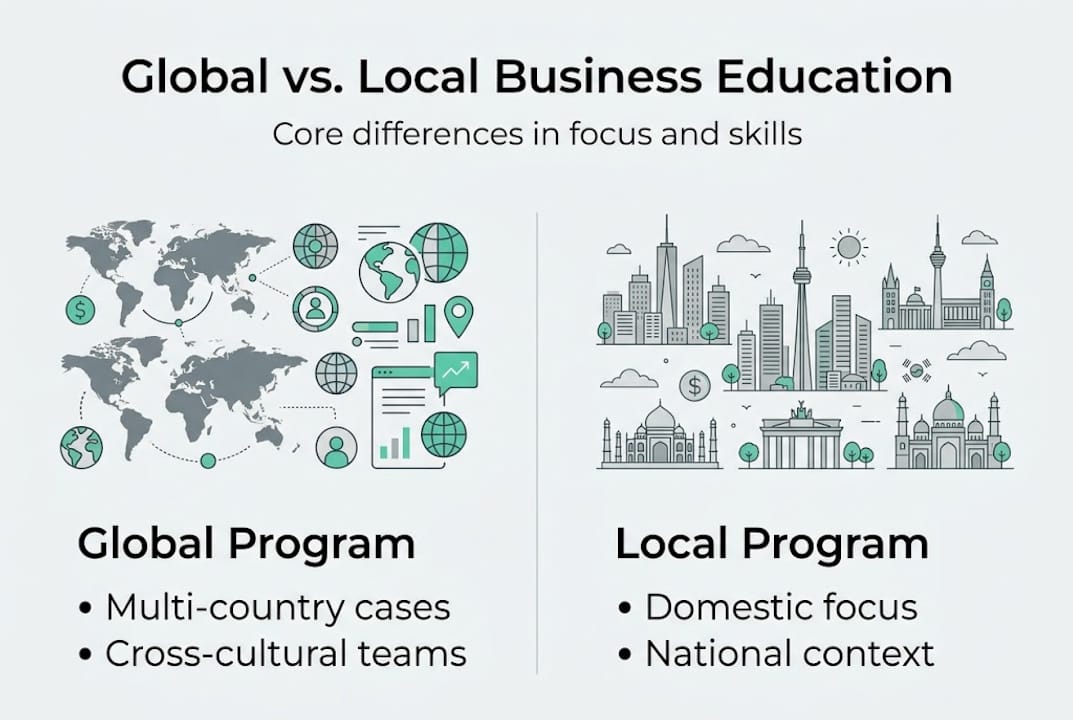
At its core, global business education combines international case studies drawn from real companies operating across multiple markets, multicultural team projects that mirror actual workplace dynamics, cross-border strategy development, and a strong emphasis on digital fluency. Where a local business program might analyze a domestic retailer, a global program examines how that same retailer navigates supply chains across Asia, regulatory shifts in Europe, and consumer behavior shifts in North America simultaneously. The difference in intellectual complexity is significant.
One major shift reshaping the landscape is the growth of non-degree and executive education models. The non-degree and executive education market is projected to reach $134 billion by 2033, which signals a profound change in how professionals think about learning and credentials. Short programs, professional certificates, and modular learning are becoming standard tools for career advancement, not just full degrees.
Accreditation is the clearest signal of program quality. The AACSB accreditation standard is one of the most respected worldwide, yet only about 5 to 6 percent of business schools hold it. That small percentage matters. It means the vast majority of business schools operate without external validation of their curriculum quality, faculty standards, or student outcomes. When you’re choosing a program, knowing whether a school is accredited or not is one of the first questions to ask.
Here’s a quick snapshot of what separates top global business programs from the rest:
| Feature | Strong global program | Typical local program |
|---|---|---|
| Case study scope | International, multi-market | Domestic, single-market |
| Accreditation | AACSB, Ofqual, or equivalent | Often none or regional only |
| Faculty background | International research and industry | Primarily local academics |
| Network access | Global alumni and employer network | Local or national only |
| Language support | Business English and multilingual tools | Single language focus |
Beyond curriculum, strong business English skills are a non-negotiable foundation for success in global programs. Students who invest early in professional language development adapt faster to international classroom environments and perform better in group projects and presentations.
It’s also worth noting that the digital divide remains a real challenge. Not every student has equal access to high-speed internet, devices capable of running video-intensive platforms, or technical support when problems arise. The best global programs account for this reality by offering flexible delivery formats and offline access to course materials.
Key components that define strong global business education:
- International case studies that reflect real decision-making in global firms
- Multicultural cohort structures that replicate real workplace diversity
- Cross-border regulatory and strategic thinking baked into the curriculum
- Digital tools and platforms used for global collaboration
- Recognized accreditations that validate quality to employers worldwide
Earning an international business degree from a well-accredited institution signals to employers that you’ve been tested against high global standards, not just local benchmarks.
Comparing global vs. local business education pathways
With a foundation in what global business education means, it’s helpful to see how it compares to more traditional, local business study routes. The differences are more significant than most prospective students expect.
Local business programs are not inherently bad. They often provide strong grounding in domestic markets, national regulatory frameworks, and region-specific business practices. For students planning careers primarily within their home country, a local program can be entirely appropriate. But for anyone aiming at international roles, multinational employers, or cross-border career growth, the gap in preparation can be substantial.
AACSB accreditation signals quality and rigor in global programs — and the absence of it is something employers notice. A multinational company hiring for a regional management role in Southeast Asia doesn’t just want business knowledge. They want candidates who have worked in multicultural teams, analyzed international markets, and earned credentials that translate across borders. Understanding business school accreditation and why it matters helps you evaluate programs with a sharper eye.
Here’s a direct comparison between global and local pathways:
| Criteria | Global program | Local program |
|---|---|---|
| Curriculum focus | International strategy, global markets | Domestic operations, local regulations |
| Accreditation recognition | International (AACSB, Ofqual, etc.) | Often regional only |
| Career opportunities | Multinational firms, international roles | Primarily domestic employers |
| Alumni network | Global, cross-industry | Local or national |
| Cultural exposure | High, built into program design | Low, depends on student’s initiative |
One common misconception is that an MBA from any institution delivers the same outcomes. That’s simply not true. An MBA from an unaccredited school with no international cohort and a curriculum built around one country’s business environment will not prepare you for a global role in the same way as a program designed specifically for cross-border leadership.
Here’s how to evaluate your options clearly:
- Check accreditation first. Does the program hold AACSB, Ofqual, or an equivalent credential?
- Look at the cohort composition. Are students from multiple countries represented in the program?
- Examine the curriculum. Are international case studies and cross-border strategy covered in depth?
- Research employer relationships. Does the school have active partnerships with multinational companies?
- Assess alumni outcomes. Where do graduates work — local firms or international organizations?
Pro Tip: Use resources like business school rankings to shortlist programs, but don’t let rankings override accreditation checks. A lower-ranked accredited school almost always outperforms a higher-ranked unaccredited one when it comes to international employer recognition.
Graduates from globally focused programs more consistently land roles in multinational organizations. This isn’t accidental — it’s the direct result of curricula designed to simulate international business environments and alumni networks built specifically for cross-border career support.

Key roles of global business education in career development
Understanding the differences between program types helps clarify exactly how global education powers your career journey. The impact isn’t limited to the degree itself — it extends to skills, networks, and positioning that compound over time.
One of the most tangible outcomes of global business education is the development of global leadership capability. This goes beyond knowing how to manage a team. It means understanding how leadership norms differ across cultures, how to build trust with colleagues and clients from different backgrounds, and how to make strategic decisions that account for geopolitical and market variability. These are skills that local programs rarely develop deliberately.
Digital fluency is another major career differentiator. Graduates of modern global programs understand how to leverage digital tools for collaboration, data analysis, and market strategy at a global scale. This is increasingly non-negotiable in most management roles.
“The ability to work effectively across borders, cultures, and time zones has become the defining skill of successful business leaders in the 2020s. It cannot be replicated by studying in a purely domestic context.”
AACSB-accredited programs provide a rigorous foundation recognized by employers worldwide, which directly translates into stronger job market positioning for graduates. Employers conducting international searches specifically look for accreditation as a filter when evaluating candidates’ qualifications.
The benefits of a well-structured global education extend beyond technical knowledge:
- International internship access: Top programs actively connect students with placements in global firms, giving hands-on experience before graduation.
- Alumni networks across industries and continents: These relationships translate into referrals, partnerships, and job leads that no local network can replicate.
- Professional recognition: A UK-recognized degree, for example, carries weight in markets across Asia, the Middle East, and Africa, not just in Britain.
- Executive education pathways: Many graduates continue professional growth through executive MBA programs that build directly on their undergraduate or MBA foundations.
- Career agility: Global graduates pivot between industries, markets, and functions far more effectively than those with narrow domestic training.
Pro Tip: Invest early in professional English for careers. Students who build strong professional communication skills before entering a global program consistently outperform peers in team projects, negotiations, and employer interviews.
The international degree benefits extend to how employers perceive your readiness for complex, cross-border roles. In competitive hiring environments, candidates who can demonstrate real international experience and hold credentials recognized in multiple countries have a measurable advantage.
Navigating online and blended global business programs
With the rise of digital delivery, let’s look at how to successfully navigate and choose online and blended global business programs. The shift to digital has made global education more reachable for students who cannot relocate — but it has also introduced new challenges worth understanding clearly.
Blended programs combine online coursework with on-campus intensives, often held at international partner institutions. This model gives students flexibility without sacrificing the in-person cultural exposure that makes global education distinctive. An online MBA that includes residential modules in Singapore and the UK, for example, provides much richer international exposure than a purely virtual program with no in-person component.
Accreditation remains the single best quality signal for online programs. Just because a program is delivered digitally doesn’t reduce the importance of independent quality verification. The digital divide can limit access to high-quality blended and online programs for students in regions with limited internet infrastructure, and the best schools actively work to address this through mobile-optimized platforms and downloadable content.
Understanding the difference between online and on-campus MBA programs helps you match your study model to your career goals, life situation, and learning style.
Here’s what strong digital and blended global programs typically offer:
- Synchronous and asynchronous learning options that accommodate different time zones
- Virtual group projects with international classmates that simulate real global teams
- Digital collaboration tools that mirror the platforms used in multinational companies
- On-campus intensives at international partner universities for immersive cultural exposure
- 24/7 access to learning resources so students in different time zones can study on their own schedules
A critical stat worth noting: the non-degree and executive education market is forecast to exceed $134 billion by 2033, suggesting that learners are actively moving toward flexible, modular formats over traditional multi-year residential programs. This trend validates the value of blended and online pathways — but it also means the market is getting crowded with providers of varying quality.
Pro Tip: Before enrolling in any online business program, verify three things — accreditation status, the presence of real international networking opportunities, and whether the program includes any in-person component at a recognized international institution. These three factors separate programs that genuinely advance your career from ones that simply give you a certificate.
Strong self-direction is also essential. Online learners who succeed treat their programs like professional commitments — blocking dedicated study time, proactively engaging with international classmates, and using virtual platforms to build relationships that carry forward into their careers.
A fresh perspective: Why future business leaders need a global lens
Conventional wisdom in education often tells students to chase rankings and prestige. Pick the school with the most impressive name, the thinking goes, and the career outcomes will follow. After working closely with international students across multiple markets, we’d push back on that assumption strongly.
What actually separates high-performing global business graduates from the rest isn’t the name on their diploma. It’s their agility — their ability to move between cultural contexts, adapt their leadership approach to different team dynamics, and apply strategic thinking in environments they’ve never encountered before. These capabilities are built through program design, not institutional prestige.
The non-degree boom and widening digital gaps are making this point even more urgent. The students who thrive are those who combine credentialed learning with real practical exposure. They seek out programs that place them in international cohorts, demand cross-cultural project work, and connect them to global employer networks. They don’t wait for prestige to open doors — they build the skills that keep doors open over an entire career.
The EMBA real-world outcomes we’ve seen from students who prioritize practical global skills over institutional brand consistently outperform those chasing name recognition alone. A UK-recognized degree from an accredited institution, paired with genuine international experience, is more valuable in most hiring contexts than a well-known brand that lacks those credentials.
Focus on the skills. Build the network. Choose accreditation over prestige when you have to choose.
Explore your global business education options
If you’re ready to start your international business journey, SeekStudy offers accelerated programs built specifically for students who want internationally recognized credentials without spending four or five years getting there.
SeekStudy’s programs combine UK-accredited degrees with real international study experiences — including modules in Singapore and the UK — designed to produce career-ready graduates in less time. Whether you’re considering accelerated business degree options, exploring an Executive MBA online built for working professionals, or looking for guidance through the business management bachelor’s guide, SeekStudy has pathways designed for ambitious international students. Take the next step today and connect your education directly to global career opportunity.
Frequently asked questions
How does global business education impact career prospects?
Global business education opens access to roles in multinational companies, builds cross-border professional networks, and makes candidates more competitive in international hiring. Programs recognized by employers through AACSB accreditation signal the kind of quality and rigor that global employers actively look for.
Is accreditation important for online global business programs?
Absolutely. Accreditation like AACSB ensures that even online programs meet high international standards in curriculum, faculty, and student outcomes. Only 5 to 6 percent of business schools worldwide hold this distinction, making it a reliable filter for quality.
What’s the difference between a global and a local business degree?
Global degrees integrate international case studies, multicultural teamwork, and cross-border strategy into the core curriculum, while local programs typically focus on domestic markets and region-specific practices. Curriculum scope and outcomes differ significantly between the two models.
Can online programs support strong international networking?
Yes, well-designed online and blended programs connect students across countries through virtual collaboration and international cohorts. However, the digital divide can affect the quality of that experience depending on your internet access and the platform quality of the program you choose.