

TL;DR:
- International study pathways vary widely, from English courses to multi-year visa programs.
- Pathways connect to visas and work rights differently across countries, requiring careful verification.
- Choosing the right pathway with clear outcomes improves degree completion and student success.
Most students assume “international study pathway” means one clear thing. It does not. The term gets used by universities, governments, and education agents to describe wildly different programs, from a short English prep course to a fully regulated visa track that lets you study three consecutive programs in one country. That gap between expectation and reality has derailed real students’ plans, blocking work rights and credit transfers they counted on. This guide cuts through the confusion by defining what pathways actually are, comparing the main types, explaining how visa rules connect to pathway design, and helping you identify which route genuinely leads to an accredited degree.
Table of Contents
- What are international study pathways?
- Key types of international study pathways
- How study pathways connect with visas and work rights
- Flexible learning pathways: Policy, design, and future trends
- Outcomes: Do pathway programs really boost student success?
- Why definitions matter: Lessons from the patchwork of pathway programs
- Explore flexible, accredited international pathways with SeekStudy
- Frequently asked questions
Key Takeaways
| Point | Details |
|---|---|
| No single definition | The meaning of ‘international study pathway’ varies widely by program, country, and institution. |
| Choose carefully | Understand outcomes, recognition, and work rights before enrolling in any pathway. |
| Flexible options growing | Policy changes are expanding flexible pathways for balancing work and accredited study. |
| Success depends on fit | Outcomes from pathway programs depend on program type, preparation, and your specific goals. |
What are international study pathways?
At its core, an international study pathway is a structured program that helps you meet the academic or language entry requirements for a degree at a foreign university. Think of it as a bridge: you may not yet qualify for direct entry into a bachelor’s or master’s program, and the pathway fills that gap with targeted preparation.
As Study International notes, “pathway” is used across the international education sector to refer to programs such as pre-university, pre-master’s, and foundation courses intended to provide a relatively seamless transition to overseas education. That definition sounds tidy, but the practical reality is messier. Every country, and sometimes every institution, applies the term differently.
Here are the most common pathway categories you will encounter:
- Foundation or pre-university programs: One-year courses that replace A-levels or equivalent qualifications for students who finished secondary school in a different system
- Pre-master’s programs: Short academic preparation courses for students whose undergraduate degree does not meet postgraduate entry standards
- English language preparation: Intensive courses that bring your IELTS or TOEFL score to the required level before degree entry
- Advanced credit pathways: Programs like A-levels, the International Baccalaureate (IB), or Advanced Placement (AP) that grant credit toward a degree
- Exchange and semester-abroad programs: Short-term international study that can count toward your home degree
Understanding the study pathway benefits of each type is essential before you commit, because not every pathway leads to the same outcome. Some guarantee conditional admission to a partner university. Others simply improve your readiness without any formal progression agreement attached.
Key takeaway: A pathway is only as valuable as what it leads to. Always ask for written confirmation of where the program connects you next.
If you are exploring UK study pathway options, the landscape includes a strong mix of foundation years offered directly by universities and independent pathway colleges that partner with multiple institutions.
Key types of international study pathways
Now that you understand the baseline definition, it helps to compare the main pathway types side by side. The differences in structure, duration, and outcomes are significant.
-
Foundation or pre-university pathways are the most widely recognized. They typically last 9 to 12 months and lead to conditional or guaranteed entry into the first year of a bachelor’s degree. They are common in the UK, Australia, and Singapore.
-
Pre-master’s pathways are shorter, usually 3 to 6 months, and target graduates who need to strengthen academic writing, research skills, or subject knowledge before entering a postgraduate program.
-
Advanced credit pathways such as A-levels, IB, or AP allow students to enter a degree program with credit already earned, potentially shortening the time to graduation. This is one of the most efficient routes when your qualifications are recognized by the target institution.
-
English and academic preparation programs focus purely on language and study skills. They do not always include a guaranteed progression agreement, so confirm this before enrolling.
-
Student exchange and semester-abroad programs are alternative pathways that some institutions accept for credit transfer, though recognition is highly variable.
-
Policy-governed sequence pathways are formalized tracks, often tied to specific visa categories, where you complete multiple programs in a defined order. New Zealand’s Pathway Student Visa is the clearest example of this model.
| Pathway type | Typical duration | Admission outcome | Credit transfer | Common countries |
|---|---|---|---|---|
| Foundation/pre-university | 9 to 12 months | Conditional or guaranteed degree entry | Rarely | UK, Australia, Singapore |
| Pre-master’s | 3 to 6 months | Conditional master’s entry | Sometimes | UK, Canada, Australia |
| Advanced credit (IB/AP/A-level) | 1 to 2 years | Direct entry with credit | Yes | US, UK, Australia |
| English preparation | 4 to 12 weeks | Improved readiness only | No | Global |
| Exchange/semester abroad | 1 semester | Home degree credit | Variable | Global |
| Policy-governed sequence | 1 to 3 programs | Visa-linked progression | Depends on design | New Zealand |
If you want to understand the international study experience explained in practical terms, the table above shows that “pathway” can mean anything from a four-week English course to a multi-year, visa-governed study sequence. Knowing which category you are entering changes everything about your planning.

Exploring business education options through a structured pathway is particularly valuable because management and accounting degrees often have specific prerequisite expectations that a well-chosen pathway can address directly.
Pro Tip: Before you enroll in any pathway program, ask the provider for written documentation of the progression agreement, the receiving institution’s name, and the conditions you must meet to advance. Verbal assurances are not enough.
The UK degree benefits are a strong draw for many students, and UK-based pathway programs are generally well-structured with clear progression agreements, making them a reliable starting point for international students.
How study pathways connect with visas and work rights
Pathway type and visa eligibility are closely linked, and this is where many students get caught off guard. In some countries, “pathway” is not just an educational label. It is a legally defined visa category with specific rules about how many programs you can study, in what order, and whether you can work.
As Immigration New Zealand clarifies, in some countries “pathway” is formalized into visa and provider-governed study sequences that allow students to complete multiple programs in order while studying abroad. New Zealand’s Pathway Student Visa, for example, allows students to study up to three programs on a single visa, with work rights attached based on the course type and duration.
| Country | Pathway visa type | Part-time work allowed | Holiday work | Progression requirement |
|---|---|---|---|---|
| New Zealand | Pathway Student Visa | Yes, up to 20 hours/week | Yes, full-time | Must complete each program in sequence |
| UK | Student Visa | Yes, up to 20 hours/week | Yes, full-time | Must maintain enrollment |
| Australia | Student Visa (subclass 500) | Yes, up to 48 hours/fortnight | Yes, full-time | Must maintain satisfactory progress |
| Singapore | Student Pass | Limited, requires MOM approval | Limited | Must maintain full-time enrollment |
| USA | F-1 Student Visa | On-campus only (20 hours/week) | Limited OPT/CPT | Maintain full course load |
The variation across these countries is significant. A student who assumes their pathway program automatically grants the same work rights as a full degree enrollment could face serious problems. Immigration rules change, and university marketing materials do not always reflect the most current policies.
Pro Tip: Always verify work rights directly with the host country’s immigration authority, not just with your university or pathway provider. A quick check of official government immigration websites takes 15 minutes and can save months of frustration.
For students who want to fast-track UK study, the UK Student Visa is relatively straightforward for pathway students, with consistent part-time work rights of up to 20 hours per week during term time. This makes the UK an attractive destination for students who need to balance study costs with part-time income.
Flexible learning pathways: Policy, design, and future trends
Beyond individual programs, “flexible learning pathways” is also a policy concept that governments and universities use to redesign how students enter, progress through, and complete higher education. This is a different but related use of the term, and it matters for anyone planning a long-term study strategy.
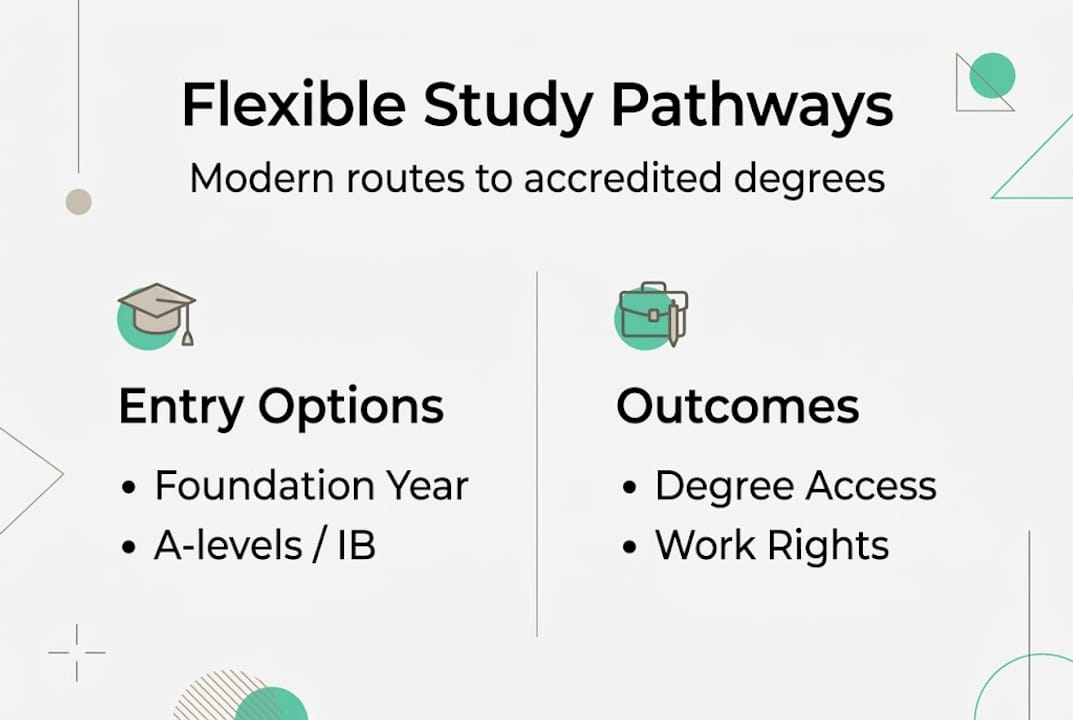
UNESCO’s IIEP frames flexible learning pathways as a policy and design concept for higher education that enables more flexible entry, progression, and governance, with research methodology involving both quantitative and qualitative approaches. In plain terms, this means governments are actively redesigning higher education systems to make it easier for working adults and non-traditional students to access and complete degrees.
Key trends shaping flexible learning pathways right now:
- Blended and online learning: More universities now offer hybrid programs that combine on-campus and online study, reducing the need to relocate permanently
- Stackable credentials: Short courses and certificates that build toward a full degree, allowing you to earn and apply qualifications in stages
- Recognition of prior learning (RPL): Formal processes that credit your work experience or informal learning toward degree requirements
- Modular program design: Degrees broken into discrete units that you can complete at your own pace
Statistic: Global higher education enrollment has more than doubled in two decades, according to UNESCO, driving demand for more accessible and flexible entry routes.
This growth is pushing institutions to innovate. The days of a single rigid entry point and a fixed four-year timeline are fading. For students balancing work, family, and study, this shift is genuinely good news.
If you are considering studying in Singapore as part of a flexible pathway, the city-state’s education system has embraced modular and accelerated formats that align well with these global trends. Understanding fast-track entry requirements before you apply will help you identify which flexible options you already qualify for.
Outcomes: Do pathway programs really boost student success?
The most important question is whether pathway programs actually work. The evidence is encouraging, but it comes with important conditions.
Students who enter degree programs through credit-bearing advanced preparation consistently outperform peers who enter without that preparation. At Florida State University, Cambridge International students with advanced credit achieved a 90% four-year graduation rate compared to 78% for students without such credit. That is a meaningful gap, and it reflects the value of arriving at a degree program with both academic preparation and recognized credit already in hand.
However, the evidence also shows that not all pathway outcomes are equal. Preparation-only programs that do not include credit transfer tend to show weaker graduation rate improvements. The mechanism matters.
Factors that most strongly influence pathway outcomes:
- Type of preparation: Credit-bearing pathways consistently outperform prep-only programs in graduation rate data
- Language readiness: Students who enter degree programs below the required language threshold struggle regardless of academic preparation
- Credit transfer clarity: Knowing exactly how many credits transfer, and to which courses, before you enroll removes a major source of post-enrollment stress
- Student support services: Access to academic advising, tutoring, and peer networks during the transition period significantly affects completion rates
- Institutional track record: Pathway providers with long-standing university partnerships have more reliable progression data than newer or unaccredited providers
The takeaway is not that pathways always work. It is that the right pathway, chosen carefully and with full information, genuinely improves your chances of completing a degree on time. Reviewing study abroad essentials before committing to a pathway program will help you ask the right questions and avoid programs that cannot back up their claims with outcome data.
Why definitions matter: Lessons from the patchwork of pathway programs
Here is something most pathway guides will not tell you directly: the word “pathway” is doing a lot of heavy lifting in international education marketing, and it is not always honest work.
We have seen students arrive at partner universities expecting credit transfer, only to discover their pathway program had no formal agreement with that institution. We have seen others enroll in programs marketed as “flexible learning pathways” that offered no online options and no recognition of prior work experience. The label was accurate in the loosest sense. The reality was not what anyone expected.
The uncomfortable truth is that universally defined pathways are a myth. Every option you encounter needs to be treated as unique until you verify it independently. Even the phrase “flexible learning” means something different depending on whether you are reading a UNESCO policy paper, an Australian university brochure, or a Singapore education agent’s website.
Our advice is to start with the destination country’s official immigration and education authority websites, then confirm the specific program’s progression agreement, credit transfer policy, and outcome data. Only then should you evaluate the provider’s marketing materials. Smart students dig behind the labels and ask for evidence, not promises.
The study pathways and outcomes data consistently shows that students who do this research upfront make better decisions and have better results. It takes more time at the start, but it saves enormous frustration later.
Explore flexible, accredited international pathways with SeekStudy
Understanding pathways is step one. Finding a program that actually delivers on its promises is step two.
SeekStudy offers accredited foundation, management, accounting, and business programs designed for international students who need flexibility without sacrificing recognition. Our programs are regulated by Ofqual and delivered in partnership with UK, Singapore, Hong Kong, and Australian institutions, so you know exactly what your qualification is worth before you enroll. Whether you are starting with a university entry success guide or ready to explore accelerated business degrees that fit around your work schedule, SeekStudy has a clear next step for you. Free consultations and downloadable planning guides are available for students who are not yet ready to apply.
Frequently asked questions
What is an international study pathway in simple terms?
An international study pathway is a structured program that helps students meet academic or language requirements and progress toward a degree at a foreign university, often through foundation or prep courses. As Study International notes, these programs are designed to provide a relatively seamless transition to overseas education.
Do international study pathways let me work while studying?
Work rights depend entirely on the country and visa type. Immigration New Zealand defines specific work rights for Pathway Student Visa holders, but rules differ significantly across the UK, Australia, Singapore, and the US, so always check the host country’s immigration authority directly.
Which pathway type offers the fastest route to an accredited degree?
Advanced credit pathways such as A-levels, IB, or AP offer the fastest route because they allow you to enter a degree with credit already earned. Cambridge International data shows 90% of students with advanced credit at Florida State University graduate within four years, compared to 78% for peers without such credit.
How do I know if a pathway program is recognized?
Confirmation must come from both the receiving university and the host country’s education authority, not just the pathway provider. As Immigration New Zealand’s guidance illustrates, “pathway” is not one standardized product globally, and definitions vary by provider and jurisdiction, so independent verification is essential.