

TL;DR:
- Accreditation by AACSB, AMBA, or EQUIS signals a school’s global recognition and quality standards.
- Evaluating curriculum relevance, faculty experience, student diversity, and employment outcomes ensures career value.
- Verifying international recognition before enrollment prevents credential issues and maximizes global career mobility.
Imagine completing a two-year MBA, walking into a job interview abroad, and discovering your degree isn’t recognized in that country. This scenario plays out more often than most applicants expect, and it costs graduates real time, money, and career momentum. Choosing the wrong business school isn’t just an academic inconvenience; it can quietly limit your earning potential and international mobility for years. This guide walks you through exactly how to evaluate business schools based on accreditation, curriculum quality, faculty strength, and global career outcomes so you make a decision you won’t regret.
Table of Contents
- Understand accreditation and global recognition
- Key criteria for choosing an accredited business school
- Step-by-step approach to evaluating your options
- Pitfalls and mistakes to avoid
- Our perspective: Why global accreditation is worth the extra effort
- Explore accredited business programs built for global careers
- Frequently asked questions
Key Takeaways
| Point | Details |
|---|---|
| Check global accreditation | Confirm your school is recognized internationally to maximize career mobility. |
| Evaluate faculty and curriculum | Prioritize institutions with industry-experienced PhDs and modern curriculum focus. |
| Assess alumni and support | Choose schools with large networks and proven career placement rates. |
| Avoid common mistakes | Don’t overlook accreditation, employment results, or curriculum relevance. |
| Focus on international flexibility | Triple-accredited, flexible programs ensure your credentials work worldwide. |
Understand accreditation and global recognition
Having outlined the risks, let’s clarify what “accredited” really means and why it matters globally. Not all accreditations carry the same weight, and understanding the difference can determine whether your degree opens doors or closes them.
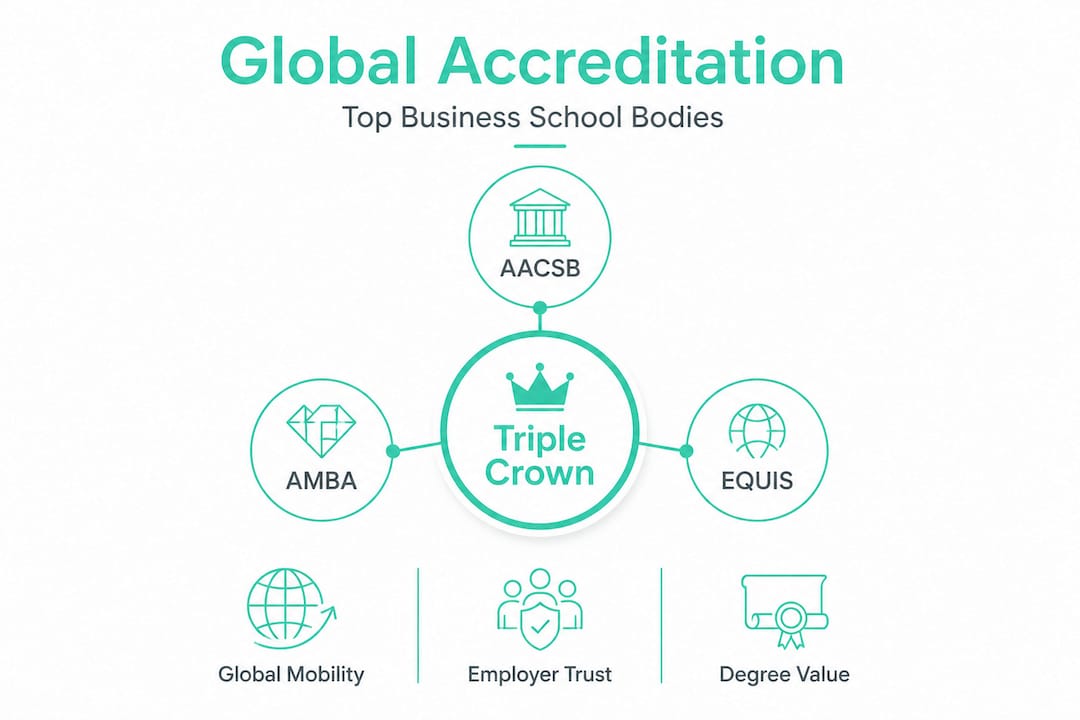
There are three major bodies that evaluate business schools worldwide: AACSB (Association to Advance Collegiate Schools of Business), AMBA (Association of MBAs), and EQUIS (European Quality Improvement System). Each has a different focus and regional influence. Understanding business school accreditation explained is the first step toward making a confident school selection.
| Accreditation | Based in | Primary focus | Who recognizes it |
|---|---|---|---|
| AACSB | United States | Research and teaching quality | Widely recognized in the US and Asia |
| AMBA | United Kingdom | MBA-level programs only | Strong in Europe, Middle East, Asia |
| EQUIS | Belgium (EFMD) | Institutional quality and international exposure | Primarily Europe and global institutions |
Schools that hold all three are considered triple-accredited, a status that signals the highest level of quality assurance across teaching, research, and international engagement. As noted in the triple accreditation literature, US schools often hold AACSB only because AMBA typically requires applicants to have at least three years of work experience, which makes European schools more competitive for internationally focused students seeking broad recognition.
“Triple accreditation is widely regarded as the gold standard for business schools seeking global mobility for their graduates. It signals that a school meets the highest benchmarks set by three independent international bodies simultaneously.”
Here is why this matters in practice:
- A degree from an AACSB-accredited school carries strong credibility in the US and parts of Asia but may receive less recognition from European employers.
- AMBA accreditation signals that your MBA program was evaluated specifically for postgraduate rigor and professional relevance.
- EQUIS-accredited schools emphasize internationalization, which is critical if you plan to work across multiple countries.
- For degree accreditation for global careers, regional relevance matters as much as the accreditation label itself.
The smartest approach is to identify where you plan to build your career and work backward from there. If your target market is Europe or the Middle East, prioritize EQUIS or AMBA. If your goal is the US or parts of Southeast Asia, AACSB-accredited programs will carry more weight with hiring managers.
Key criteria for choosing an accredited business school
Now that accreditation types are clear, let’s walk through the main criteria to compare schools. Accreditation is the foundation, but it is not the only factor that determines whether a program delivers real career value.
According to MBA selection research, applicants should evaluate curriculum relevance, faculty with PhDs and industry experience, peer diversity, career support systems, and employment rates three to six months after graduation. Here is how each criterion breaks down in practice.
1. Curriculum relevance
Business environments are shifting fast. A curriculum built five years ago may still feature case studies that have no bearing on today’s AI-driven, digitally connected marketplace. Look specifically for courses that address data analytics, digital business models, artificial intelligence in management, and ESG (environmental, social, and governance) strategy. Schools that update syllabi annually tend to produce graduates who can step into current roles without a significant retraining period.
2. Faculty qualifications and real-world experience
Faculty quality is one of the most under-evaluated criteria. It is not enough for professors to hold PhDs. The best programs combine academic rigor with instructors who have run companies, consulted for global firms, or held senior roles in industry. Look for a balance: roughly 50% doctoral-qualified faculty paired with practitioners who bring street-level business insight.
3. Peer diversity and international student mix
Your classmates are part of your education. A cohort drawn from 30 or more countries exposes you to different regulatory environments, cultural approaches to negotiation, and market structures. This peer diversity becomes a competitive advantage once you graduate and need to navigate international teams or cross-border deals.
4. Alumni network and career placement outcomes
A robust alumni network is one of the most tangible assets a business school can offer. Top-tier programs feature 100k+ global alumni and dedicated career placement offices that maintain relationships with employers across sectors.

Pro Tip: Always ask the admissions office for employment outcome data at three and six months post-graduation. Reputable schools publish this data. If a school hesitates, that tells you something.
The business school rankings guide for international students offers a useful framework for comparing these factors across multiple institutions side by side, which saves considerable research time.
| Criterion | What to look for | Red flag |
|---|---|---|
| Curriculum | AI, digital, ESG modules | Outdated case studies only |
| Faculty | 50%+ PhDs, industry backgrounds | No practitioner instructors |
| Student diversity | 20+ nationalities | Predominantly domestic cohort |
| Alumni network | 100k+ global, active chapters | No dedicated alumni office |
| Employment rate | 80%+ at 6 months post-grad | No published employment data |
For international students, accredited qualifications for global careers are especially important because visa sponsorship, employer recognition, and salary benchmarking often depend on the credential being universally understood.
Step-by-step approach to evaluating your options
With your criteria identified, here’s how to actually evaluate and select schools that deliver on global credentials. The process is more structured than most applicants realize, and following a clear sequence helps you avoid the time-consuming mistake of comparing schools on surface-level factors alone.
Step 1: Build your shortlist using accreditation databases
Start with the official databases maintained by AACSB, AMBA, and EQUIS. These databases are publicly available and updated regularly. Search for programs in your preferred country or delivery format, whether in-person, online, or blended. Aim for a shortlist of eight to twelve programs before narrowing down.
Step 2: Filter by delivery format and duration
For working professionals, program flexibility is not a luxury; it is a necessity. Identify whether you need a part-time format, an accelerated track, or a fully online option. Confirm whether the program can be completed in your target timeframe without sacrificing the credential quality.
Step 3: Evaluate curriculum documentation
Most schools publish full curriculum outlines online. Look for module titles, learning outcomes, and assessment methods. Programs that describe learning outcomes in terms of practical skills rather than abstract theory tend to produce more job-ready graduates. Check specifically for choosing best business management program criteria including digital literacy modules and leadership development tracks.
Step 4: Investigate faculty profiles
The faculty page on any school website tells you a great deal. Read instructor bios and note their most recent industry experience. A professor who last worked in a company in 2009 may struggle to teach modern supply chain management or fintech regulation with authority.
Step 5: Contact current students and recent graduates
This step is skipped by most applicants and it is a significant mistake. LinkedIn makes it easy to find current students or recent graduates. A short, specific message asking about their placement experience and program quality typically receives a candid response.
Pro Tip: When contacting alumni, ask one focused question rather than a list. Something like, “Would you choose this program again given your current career trajectory?” generates far more honest answers than generic questions about the program.
Step 6: Confirm international recognition of the degree
If you plan to work in a country different from where the school is based, verify how that country’s professional bodies and employers view the credential. For example, a UK-recognized degree carries significant weight across former Commonwealth nations, parts of the Middle East, and much of Southeast Asia.
Exploring international study options with UK accreditation can help you find programs specifically designed to maximize cross-border recognition. Similarly, understanding the study abroad benefits of accelerated formats shows you how combining study locations can strengthen both your credential and your professional network simultaneously.
Here is a quick evaluation checklist:
- Does the school appear in at least one major accreditation database?
- Is the curriculum updated within the last two years?
- Are employment outcomes published and independently verified?
- Does the school offer career support beyond graduation?
- Are there alumni in the country or industry where you plan to work?
Pitfalls and mistakes to avoid
Even with all the steps in hand, it is easy to fall into common traps. Here is what to watch for and how to avoid them.
Focusing only on rankings
Rankings measure prestige, not fit. A top-20 ranked school that does not offer strong alumni presence in your target market may deliver less actual career value than a top-50 school with deep industry connections in your sector. Rankings are a starting point, not a decision-making tool.
Overlooking curriculum relevance
Many applicants assume that all MBAs teach the same content. They do not. MBA curriculum gaps in areas like AI applications, digital marketing, and fintech can leave graduates underprepared for 2026 job market expectations, even if the degree itself is accredited. Always cross-reference module content against current job postings in your field.
Not verifying faculty credentials
It is surprisingly common for schools to list faculty who are primarily adjuncts with minimal research or industry experience. Check whether the instructors listed on the website are the ones who actually teach the courses you plan to take. This is especially important for online programs where instructional quality can vary widely across modules.
Waiting too late to confirm global recognition
Some applicants assume their degree will be recognized abroad after they complete it. This is a costly error. Verify recognition before you enroll, not after you graduate. Contact the relevant professional body or employer associations in your target country directly if you are unsure.
“One of the most overlooked due-diligence steps is confirming that the awarding institution is listed on the target country’s official register of recognized qualifications. This step takes one hour and can save years of frustration.”
Using accredited online programs as a reference point helps you identify digital-first programs that still carry robust institutional accreditation, which is particularly useful for professionals who cannot relocate for study.
Additional pitfalls to keep in mind:
- Accepting marketing language about “globally recognized” at face value without independent verification
- Ignoring the school’s student-to-faculty ratio, which affects how much personal mentorship you receive
- Choosing a program based on tuition cost alone without factoring in the return on investment from stronger career outcomes
- Skipping the campus visit or virtual open day, which often reveals cultural fit and program culture that no brochure communicates
Our perspective: Why global accreditation is worth the extra effort
Here is the part most guides leave out: accreditation is not just a credential checkbox. It is an infrastructure that shapes every interaction you will have with employers, visa officials, and professional licensing bodies for the rest of your career.
We have seen applicants choose a prestigious-sounding school with no formal accreditation because the brand name felt impressive. Years later, they find themselves retaking qualifications or struggling to have their degree recognized when they relocate. The frustration is real, and it was entirely preventable.
The conventional wisdom says you should pursue the most recognizable brand name. We disagree. A triple-accredited program from a mid-tier school will often unlock more doors globally than a degree from a famous school with only regional recognition. Employers in Singapore, the UAE, or Canada who are unfamiliar with a US regional university will trust a globally standardized accreditation mark far more than an institutional name.
There is also a growing body of evidence that practical skills and professional networks matter as much as the school name. Employers consistently rank communication, analytical thinking, and cross-cultural collaboration above the brand on the diploma. Fast-track and flexible programs that deliver these competencies, especially when combined with international study experiences, can be as impactful as traditional three-year full-time MBAs.
This is why evaluating accelerated study paths deserves serious consideration alongside traditional routes. When structured properly, accelerated programs compress the timeline without compressing the quality of learning or the credential value.
The extra effort required to verify accreditation, research faculty, and contact alumni is not bureaucratic box-ticking. It is the most important career research you will do before making a five-figure investment in your education.
Explore accredited business programs built for global careers
Choosing the right business school takes research, and we built Seekstudy specifically to reduce the guesswork for international students and working professionals who need accredited, flexible, and internationally recognized programs.
At Seekstudy, our programs are Ofqual-regulated and delivered in collaboration with institutions across the UK, Singapore, Hong Kong, and Australia. Our two-year accelerated bachelor’s degree in Business Management and our one-year online MBA are designed around exactly the criteria this guide covers: updated curricula, qualified faculty, diverse cohorts, and verified career support. If you are ready to compare programs, explore outcome data, or speak with an advisor about which track fits your goals, visit seekstudy.com to start your application process today.
Frequently asked questions
Which accreditation is most respected internationally for business schools?
Triple accreditation (AACSB, AMBA, EQUIS) is widely recognized for global mobility and employer trust, making it the strongest signal of institutional quality across multiple regions.
Does faculty experience impact my degree’s value?
Faculty quality directly affects learning outcomes; look for schools where at least 50% hold PhDs combined with real industry experience for the strongest academic and practical foundation.
How can I compare alumni networks?
Request data on global alumni size and job placements; 100k+ alumni networks with active career support offices are a reliable indicator of a school’s long-term value to graduates.
What mistakes should I avoid when selecting a business school?
Avoid prioritizing rankings or brand prestige alone; always verify accreditation status, curriculum relevance, and faculty credentials before committing to any program.
How can studying abroad affect my business school choice?
Studying abroad can significantly expand your professional network and expose you to diverse business cultures, but only if your degree carries a globally recognized accreditation that employers in your target country respect and understand.