

TL;DR:
- Professional qualifications signal industry-recognized skills and boost career advancement globally.
- Exemptions and fast-track programs help efficiently earn credentials by leveraging prior learning.
- Combining relevant qualifications with practical experience maximizes employability and salary potential.
A strong academic record opens doors, but it rarely guarantees you a seat at the table in a competitive international job market. Employability is often tied more to work experience and the type of role you hold than to your GPA or the prestige of your university alone. If you have been assuming that a bachelor’s or master’s degree is enough to propel your global career forward, this guide will shift your thinking. Here, we break down the real impact of professional qualifications, how exemptions and fast-track pathways work, and how to strategically stack credentials so that every step you take builds genuine career capital.
Table of Contents
- Why professional qualifications matter for global careers
- How exemptions and fast-track pathways accelerate your journey
- Striking the balance: Professional qualifications, experience, and employability
- Making strategic choices: Module selection, accreditation, and stacking credentials
- What most professionals miss about qualifications and career mobility
- Accelerate your journey with accredited fast-track degrees
- Frequently asked questions
Key Takeaways
| Point | Details |
|---|---|
| Experience outshines academics | Employers give more weight to practical experience and contract type than to academic grades alone. |
| Strategic credentials matter | Professional qualifications boost your career most when combined and chosen to fit your goals. |
| Exemptions accelerate progress | Leveraging exemptions with documented proof can fast-track your degree or certification timeline. |
| Accreditation is non-negotiable | Always ensure your program and qualifications are properly accredited for international recognition. |
Why professional qualifications matter for global careers
Professional qualifications are not simply extra letters after your name. They signal to employers that you have passed rigorous, standardized assessments recognized across industries and borders. The most prominent credentials in business and accounting include:
- CMA (Certified Management Accountant): Focused on financial planning, analysis, control, and strategic decision-making.
- CPA (Certified Public Accountant): The gold standard for accounting roles in the United States and highly recognized internationally.
- ACCA (Association of Chartered Certified Accountants): Widely recognized across 180 countries, particularly valued in the UK, Asia, and the Middle East.
- CIMA (Chartered Institute of Management Accountants): Designed for professionals working at the intersection of finance and management.
- ACA/ICAEW (Institute of Chartered Accountants in England and Wales): Especially respected in European and Commonwealth markets.
Employers consistently differentiate candidates who hold these credentials because they demonstrate applied knowledge, not just theoretical study. However, the research picture is more nuanced. Professional qualifications contribute to career advancement and financial success, though these outcomes also depend on experience and economic context. In other words, a qualification without practical experience is only half the story.
“The most promotable professionals combine recognized credentials with clear evidence of applying those skills on the job. One without the other leaves a gap employers are trained to spot.”
When you explore qualification pathways for career growth, you quickly realize that accreditation is the factor that determines whether your credential travels with you globally. A qualification from a non-accredited institution may carry weight locally but fail to open doors in Singapore, Hong Kong, the UK, or Australia. Understanding accredited qualifications and global mobility early in your planning process saves you significant time and money down the road.
The career premium from professional qualifications is most visible in promotions, salary negotiations, and leadership roles. Mid-career professionals with a recognized credential often negotiate 15 to 25 percent higher salaries compared to peers with equivalent experience but no formal certification. The key word here is “equivalent.” When experience levels differ, the gap widens further.
How exemptions and fast-track pathways accelerate your journey
Once you understand why qualifications matter, the next practical question is: how do you earn them as efficiently as possible? This is where exemptions and accelerated programs become your most powerful tools.
Exemptions allow you to skip specific exam papers or modules based on prior learning, whether that is an undergraduate degree, a postgraduate qualification, or a combination of both. Here is a step-by-step view of how the process typically works:
- Gather your transcripts and certificates. Every exemption claim requires evidence of prior study, so start with official transcripts and degree certificates.
- Use the body’s exemption calculator or database. Organizations like ACCA provide online tools where you can match your prior qualification to specific papers.
- Submit your documentation. Upload your evidence through the official portal. Some bodies charge an exemption fee, though several waive fees for students already enrolled in a recognized partner program.
- Wait for assessment results. Prior learning assessment for exemptions requires documentation, with results typically arriving in 10 to 20 days; some boards waive exemption fees for enrolled students.
- Plan your remaining paper schedule. Once exemptions are confirmed, map out the remaining exams and target the fastest achievable completion date.
| Qualification Body | Exemption Mechanism | Average Processing Time | Fee Waiver Available |
|---|---|---|---|
| ACCA | Online exemption calculator | 10 to 20 days | Yes, for some partners |
| CIMA | Prior learning database | 15 to 25 days | Case by case |
| CPA (US boards) | Credit hour evaluation | Varies by state board | Rarely |
| ICAEW/ACA | Application with transcript review | Up to 30 days | No |
Choosing exemptions strategically is just as important as claiming them. Not every exemption saves you time in a meaningful way. If a paper you skip covers material central to your target role, you may later find yourself underprepared for workplace challenges. The smarter move is to claim exemptions in areas where your prior study was genuinely deep, and retain papers that build skills directly relevant to where you want to work.
Pro Tip: Before claiming every available exemption, map the remaining papers against the job descriptions of your target roles. If a skipped paper aligns with skills employers consistently list, consider sitting it anyway for the learning benefit.
One critical pitfall many professionals overlook is failing to verify accreditation before enrolling in a preparatory program. A course that promises ACCA exemptions but lacks official recognition from ACCA itself is useless for that purpose. Always check why accreditation matters before committing to any program, and use resources like business school accreditation explained to understand what regulated institutions must meet.
Striking the balance: Professional qualifications, experience, and employability
Qualifications and experience are not competing factors. They are multipliers. When you combine a recognized credential with relevant, well-documented work experience, employers see a candidate who can both pass rigorous assessments and apply that knowledge under real business pressure.

Research confirms this dynamic clearly. Contract type and work experience are stronger predictors of employability than pure academic performance, though professional qualifications still boost promotions or salary. What this means practically is that a permanent contract with substantive finance responsibilities, combined with an ACCA or CMA credential, will outperform a high GPA with no workplace exposure in almost every hiring scenario.
| Candidate Profile | Likely Outcome |
|---|---|
| High GPA, no work experience, no professional credential | Entry-level only, limited negotiating power |
| Average GPA, 2 years relevant work, ACCA in progress | Strong mid-level candidacy |
| Strong GPA, relevant internships, completed CMA | Competitive for management and senior analyst roles |
| Relevant permanent role, completed ACCA + MBA | Leadership track, premium salary expectations |
How do you actually integrate fast-track study, exemptions, and meaningful work experience? Here are the combinations that deliver the strongest returns:
- Full-time work combined with online study. Fast-track programs designed for working professionals allow you to study evenings and weekends without leaving your current role. This means you build work experience and credentials simultaneously.
- Internships in your target market. A three to six month placement in Singapore, Hong Kong, or the UK creates international exposure that domestic experience cannot replicate. Pair this with a fast-track degree program for compounding benefits.
- Project-based roles over purely administrative positions. Employers distinguish between candidates who managed budgets or led analysis versus those who only processed transactions. Choose assignments that let you own outcomes.
- Mentorship from credentialed professionals. Working under a CPA or ACCA-qualified manager accelerates learning in ways no classroom can match.
Pursuing international study experience benefits adds another layer of value that domestic programs simply cannot provide: cross-cultural communication skills, global professional networks, and firsthand understanding of how different markets operate. The benefits and impact of study abroad go well beyond academic knowledge and often become the differentiator in senior hiring decisions.
Making strategic choices: Module selection, accreditation, and stacking credentials
With your credentials and experience aligned, the final strategic layer involves careful selection of modules and thoughtful stacking of qualifications for maximum impact.
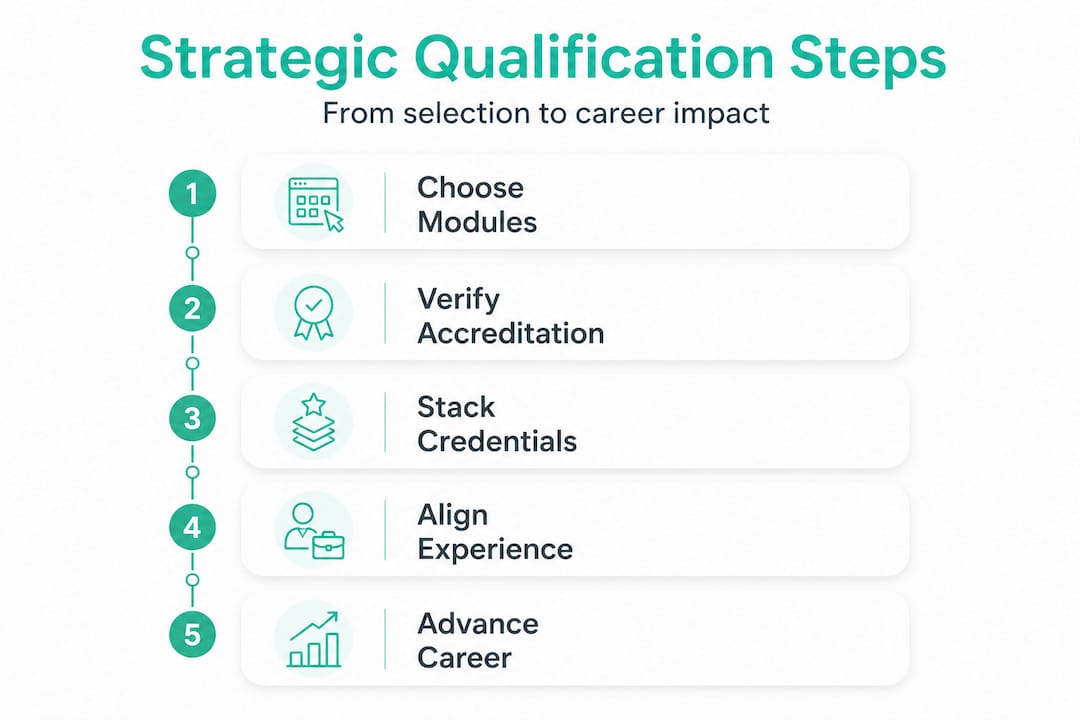
Module choice matters far more than most candidates realize at the start. If you are targeting a CFO track, modules in strategic financial management, risk, and business leadership carry more weight than a generic accounting module. If your target is international taxation or transfer pricing, specific papers within the ACCA or CPA framework are directly relevant. Strategic module selection and verifying accreditation are crucial for getting the full benefit of both exemptions and combined qualifications.
Here is a practical step-by-step process for maximizing credential value:
- Define your target role and location. A management accountant role in Singapore has different credential expectations than a public accounting role in New York or London.
- Research the most valued credentials in that market. Use job postings, professional body reports, and recruiter insights to identify which qualifications appear most frequently.
- Select a primary qualification and map exemptions. Choose one primary credential as your anchor, then use exemptions from your existing degree to reduce the time and cost of completion.
- Choose a complementary secondary qualification. Stacking credentials like CMA and CPA provides employers with clear evidence of both management and public accounting expertise, commanding a higher premium than either alone.
- Verify accreditation at every stage. Every program, institution, and awarding body involved in your plan must carry recognized accreditation.
- Document and communicate your combination clearly. A well-structured resume and LinkedIn profile that connects your qualifications to concrete business outcomes creates a compelling narrative.
Pro Tip: When stacking credentials, prioritize depth over breadth. Two highly relevant qualifications with documented work experience outperform four credentials with shallow relevance every time.
You can begin exploring selecting premium courses that align with your target credential stack, particularly if you are considering fast-track bachelor or master’s programs as the foundation of your exemption strategy.
What most professionals miss about qualifications and career mobility
Here is the uncomfortable truth most qualification guides will not tell you: collecting credentials without a coherent strategy is expensive and often ineffective. We see this pattern regularly. A professional earns an undergraduate degree, adds a postgraduate diploma, pursues two or three professional qualifications, and still finds themselves stuck at the same career level. Why? Because credentials without evidence of real application are just paper.
Employers in competitive international markets, particularly in financial hubs like Singapore, Hong Kong, and London, are experienced at spotting the difference between a candidate who has accumulated credentials and one who has built genuine capability. They ask for examples of decisions you made, problems you solved, and results you drove. A wall of certifications with thin experience behind it raises red flags rather than excitement.
The professionals who accelerate fastest are not those with the most qualifications. They are the ones who chose credentials deliberately, applied that learning visibly in their roles, and can articulate exactly how their skills solved real business problems. Stacking only what aligns with your specific ambitions is not a limitation; it is a competitive advantage.
The other missed insight involves the timing of credential pursuit. Many professionals wait until they feel “ready” to study, which often means waiting until they are comfortable, which means waiting too long. Fast-track and accredited online learning options have made it genuinely possible to earn recognized qualifications while working full-time, so the old excuse of “I don’t have time” carries much less weight than it used to.
The professionals who win globally are those who treat credential selection the way a skilled investor treats a portfolio: every asset must earn its place, and the combination must work toward a clear long-term goal.
Accelerate your journey with accredited fast-track degrees
Ready to move from strategy to action? SeekStudy’s accredited fast-track programs are built exactly for professionals like you: people who want recognized credentials without spending three to four years in full-time study.
SeekStudy is regulated by Ofqual and partners with institutions in the UK, Hong Kong, Singapore, and Australia. Whether you are exploring fast-track bachelor degrees in business management that can be completed in two years, or you want accelerated business degrees that are designed to stack with professional qualifications like ACCA and CMA, SeekStudy structures its programs to maximize your exemption eligibility. You can also compare accredited online degree options that let you study while you work, building both credentials and experience simultaneously. Your global career does not need to wait.
Frequently asked questions
How do I get exemptions for professional qualifications?
Use your official transcripts and prior qualification certificates to submit a claim through the relevant body’s portal or exemption calculator. Exemptions require prior learning proof and follow a documented process, with results typically returned within 10 to 20 days.
Do employers value experience over qualifications?
Both count, but the research is clear: work experience and contract type tend to outweigh academic performance in actual hiring decisions, while professional qualifications still drive salary and promotion outcomes.
Which qualifications combine best for maximum career impact?
Pairing credentials that cover complementary skill sets, like CMA for management accounting and CPA for public accounting, creates a premium profile that employers reward with stronger offers and faster advancement.
How can I check if my qualification is globally recognized?
Always verify the accreditation status of both the awarding body and the institution delivering your program before enrolling, and confirm that exemptions claimed from that program are officially recognized by the professional body you are targeting.
Recommended
- Professional business qualifications: pathways to career growth
- Why pursue accredited qualifications? Unlock global career mobility
- Fast-Track Degrees: Boosting Career Advancement Worldwide
- International Study Experience Explained: 30% Career Boost
- Personal Work Goals 2026: 72% Higher Achievement Rates – Optio Station: Best Project Management App for Prioritization