

TL;DR:
- Choosing an international study destination requires evaluating accreditation, rankings, program speed, and cultural fit to align with career goals. The US leads in ranking prestige and industry networks, while the UK offers faster, more affordable programs with global recognition, and China provides rapidly rising opportunities with English-taught courses at lower costs. Prioritizing program fit, accreditation, and practical industry exposure often yields better career outcomes than chasing name prestige alone.
Choosing where to study for a Management or Accounting degree abroad is one of the most consequential decisions you will make for your career. The destination shapes your network, the pace of your degree, the weight of your credentials in the job market, and ultimately the speed at which you enter a competitive global workforce. With more countries than ever offering world-class programs, the choice feels overwhelming. This guide cuts through that noise with a structured, evidence-backed framework so you can match your goals to the right destination confidently and efficiently.
Table of Contents
- How to evaluate international study destinations for business degrees
- United States: World-leading business and accounting education
- United Kingdom: A global hub for accredited management degrees
- Emerging top study destinations: China and beyond
- Comparison table: Which destination best fits your goals?
- Our perspective: Stop chasing rankings and start chasing fit
- Accelerate your career with Seekstudy
- Frequently asked questions
Key Takeaways
| Point | Details |
|---|---|
| US leads in rankings | The United States offers the top-ranked business and accounting universities globally. |
| UK enables fast-track degrees | UK study programs allow you to complete business and accounting qualifications more quickly. |
| China and Europe rising | China and continental Europe are rapidly emerging as top-tier destinations for Management and Accounting. |
| Consider fit and format | Beyond rankings, evaluate program speed, language, cost, and networking for your best study match. |
How to evaluate international study destinations for business degrees
Before you compare rankings or calculate tuition, you need a clear set of criteria. Without a framework, you end up chasing prestige without asking whether a particular program actually fits your timeline, budget, and career target.
Here are the most important factors to weigh:
- Accreditation and degree portability: A degree is only as valuable as the doors it opens. UK degrees regulated by Ofqual, for example, carry strong international recognition. Always verify that a program meets the official accreditation standards of your target job market. Exploring UK accreditation options is a smart starting point if you want a credential with wide international reach.
- Rankings for your specific subject: General university rankings can be misleading. A university ranked 200th overall might have a top-30 Accounting department. The QS Accounting & Finance 2026 top universities list places Harvard first, followed by Stanford, MIT, Oxford, and the University of Chicago, which tells a very specific story about where specialized excellence actually lives.
- Program speed and fast-track availability: If you are a working professional or an adult learner, a three-year bachelor’s or a one-year master’s program is dramatically more attractive than a four-year or two-year equivalent. Always ask whether accelerated or fast-track formats exist.
- Cultural and language fit: English-medium instruction, multicultural campuses, and strong international student communities all reduce friction for foreign students. Some destinations also offer better visa pathways and post-study work rights.
- Cost and funding access: Tuition, living costs, and scholarship availability vary enormously between countries. The US offers generous merit scholarships, the UK offers shorter programs that reduce total spend, and emerging markets like China offer government-sponsored tuition for international students.
Pro Tip: When shortlisting programs, look specifically for universities that offer key UK study benefits such as integrated industry placements, hybrid learning, or pathway courses that let you enter a degree program even if your grades are not perfectly aligned.
The goal at this stage is to build your personal scorecard before you fall in love with a university’s marketing materials.
United States: World-leading business and accounting education
No conversation about international business education starts anywhere but the United States. American universities dominate virtually every major subject-specific ranking, and the Accounting and Finance category is no exception.
According to the QS Accounting & Finance 2026 rankings, the top five globally are Harvard, Stanford, MIT, Oxford, and the University of Chicago, with four of those five being American institutions. The THE Business & Economics 2026 rankings reinforce this dominance, placing MIT first, Stanford second, and UC Berkeley fifth. These are not outliers. They reflect decades of investment in faculty, research infrastructure, and industry partnerships.
What makes US programs distinctive?
- Flexible, modular structures: American business programs typically allow you to tailor your curriculum with electives and concentrations. This means you can specialize in Financial Reporting, Corporate Strategy, or Entrepreneurial Finance within the same degree.
- Industry integration: US universities maintain some of the densest networks of corporate recruiters in the world. Internship programs, case competitions, and guest lecture series are built into the curriculum rather than treated as optional extras.
- Fast-track and dual-degree options: Several universities now offer accelerated pathways that compress a four-year bachelor’s into three years, or combine a bachelor’s and MBA into a five-year program. These are particularly relevant if you already have professional experience and want to reduce time out of the workforce.
- International student support: US universities invest significantly in international student offices, scholarship programs, and visa guidance. Many offer STEM-designated MBA tracks that extend Optional Practical Training (OPT) work authorization to three years.
The honest trade-off is cost. US tuition fees are among the highest globally, and living costs in cities like Boston, San Francisco, and Chicago add up quickly. However, scholarship availability at top-tier schools is substantial if you apply strategically. For a broader picture of how studying abroad pays off, look at the evidence on study abroad business benefits to understand the long-term return on that investment.
Key takeaway: The US offers unmatched ranking prestige and industry access, but requires careful financial planning and a competitive application.
United Kingdom: A global hub for accredited management degrees
If the US represents scale and prestige, the UK represents precision and efficiency. British universities have built a reputation for delivering rigorous, intensely focused degrees in significantly less time than most other countries.

A bachelor’s degree in the UK typically takes three years instead of four. A master’s degree typically takes one year instead of two. For Management and Accounting students who want to enter the workforce or return to it faster, this structure is a concrete, measurable advantage. You save a full year of tuition and a full year of lost salary in a single degree decision.
Oxford appears in both major 2026 rankings as a top-tier institution. The QS Accounting & Finance 2026 places Oxford fourth globally in the subject, and the THE Business & Economics 2026 rankings place Oxford fourth and Cambridge sixth in Business and Economics. These rankings reflect not just research output but teaching quality and graduate outcomes.
Why the UK works especially well for international students:
- Globally recognized credentials: A UK degree regulated by official bodies carries significant weight across Asia, the Middle East, Africa, and beyond. Employers in Hong Kong, Singapore, and the Gulf consistently prioritize UK-accredited qualifications. Understanding UK accounting recognition can clarify exactly how this plays out in specific job markets.
- Vibrant multicultural campuses: UK universities draw students from over 150 countries. This is not just a social benefit. Your study group becomes a professional network that spans continents before you even graduate.
- Pathway programs for easier entry: If your undergraduate grades are not at the level required for direct entry, UK universities widely offer foundation or pathway programs that bridge the gap in one year or less. This is an underused route that dramatically expands access.
- Hybrid and online options: Several UK institutions now allow you to begin coursework online or offshore, then complete the final residential portion in the UK. This is ideal if you are balancing work and study.
Pro Tip: If you are not yet fully prepared for direct university entry, invest in a structured foundation course. This single step can open doors to programs that would otherwise be out of reach. Preparing for UK study with a clear roadmap makes the process far less intimidating than most students expect.
Emerging top study destinations: China and beyond
The narrative around top-tier business education used to be almost exclusively Anglo-American. That story is changing, and changing fast.
“The rise of Asian universities in global business rankings is not a trend. It is a structural shift driven by sustained government investment, growing faculty quality, and an increasingly international student body.”
China’s rise in business education
Tsinghua University now ranks third globally in the THE Business & Economics 2026 rankings for Business and Economics. That is not a typo. Third. Behind only MIT and Stanford. Tsinghua’s School of Economics and Management attracts faculty from top US and European schools, and its programs increasingly reflect a global curriculum. Peking University’s Guanghua School of Management and Fudan University are close behind.
For international students, the practical question is language. An increasing number of Chinese university programs now offer full Management and MBA tracks in English. Combined with substantially lower tuition fees and living costs compared to the US or UK, China represents genuine value if you are comfortable with the cultural transition.
Singapore as a regional gateway
Singapore deserves special mention. It functions as a bridge between East and West for business students, with institutions like the National University of Singapore (NUS) and Nanyang Technological University (NTU) consistently appearing in global top-50 lists. Programs are taught in English, the city has one of the lowest crime rates in the world, and the business environment is sophisticated and internationally connected. Studying in Singapore gives you direct exposure to one of Asia’s most dynamic commercial hubs. Understanding the UK degree value in this context is relevant too, as Singapore employers increasingly value UK-accredited qualifications.
Continental Europe
The CEMS (Community of European Management Schools) network spans institutions across 34 countries and produces graduates with a genuinely pan-European management perspective. Schools like HEC Paris, ESADE in Spain, and Bocconi in Italy offer world-class programs, often with significant portions taught in English. Costs are generally lower than the US, and post-study work options within the EU are growing.
Comparison table: Which destination best fits your goals?
Use this table as a quick-reference tool, not a final verdict. Every row reflects general patterns, and individual programs within each country vary significantly. The QS and THE 2026 rankings are the basis for the ranking assessments here.
| Factor | United States | United Kingdom | China | Europe (select schools) |
|---|---|---|---|---|
| Global ranking strength | Very high (QS/THE top 5) | Very high (Oxford, Cambridge) | Rising fast (Tsinghua top 3 THE) | Strong (HEC, Bocconi) |
| Degree length (bachelor’s) | 4 years | 3 years | 4 years | 3 to 4 years |
| Master’s length | 1.5 to 2 years | 1 year | 2 years | 1 to 2 years |
| Average tuition cost | High ($$$) | Moderate ($$) | Low to moderate ($) | Low to moderate ($) |
| English-medium programs | Universal | Universal | Growing | Selective |
| Fast-track availability | Moderate | High | Low | Low to moderate |
| International student support | Strong | Strong | Growing | Varies |
| Post-study work rights | Complex (OPT/H1B) | Graduate visa (2 years) | Limited | Varies by country |
| Entry pathway programs | Limited | Widely available | Limited | Limited |
For a deeper look at how these pathways connect to real career outcomes, reviewing the evidence on international study pathways gives you a sharper picture of what employers actually value.
The table makes one pattern obvious: if program speed, entry flexibility, and internationally recognized accreditation are your top three priorities, the UK consistently comes out ahead. If raw ranking prestige and deep industry networks are your priority, the US leads. If cost and Asia-Pacific market access matter most, China and Singapore offer a compelling case.
Our perspective: Stop chasing rankings and start chasing fit
Here is the uncomfortable truth that most ranking-obsessed guides will not tell you. A degree from the 50th-ranked university that you complete in two years with strong grades and industry exposure will outperform a prestigious degree you struggle through in four years with mediocre results and zero network.
We have worked with students from dozens of countries, and the pattern is consistent. The students who accelerate their careers fastest are not always the ones who attended the most famous institutions. They are the ones who chose a program that matched their learning style, respected their timeline, leveraged accreditation that their target market recognizes, and built real relationships while studying.
The students who chase a famous name without considering fit often find themselves in programs that are not designed for international students, in countries where their qualifications are not recognized at home, or spending two extra years in education when they could have been earning, building experience, and growing professionally.
Fast-track programs exist precisely because many adult learners and working professionals cannot afford to pause their lives for four years. Choosing a shorter, accredited, internationally recognized program is not a compromise. It is a strategic decision that reflects how the real job market works. Employers want current, relevant, well-credentialed graduates. A one-year UK master’s from an Ofqual-regulated institution checks every one of those boxes.
Accelerate your career with Seekstudy
At Seekstudy, we built our entire model around the insight in this article. Our fast-track programs in Management and Accounting are accredited, internationally recognized, and designed for students who want to move quickly without sacrificing quality.
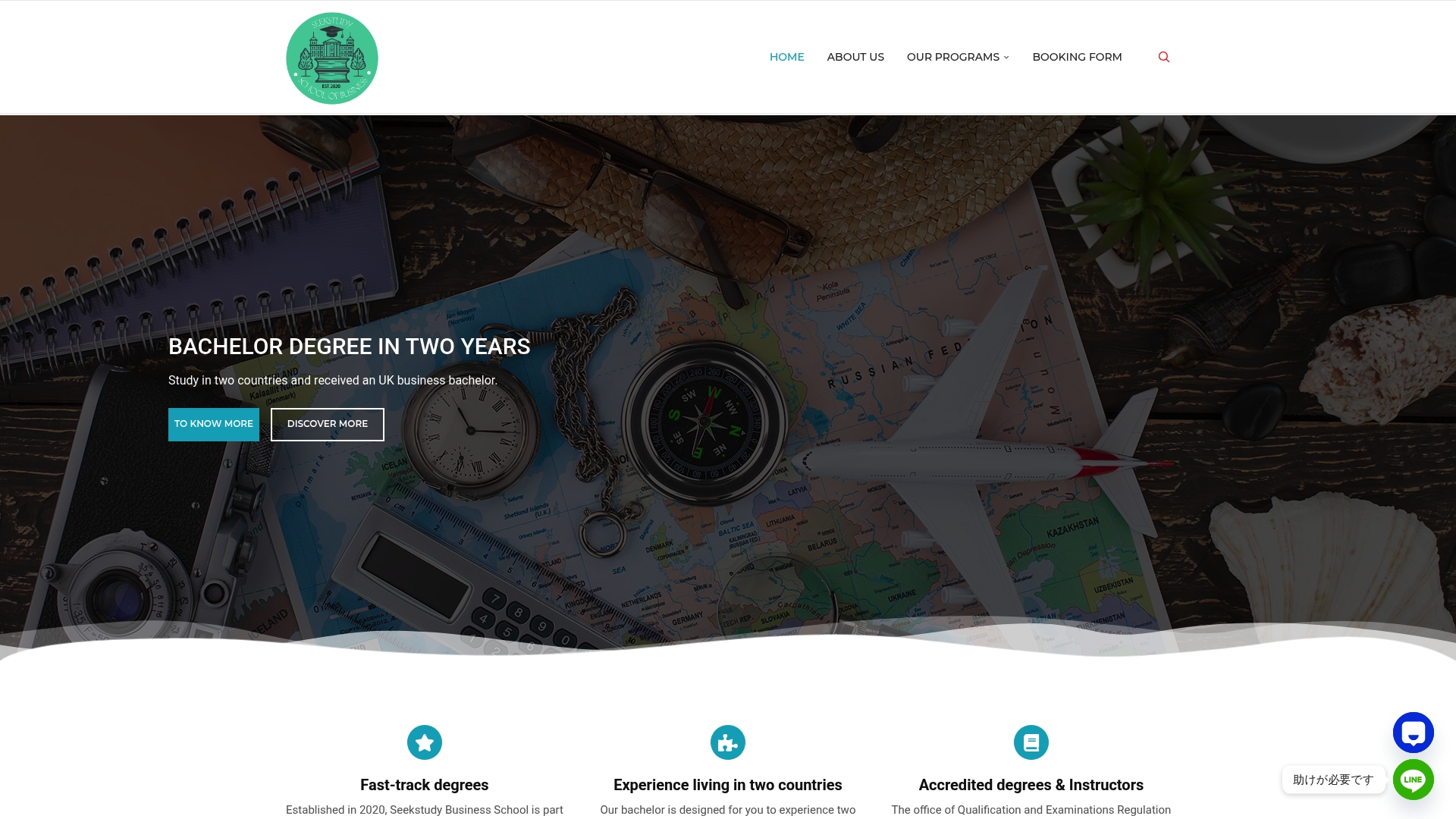
Our two-year bachelor’s in Business Management, one-year online MBA, and university pathway courses are delivered in collaboration with institutions across the UK, Singapore, Hong Kong, and Australia. You can begin your studies online and gain real international study experience without putting your career on hold for years. Whether you are starting from scratch or building on existing qualifications, Seekstudy’s programs connect you to a UK-recognized degree through the most direct route available. Explore your options today and find the program that matches where you want to be in two years, not five.
Frequently asked questions
Which country has the best business and accounting programs for international students?
The US leads globally, with four of the QS top five spots in Accounting and Finance, but the UK and China’s Tsinghua University are also ranked at the highest tier and offer strong outcomes for international students.
What is the fastest route to an accredited business degree abroad?
UK universities offer the most consistently fast-track formats, with bachelor’s programs in three years and master’s programs in one year. Oxford and Cambridge both rank in the global top six for Business and Economics and follow this compressed format.
Are business programs in China taught in English?
Yes, increasingly so. Tsinghua University, ranked third globally in THE Business & Economics 2026, and other leading Chinese institutions now offer Management and MBA programs fully in English to attract international applicants.
How important are rankings when choosing a study destination?
Rankings signal quality but should not be the only factor. Program speed, accreditation relevant to your job market, and entry flexibility matter just as much. The QS Accounting & Finance 2026 list is a useful benchmark, but a lower-ranked accredited program that fits your timeline will often serve your career better than a prestigious one that does not.
Recommended
- Best 3 Fast-track business degrees 2026
- Top 4 Fast-track business degrees 2026
- Top types of business degrees for fast-track careers in 2026
- Fast-track degrees: accelerate your management career
- Why career-focused courses boost your job prospects
- Accredited courses in Australia: boost your career prospects — Canterbury Training and Development Institute