

TL;DR:
- In 2026, the value of online degrees depends on guided AI integration, credential stacking, and clear return on investment.
- Global online learning expands rapidly with accreditation, support, and recognition shaping international career opportunities.
Most students assume that faster delivery and flashy technology are what make an online degree valuable in 2026. That assumption can cost you real money and career momentum. The actual drivers of value right now are guided AI integration, strategically stacked credentials, and a clear return on credential mindset. Whether you are a working professional pursuing an online MBA or an international student weighing a fast-track business degree, understanding these shifts helps you choose programs that genuinely move your career forward rather than just filling a line on your resume.
Table of Contents
- GenAI transforms online learning—when used with guidance
- Online degrees go global: Growth in fast-track and international access
- Micro-credentials: Complement or competitor to online degrees?
- Maximizing ROI: What to look for in 2026 online programs
- Why chasing credentials alone misses the 2026 opportunity
- Explore next-gen online degrees and fast-track your global career
- Frequently asked questions
Key Takeaways
| Point | Details |
|---|---|
| AI needs pedagogy | Generative AI is only effective in online education when guided by expert teaching frameworks. |
| Degrees expand globally | Online business and accounting programs are becoming more accessible and relevant for international students in 2026. |
| Micro-credentials are stackable | Short-form credentials are increasingly paired with degrees to improve career flexibility and workforce alignment. |
| ROI is measurable | Modern programs now offer evidence of improved learning outcomes and career impact—demand these metrics before you enroll. |
| Guidance matters most | The smartest students succeed by strategically choosing programs with robust support, not just by chasing speed or trend. |
GenAI transforms online learning—when used with guidance
Now that we have set new expectations for educational innovation, let’s see how AI is truly reshaping the learning experience in 2026.
Generative AI has moved well past the novelty stage. In 2026, it functions as a tutor, a writing coach, a case study generator, and an assessment tool inside many online programs. For management and accounting students studying across time zones, that kind of always-available academic support is genuinely useful. But there is a critical distinction between AI that helps you learn and AI that simply completes tasks for you.
The OECD’s Digital Education Outlook 2026 is direct about this: GenAI benefits depend on pedagogical guidance, and without structured faculty oversight, outsourcing tasks to AI can improve surface-level performance without producing real learning gains. In plain terms, a student can use AI to produce a well-formatted financial analysis report without actually understanding the underlying accounting principles. That is a serious problem when employers test those skills in interviews or on the job.
On the assessment side, Scientific Reports (2026) tested a generative AI framework for personalized assessment and found accuracy correlated with expert consensus while substantially reducing generation time. The efficiency gains are real. But the study’s core finding is that meaningful learning gains only appear when the AI framework is matched to structured credentialing outcomes and guided by clear pedagogical design.
Here is what to look for when evaluating how a program uses AI:
- Does faculty set specific learning objectives that AI tools must support, not replace?
- Are students given real feedback on AI-assisted work, not just automated scores?
- Is there a clear policy on how GenAI use is monitored within coursework?
- Do instructors design assessments that require synthesis and critical thinking, not just output production?
- Are AI tools built into the curriculum intentionally, rather than bolted on as optional extras?
“The question is not whether your program uses AI. The question is whether AI in your program makes you smarter or just faster.” This distinction defines educational quality in 2026.
Pro Tip: When speaking to admissions teams, ask specifically how faculty structure AI use in graded coursework. Vague answers like “students can use AI tools” signal that no real pedagogical framework exists.
For those exploring how online learning for management careers has evolved alongside these tools, the key takeaway is that guided AI integration separates genuinely rigorous programs from those chasing tech trends.
Online degrees go global: Growth in fast-track and international access
With AI making coursework more adaptive and efficient, it’s fueling a surge in global online degree options—especially for fast-track learners.
International demand for accredited online degrees is not slowing. Institutions across the UK, US, Singapore, Hong Kong, and Australia are actively expanding direct online pathways for students who cannot or prefer not to relocate. The shift is measurable. Deloitte’s 2026 Higher Education Trends report notes that 21% of US colleges surveyed by NAFSA expect to increase online offerings for international students, reflecting a broader recognition that geography should not limit access to quality credentials.

For management and accounting students, this opens up a wider field of legitimate fast-track options than existed even three years ago.
| Program type | Duration | Delivery mode | Best suited for |
|---|---|---|---|
| Accelerated bachelor’s (business) | 2 years | Fully online or blended | School leavers seeking faster entry to careers |
| Online one-year MBA | 12 months | Online with optional residency | Working professionals with a first degree |
| Professional qualification pathway | 6 to 18 months | Online, self-paced | Career changers or upskilling professionals |
| Foundation plus degree | 18 to 36 months | Online with academic support | Students needing entry-level preparation |
21% of US colleges plan to expand online access for international students in 2026, according to Deloitte’s higher education survey, signaling a structural shift rather than a short-term response.
If you are evaluating whether a specific program is genuinely designed for global students and not just marketed to them, follow these steps:
- Check accreditation and recognition. A UK-regulated degree should be listed with Ofqual or a recognized awarding body. Degrees from Singapore or Hong Kong should map to the country’s national qualifications framework.
- Assess support for international students. Look for time-zone-adapted support, multilingual resources, and clear pathways for credit recognition.
- Examine the delivery structure. Synchronous live sessions that only run in European daytime are effectively inaccessible to students in Asia or the Americas without significant lifestyle disruption.
- Research graduate outcomes by region. A strong program will show you where graduates are working, not just aggregate employment rates.
- Verify tuition versus total cost. Factor in examination fees, technology subscriptions, and any required in-person components.
Understanding how to design a meaningful international study experience matters just as much as the degree itself. The credential you earn should open doors globally, and how you engage with the program often determines whether it does. If you are ready to take action, exploring how to apply for a UK online degree in 2026 is a practical starting point, particularly for those interested in globally recognized business management credentials. Students focused on accounting can explore options to study accounting online with the flexibility needed to balance work, life, and study.
Micro-credentials: Complement or competitor to online degrees?
Beyond just pursuing a fast degree, many are turning to micro-credentials—let’s break down how they compete with or complement traditional programs.
Micro-credentials have grown from an experimental concept into a mainstream workforce tool. Modern Campus (2026) reports that 85% of institutions now design micro-credentials specifically for workforce development, up from 55% in 2021. That is a dramatic shift in intent. Institutions are no longer offering micro-credentials as sideline products. They are embedding them directly into workforce strategy.
For management and accounting students, this matters because it means more micro-credentials are now directly tied to employer needs rather than being generic academic additions. A micro-credential in financial modeling, ESG reporting, or digital accounting systems carries real signal to hiring managers when it is issued by a recognized institution and mapped to identifiable job competencies.
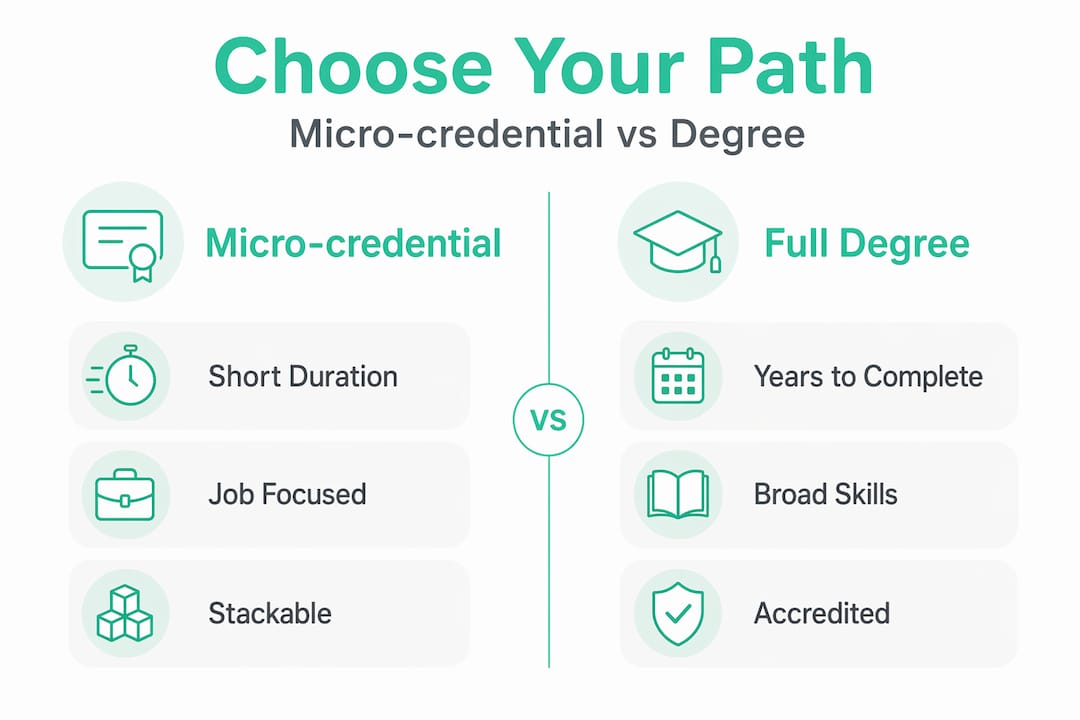
| Factor | Micro-credential | Full degree |
|---|---|---|
| Time commitment | Weeks to a few months | 1 to 4 years |
| Cost | Low to moderate | Moderate to high |
| Employer credibility | Growing, context-dependent | Broadly recognized |
| Career pivot suitability | Strong for targeted skills | Strong for role changes |
| Stackability | High, especially when mapped to degree | Provides the credential framework |
| Global recognition | Variable by issuer | Stronger with accredited institutions |
The important nuance here is that Deloitte’s 2026 Higher Education Trends emphasize that return on credential conversations are still driving strategy in both micro-credential and degree program design. Neither is fully replacing the other. The smarter approach is understanding when each serves your specific goal.
Before choosing a micro-credential or stacked path, ask yourself these questions:
- Does this micro-credential stack toward a degree I plan to pursue, or is it a standalone investment?
- Is the issuing institution recognized in the country or sector where I plan to work?
- Does this credential address a skill gap my current employer or target employer has identified?
- What is the total cost and time investment relative to the career uplift it realistically provides?
- Are there alumni or graduate outcome data I can review before committing?
Exploring the benefits of professional qualifications helps clarify how micro-credentials and formal degrees can work together rather than against each other. For those weighing multiple international study pathways, a blended strategy often delivers the best combination of speed and long-term credential value.
Maximizing ROI: What to look for in 2026 online programs
Micro-credentials and degrees both promise career ROI, but how do you actually find offerings that match their claims in 2026?
Not all online degrees deliver equal value. The gap between a well-designed fast-track program and a credential factory can be subtle from the outside but enormous in your career outcomes. Scientific Reports (2026) found that framework-driven GenAI assessment yields measurable learning gains with a Cohen’s d of 0.56, but only when matched to credentialing outcomes and verified by expert consensus. That effect size is meaningful. It means thoughtful program design genuinely moves the needle on what students actually learn and retain.
Deloitte’s 2026 analysis confirms that return on credential value is now the dominant driver in how institutions design both degree programs and micro-credentials. Programs that cannot demonstrate tangible graduate outcomes are losing enrollment to those that can.
Here is a practical five-step checklist before you apply to any program:
- Confirm accreditation status. Look for regulation by a national body such as Ofqual in the UK, TEQSA in Australia, or CPE in Singapore. Check whether partner universities are recognized by those bodies specifically.
- Request graduate employment data. Ask for job placement rates, average salary changes post-graduation, and the industries where graduates are working. If a school cannot provide this, treat it as a red flag.
- Assess AI and technology integration. Find out whether AI tools are embedded in structured learning activities or simply available as optional extras. The difference matters enormously for your actual skills development.
- Evaluate faculty access and feedback quality. Fast-track does not have to mean low-touch. Look for programs where you receive direct, personalized feedback from qualified instructors, not just automated scoring.
- Understand the credit recognition landscape. If you plan to work or study further in multiple countries, check whether your qualification is recognized across those markets before you commit.
Understanding the importance of accreditation is not a bureaucratic exercise. It is the difference between a qualification that opens doors globally and one that creates friction at every hiring or further education stage.
Pro Tip: If a program provider cannot tell you clearly what percentage of graduates secured relevant employment within six months of completing their degree, and they cannot point you to a verified source for that data, reconsider your application.
Why chasing credentials alone misses the 2026 opportunity
As you reflect on these trends, there’s a bigger lesson few discuss—one that can redefine your international education journey.
Here is the uncomfortable truth about the credential rush in 2026: speed and technology adoption are not the competitive advantage most people think they are. Earning a fast degree matters very little if you have not genuinely developed the management, analytical, or financial skills employers are testing in selection processes. Stacking five micro-credentials signals ambition but rarely signals deep competence on its own.
What actually differentiates high-performing international graduates is intentionality. They chose programs with real pedagogical frameworks. They asked hard questions about how AI was being used in their coursework, not just whether it existed. They understood the credential recognition landscape in their target markets before enrolling, not after graduating.
International students face a specific version of this risk. The combination of studying in an unfamiliar academic system, managing language demands, and navigating credential recognition across countries creates pressure to move quickly. That pressure can push students toward the fastest or cheapest option rather than the most strategically sound one. We have seen this pattern consistently. The students who gain the most from programs that blend study experience insights across multiple markets are the ones who came in with clear goals, not just a desire to finish fast.
The hard-won lesson here is simple: ask how technologies and program innovations are actually being used, not just whether a school mentions them in its marketing materials. The presence of AI tools in a program description tells you very little. The presence of a structured framework for how those tools are integrated into assessed learning tells you a great deal.
Your career in management or accounting will be built over decades. The program you choose in 2026 is a foundation, not a finish line. Partner with advisers who understand both regional credential evaluation and AI-integrated learning design before you sign anything.
Explore next-gen online degrees and fast-track your global career
Ready to put these trends into practice? Here’s how to find future-focused programs that match your ambitions.
If you are serious about earning an accredited, globally recognized degree in management or accounting without putting your career on hold, SeekStudy is built for exactly that. Regulated by Ofqual and partnered with institutions across the UK, Singapore, Hong Kong, and Australia, our programs are designed with the fast-track international learner in mind, not retrofitted for them.
Whether you are exploring a business management 2026 guide to understand your degree options or ready to dive into an online MBA for professionals, our team can walk you through credential recognition, program structure, and how AI is integrated into real learning outcomes. For those who want to move faster without sacrificing quality, our accelerated business degrees are structured to deliver measurable skills alongside a recognized UK qualification.
Frequently asked questions
Do online degrees in 2026 help international students secure global jobs?
Yes, accredited online degrees with strong workforce alignment and recognition from global institutions support international mobility and employability. 21% of US colleges surveyed by NAFSA plan to increase online offerings for international students, signaling growing global acceptance of fully online credentials.
How is generative AI actually used in online education in 2026?
Generative AI is mainly used for personalized assessment and as a study assistant, with the best outcomes occurring when guided by structured pedagogical frameworks. Without that guidance, outsourcing tasks to GenAI can improve surface performance without producing real learning gains, according to the OECD.
Are micro-credentials in 2026 a replacement for business degrees?
No, micro-credentials are most effective when they complement degrees rather than replace them. Return on credential strategy discussions in 2026 consistently position degrees and credentials as stackable rather than interchangeable.
What should I look for before enrolling in a fast-track online degree?
Check for accreditation, employer recognition, evidence of student learning gains, and whether AI-driven feedback is genuinely integrated into the program structure. Framework-driven GenAI assessment produces measurable learning gains only when matched to verified credentialing outcomes, so program design quality is the critical variable.