

Choosing between a bachelor’s or master’s degree in management or accounting can feel overwhelming, especially when accelerated programs promise faster completion. Many international students assume these degrees are interchangeable or that a master’s is always the better choice. The reality is more nuanced. Your decision should align with your career goals, educational background, financial capacity, and timeline. This guide breaks down the critical differences between accelerated bachelor’s and master’s programs, helping you understand which path delivers the best return on your investment and positions you for success in the competitive business world.
Table of Contents
- Key takeaways
- Understanding bachelor’s and master’s degrees in management and accounting
- Comparing time, cost, and career impact of accelerated bachelor’s vs master’s
- Academic requirements and admissions for accelerated programs abroad
- Making an informed decision: factors international students should consider
- Explore accelerated business degree options with SeekStudy
- FAQ
Key Takeaways
| Point | Details |
|---|---|
| Program duration differences | Accelerated bachelor programs take about two years while accelerated master programs take one to two years, so pursuing both could take three to four years total. |
| Faster entry, lower cost | The two year accelerated bachelor path can lead to quicker employment and a smaller total cost than starting with a master’s degree. |
| Goal driven choice | Decide based on your career goals, educational background, financial capacity, and timeline to maximize return on investment. |
| International considerations | Language of instruction, transfer policies, accreditation, and transcript notation affect how accelerated programs are valued and recognized abroad. |
| Mastery depth | Master’s degrees offer advanced specialization and often include case studies, theses, or capstone projects not typical in bachelor programs. |
Understanding bachelor’s and master’s degrees in management and accounting
The fundamental distinction between bachelor’s and master’s degrees lies in depth and specialization. Bachelor’s degrees provide foundational business knowledge covering accounting principles, management theories, finance basics, marketing fundamentals, and business law. These programs build your understanding from the ground up, assuming no prior business education. You’ll learn essential concepts like financial statement preparation, organizational behavior, cost accounting, and strategic planning frameworks.
Master’s degrees take a different approach entirely. They assume you already possess foundational knowledge and dive deep into specialized areas. You might focus on advanced financial analysis, strategic leadership, international accounting standards, or corporate governance. The coursework emphasizes critical thinking, research methodology, and application of complex theories to real-world business challenges. Master’s programs often include case studies, consulting projects, and thesis requirements that bachelor’s programs don’t typically demand.
Accelerated bachelor’s programs compress traditional three to four year curricula into roughly two years. This means more intensive coursework, year-round study, and fewer breaks. You’ll cover the same material but at a faster pace, requiring strong time management and academic discipline. These programs benefit students who want to enter the workforce quickly or have clear career goals that don’t require graduate education.
Accelerated master’s programs similarly condense one to two year traditional programs into 12 months or less. The intensity ramps up significantly, with multiple courses running simultaneously and demanding schedules. These formats target working professionals or recent graduates seeking rapid career advancement. The compressed timeline means less flexibility but faster credential completion.
International students face additional considerations in accelerated formats. Language of instruction matters tremendously when coursework moves quickly. Credit requirements may differ across countries, affecting transfer policies and program recognition. Accreditation becomes crucial for ensuring your degree holds value globally. You need to verify that accelerated programs maintain the same quality standards as traditional formats and that employers in your target market recognize the credentials.
Pro Tip: Research whether accelerated programs offer the same degree classification and transcript notation as traditional programs, as some employers may distinguish between formats.
Comparing time, cost, and career impact of accelerated bachelor’s vs master’s
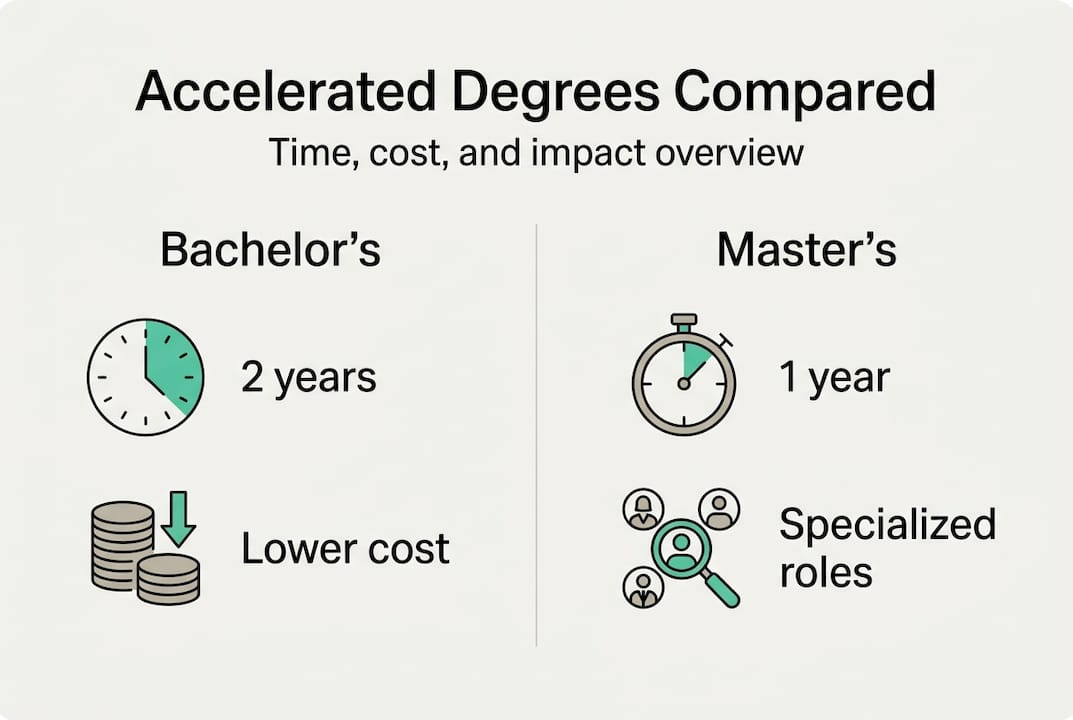
Time investment differs significantly between degree levels. Accelerated bachelor’s programs typically require two years of full-time study, while accelerated master’s programs compress advanced education into one to two years. This means you could complete both degrees in three to four years total if pursuing them sequentially. However, the two-year bachelor’s format offers faster career entry with lower total cost than starting directly with a master’s, which requires a bachelor’s degree first anyway.

Financial considerations extend beyond tuition alone. Bachelor’s programs generally charge undergraduate rates, which are lower than graduate tuition in most institutions. Living expenses accumulate over the longer bachelor’s timeline, but the total investment remains more manageable for many students. Master’s programs command premium pricing due to specialized faculty, smaller class sizes, and advanced resources. However, the shorter duration means fewer months of living expenses and lost income.
Career impact varies dramatically by degree level and field. Bachelor’s degrees qualify you for entry-level positions in accounting firms, financial departments, management trainee programs, and business analyst roles. Starting salaries typically range from moderate to good, depending on location and industry. You can begin earning immediately after graduation and gain practical experience while potentially pursuing a master’s later.
Master’s degrees open doors to specialized positions that bachelor’s holders cannot access. Senior accountant roles, financial managers, strategy consultants, and leadership positions often require graduate credentials. Accelerated business degrees boost career placement rates significantly, with some programs reporting up to 75% higher placement success. Starting salaries for master’s graduates typically exceed bachelor’s levels by 20 to 40 percent, and lifetime earning potential increases substantially.
| Factor | Accelerated Bachelor’s | Accelerated Master’s |
|---|---|---|
| Program length | 2 years full-time | 1-2 years full-time |
| Typical tuition range | $15,000-$40,000 total | $25,000-$60,000 total |
| Starting salary boost | Baseline market rate | 20-40% above bachelor’s |
| Career level access | Entry to mid-level | Mid to senior level |
| Time to workforce | Immediate after 2 years | Immediate after 1 year (plus bachelor’s time) |
The return on investment calculation depends on your starting point. If you lack a bachelor’s degree, starting there makes logical and financial sense. If you already hold a bachelor’s in an unrelated field, a master’s in management or accounting can pivot your career efficiently. If you have a relevant bachelor’s and want advancement, a master’s delivers specialized expertise that commands higher compensation.
Pro Tip: Calculate your total cost of education including tuition, living expenses, and foregone income during study, then compare against projected salary increases to determine your break-even point.
Academic requirements and admissions for accelerated programs abroad
Bachelor’s program admissions focus on secondary education completion and readiness for university-level work. You’ll need official high school transcripts showing strong academic performance, particularly in mathematics and English. Most programs require proof of English proficiency through tests like IELTS (typically 6.0 or higher) or TOEFL (usually 80+ iBT). Some institutions accept alternative English qualifications or waive requirements for students from English-speaking countries.
Master’s applications demand more extensive documentation. You must provide a relevant bachelor’s degree transcript with good academic standing, usually a minimum GPA of 2.5 to 3.0 on a 4.0 scale. Letters of recommendation from professors or employers carry significant weight, demonstrating your capacity for graduate-level work. A statement of purpose explaining your career goals, motivation for the program, and how the degree fits your professional trajectory is essential. Some programs, particularly MBAs, prefer or require professional work experience ranging from one to five years.
International students navigate additional complexity beyond academic requirements. Visa processes vary by destination country, requiring proof of acceptance, financial capability, and sometimes health clearances. Program accreditation affects visa eligibility and post-graduation work rights in many countries. You need to verify that your chosen program holds proper recognition from relevant educational authorities.
Credit transfer policies matter when you’ve completed prior coursework. Some accelerated programs accept transfer credits from previous studies, potentially shortening your program further. Others maintain strict curriculum requirements with limited transfer options. Understanding these policies upfront prevents surprises and helps you plan accurately.
Application steps for accelerated programs:
- Research programs thoroughly, comparing curriculum, accreditation, location, and career outcomes
- Prepare required documents including transcripts, test scores, identification, and financial proof
- Draft your statement of purpose and secure recommendation letters well in advance
- Submit applications before deadlines, noting that accelerated programs may have multiple intake periods
- Arrange funding through scholarships, loans, or personal resources before acceptance
- Complete visa applications immediately after receiving admission offers
- Attend interviews if required, preparing to discuss your goals and program fit
Accelerated bachelor’s programs often require demonstrated academic readiness and English proficiency as primary criteria, while master’s programs add degree relevance and sometimes professional experience to their requirements. The accelerated format itself demands students who can handle intensive coursework, manage time effectively, and maintain focus throughout compressed semesters.
Making an informed decision: factors international students should consider
Your career target determines which degree level makes sense. If you’re entering the business world without prior education, a bachelor’s provides essential foundations. Jumping directly to a master’s without understanding core business principles sets you up for struggle. Conversely, if you hold a bachelor’s in any field and want to specialize in management or accounting, a master’s offers the focused expertise employers value.
Financial capacity extends beyond affording tuition. Consider your total investment including living expenses, travel, health insurance, and opportunity cost of not working. Bachelor’s programs spread costs over two years with lower annual tuition but longer total duration. Master’s programs concentrate higher costs into one to two years but get you earning sooner. Calculate which scenario fits your financial situation better, including available scholarships, family support, or loan options.
Program recognition and accreditation directly impact your degree’s value. Verify that your chosen program holds proper accreditation from recognized bodies in the destination country. Check whether professional accounting bodies accept the degree for certification purposes if you plan to become a CPA, ACCA, or similar credential holder. Research how employers in your target job market view the institution and program.
Personal readiness for accelerated formats cannot be overstated. These programs move fast, with little room for catching up if you fall behind. You’ll balance multiple demanding courses simultaneously, complete assignments on tight deadlines, and possibly study year-round with minimal breaks. Assess honestly whether you have the discipline, time management skills, and stress tolerance for this intensity.
Career trajectory analysis helps clarify which degree serves your goals. Research job postings in your target field and location. Note which positions require bachelor’s degrees versus master’s degrees. Examine salary ranges and advancement paths for each level. Talk to professionals working in roles you want, asking about their educational backgrounds and whether they found graduate education necessary.
| Decision Factor | Choose Bachelor’s If | Choose Master’s If |
|---|---|---|
| Educational background | No prior degree or unrelated field | Relevant bachelor’s completed |
| Career goal | Entry-level business role | Specialized or senior position |
| Financial situation | Limited budget, need lower total cost | Can invest more for higher ROI |
| Time horizon | Want fastest route to any business job | Can commit to bachelor’s + master’s path |
| Skill level | Need foundational knowledge | Ready for advanced concepts |
Understanding your career goals and educational starting point proves essential before committing to either accelerated path. The wrong choice wastes time and money, while the right choice accelerates your career efficiently.
Pro Tip: Shadow professionals in your target roles or arrange informational interviews to understand which degree level they consider essential versus optional for breaking into and advancing in the field.
Explore accelerated business degree options with SeekStudy
SeekStudy specializes in accelerated bachelor’s and master’s degree programs designed specifically for international students pursuing management and accounting careers. Our comprehensive bachelor’s in business management guide walks you through program structures, career outcomes, and application processes tailored to your needs.
We offer flexible learning formats including online and blended options that let you balance study with other commitments. Our bachelor’s in business management programs deliver UK-recognized credentials through partnerships with accredited institutions in the UK, Hong Kong, Singapore, and Australia. For professionals seeking advanced credentials, our online MBA guide details how you can earn a master’s degree while maintaining your career. Connect with our advisors to explore which accelerated program aligns with your goals and timeline.
FAQ
What is the main difference between a bachelor’s and master’s degree in accelerated programs?
Bachelor’s degrees cover foundational business topics like accounting basics, management principles, and finance fundamentals over a compressed timeframe of roughly two years. Master’s degrees focus on specialized advanced knowledge such as strategic leadership, complex financial analysis, and research methodology, typically completed in one to two years. Accelerated formats maintain the same content depth as traditional programs but compress the timeline through intensive scheduling and year-round study.
Can international students apply for accelerated master’s programs without work experience?
Many accelerated master’s programs accept applicants directly after completing a relevant bachelor’s degree without requiring professional experience. However, some specialized programs, particularly executive MBAs, prefer or mandate one to five years of work experience to ensure students can contribute practical insights to class discussions. Always review specific program requirements before applying, as policies vary significantly between institutions and program types.
What career benefits do accelerated master’s degrees offer over bachelor’s?
Master’s degrees typically open access to senior-level positions, specialized roles, and leadership opportunities that bachelor’s degrees alone may not qualify you for. Starting salaries for master’s graduates often exceed bachelor’s level compensation by 20 to 40 percent, with greater lifetime earning potential. Accelerated formats deliver these benefits faster than traditional timelines, allowing you to advance your career and increase earnings sooner while the knowledge and skills remain current.
How do accelerated degree programs affect visa and study duration requirements for international students?
Accelerated programs shorten your total study time, which may affect standard student visa durations and renewal processes in your destination country. Some countries issue visas matching program length plus a buffer period, while others provide fixed-term visas requiring extensions. You should consult official immigration guidelines for your specific destination and verify that accelerated program completion still qualifies you for post-graduation work rights if available. Program administrators can usually provide guidance on visa implications specific to their accelerated format.