

Many prospective international students assume studying in Singapore means expensive tuition, rigid schedules, and limited program choices. The reality is far more compelling. Singapore hosts world-class universities ranked in the global top 20, offering accredited fast-track degree programs that slash study time while maintaining quality. This article explores how Singapore combines accelerated learning pathways, affordable costs with scholarships, flexible online and hybrid options, and unmatched career access across Asia. You’ll discover practical advantages that transform Singapore from an overlooked option into a strategic launchpad for your international education and career.
Table of Contents
- World-Class Universities And Accelerated Degree Programs In Singapore
- Cost Advantages And Financial Aid For International Students
- Flexible Learning And Career Advantages In Singapore’s Multicultural Environment
- Challenges And Considerations For International Students Studying In Singapore
- Explore Fast-Track Business Degrees And Flexible Learning Options With SeekStudy
- Frequently Asked Questions
Key takeaways
| Point | Details |
|---|---|
| Prestigious global rankings | NUS and NTU rank in the top 20 worldwide, delivering internationally recognized accredited degrees |
| Accelerated graduation timelines | Fast-track programs combine diplomas and degrees in under 6 years or integrate bachelor’s and master’s in 4-5 years |
| Affordable with financial support | Tuition costs less than UK, USA, or Australia, with scholarships like MOE Tuition Grant and part-time work allowed up to 16 hours weekly |
| Safe multicultural hub | English-speaking environment ranked #5 globally for peace, offering direct access to Asia’s booming fintech, IT, and business sectors |
| Flexible learning modes | Hybrid and online programs provide UK or Australian qualifications at lower cost with tech-enhanced engagement |
World-class universities and accelerated degree programs in Singapore
Singapore’s universities consistently dominate global rankings, with the National University of Singapore (NUS) at #8 and Nanyang Technological University (NTU) at #15. These institutions attract international students seeking fast-track degree programs that deliver prestigious credentials without the traditional four to six year commitment. The academic rigor matches top Western universities, but innovative pathways compress timelines significantly.
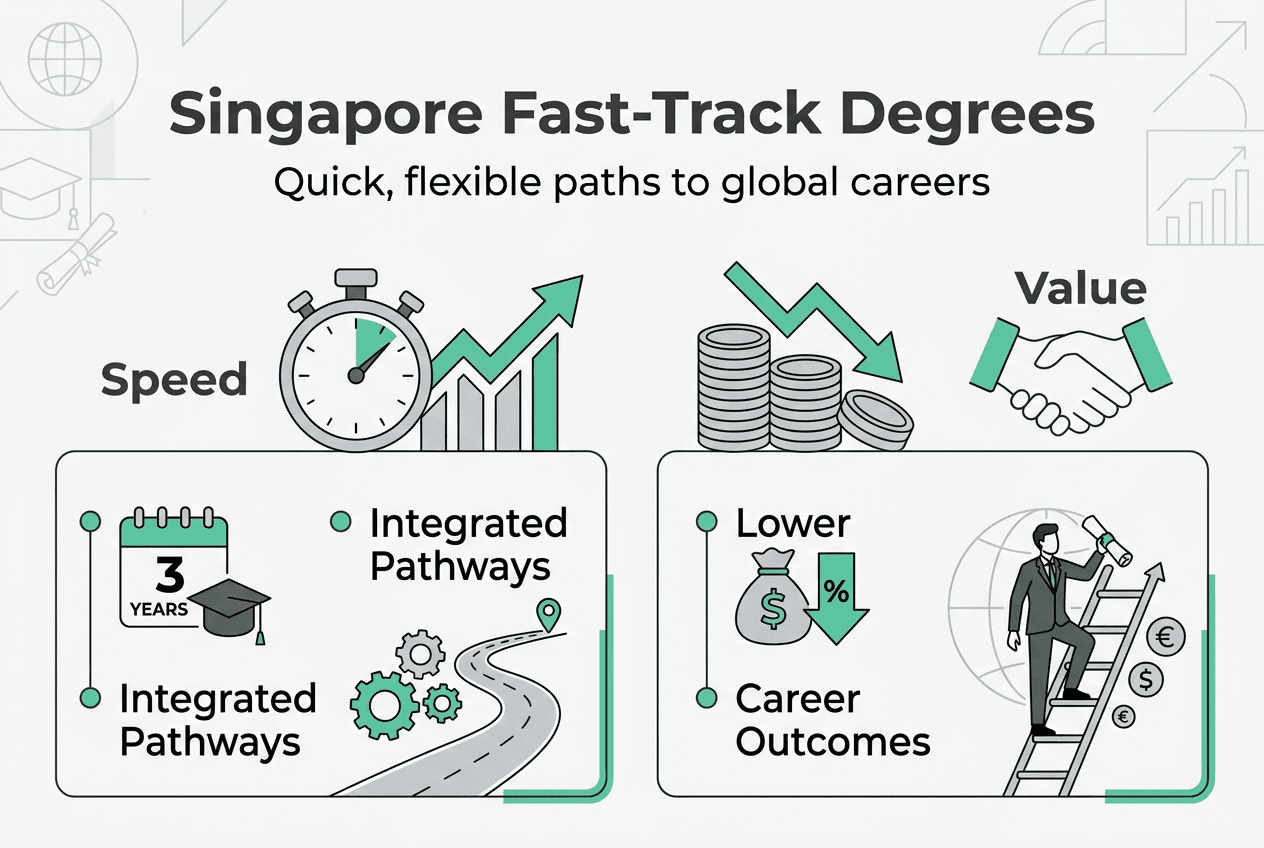
Fast-track programs restructure traditional education by integrating diplomas with bachelor’s degrees or combining undergraduate and postgraduate studies. The NYP-NUS University Pathway Programme allows diploma holders to complete a degree in under 6 years total, while Singapore Management University’s integrated programs merge a BSc with an MSc or Master of IT in Business in just 4-5 years. These accelerated routes maintain full accreditation while cutting study duration by 25-40% compared to conventional paths.
| Program Type | Duration | Credential Outcome | Time Saved |
|---|---|---|---|
| Traditional Diploma + Degree | 6-7 years | Separate qualifications | Baseline |
| NYP-NUS Pathway | Under 6 years | Integrated degree | 1-2 years |
| SMU Integrated BSc + MSc | 4-5 years | Dual degrees | 2-3 years |
| Standard Bachelor’s Only | 3-4 years | Single degree | N/A |
The core advantages of these accelerated programs include seamless credit transfer between diploma and degree levels, curriculum designed to eliminate redundancy, and earlier workforce entry. Students gain the same accredited qualifications but enter careers sooner, earning income while peers complete traditional programs. Preparing for fast-track degrees online requires understanding these structural differences.
Key features that make fast-track programs effective:
- Integrated curriculums eliminate overlap between diploma and degree coursework
- Credit transfer systems recognize prior learning and professional experience
- Diploma to degree pathways provide multiple entry points for diverse backgrounds
- Industry partnerships ensure curriculum relevance and immediate job market applicability
- Flexible scheduling accommodates working professionals pursuing study in Singapore and UK with flexible business degrees
Pro Tip: Before enrolling, verify that your chosen program holds recognized accreditation from bodies like Ofqual or equivalent international agencies, and confirm the exact duration including any internship or thesis requirements to avoid unexpected timeline extensions.
For comprehensive guidance on navigating Singapore’s education landscape, the Eduvisor Singapore study guide provides detailed program comparisons and application timelines.
Cost advantages and financial aid for international students
Financial accessibility sets Singapore apart from traditional study destinations. Annual tuition typically ranges from SGD 20,000 to 50,000 (approximately USD 15,000 to 37,000), significantly lower than comparable programs in the UK, USA, or Australia where costs often exceed USD 50,000 annually. Living expenses add SGD 1,500 to 2,500 monthly depending on accommodation choices and lifestyle, but this remains competitive with other major education hubs.
International students can work part-time up to 16 hours weekly during term and full-time during vacations, helping offset living costs while gaining local work experience. This work-study balance provides practical income without compromising academic performance. Post-study employment passes further ease the transition from education to career, allowing graduates to remain in Singapore and leverage their qualifications in Asia’s dynamic job market.
Scholarship opportunities substantially reduce the financial burden for qualified international students. The MOE Tuition Grant covers up to 50% of tuition with a 3-year work commitment in Singapore, making it attractive for those planning to build careers in Asia. SINGA scholarships support PhD candidates with full tuition coverage plus monthly stipends. ASEAN-specific scholarships and university-based awards provide additional funding streams tailored to regional students.
Key financial advantages for international students:
- Lower tuition compared to Western universities while maintaining accreditation standards
- Part-time work authorization provides income without visa complications
- Scholarship programs like MOE Tuition Grant reduce costs by 50% or more
- Post-study employment passes enable immediate job search without returning home
- Affordable public transportation and subsidized student housing options
The combination of lower base costs, earning opportunities, and generous scholarships makes Singapore financially accessible for students who might find UK or US programs prohibitive. Those interested in applying for business degree fast-track programs should research scholarship deadlines early, as competitive awards require applications 6-12 months before program start dates.
Beyond immediate cost savings, Singapore’s strategic position offers long-term career value. Graduates gain credentials recognized globally while building networks across Asia’s fastest-growing economies. The financial investment yields returns through accelerated career progression and access to markets where fast-track degrees provide measurable career advancement advantages.
Flexible learning and career advantages in Singapore’s multicultural environment
Singapore’s education sector embraces flexibility through diverse study modes that accommodate working professionals and international students managing time zone differences. Traditional full-time programs remain available, but hybrid and fully online options expand accessibility without sacrificing accreditation or quality.
| Study Mode | Annual Cost | Typical Duration | Flexibility | Accreditation |
|---|---|---|---|---|
| Traditional Full-Time | SGD 30,000-50,000 | 3-4 years | Low | Full |
| Hybrid (Online + In-Person) | SGD 25,000-40,000 | 3-5 years | High | Full |
| Fully Online | SGD 20,000-35,000 | 2-4 years | Very High | Full |
Offshore and hybrid programs deliver UK or Australian qualifications at SGD 25,000 to 50,000 total, compared to SGD 100,000 to 150,000 for studying abroad, providing the same credentials at 50-75% cost savings. These programs maintain full accreditation while allowing students to balance work, family, and education. The hybrid model combines online coursework with periodic intensive sessions in Singapore, maximizing flexibility while preserving networking opportunities.
Technology-enhanced learning platforms significantly boost engagement and comprehension. Research shows AI and VR-enhanced online programs achieve 3.85 out of 5 comprehension scores versus 2.92 for traditional methods, demonstrating that well-designed digital education can outperform conventional classrooms. International students benefit from asynchronous content, interactive simulations, and AI-driven personalized feedback that adapts to individual learning speeds.
Singapore’s environment amplifies educational value beyond academics. As a safe, multicultural, English-speaking hub and gateway to Asia with high employability in fintech, business, and IT, the city-state ranked #5 on the Global Peace Index provides security and cultural diversity that enriches the student experience. English as the primary business language eliminates language barriers while exposure to Chinese, Malay, and Tamil cultures builds cross-cultural competencies employers value.
Career advantages from studying in Singapore:
- Direct access to Asia-Pacific markets representing 60% of global economic growth
- Internship opportunities with multinational corporations headquartered regionally
- Networking with professionals across fintech, logistics, biotechnology, and digital sectors
- Post-study work authorization facilitating immediate employment in high-growth industries
- Proximity to emerging markets in Southeast Asia, China, and India
Students pursuing management studies online gain practical exposure to Asian business practices while earning credentials. The Singapore and UK degree combination provides dual recognition, opening career paths across continents. This international study experience builds adaptability and global perspectives that distinguish graduates in competitive job markets.
Pro Tip: Select programs offering a blend of online flexibility and periodic in-person sessions in Singapore to maximize both convenience and networking opportunities, as face-to-face interactions with faculty and peers create lasting professional relationships that purely online programs cannot replicate.
Challenges and considerations for international students studying in Singapore
Singapore’s education system demands high performance and maintains intense competition, particularly among local students who have navigated the rigorous national curriculum from primary school. International students entering this environment must prepare for academic expectations that often exceed those in their home countries. The pressure to excel can create stress, especially when adjusting to new cultural norms and teaching styles simultaneously.
Key challenges international students face:
- High academic stress from competitive grading curves and demanding coursework
- Competition with local students who possess familiarity with Singapore’s education style
- Cultural adaptation to direct communication styles and hierarchical classroom dynamics
- Managing expectations around work-life balance in a high-achieving environment
- Navigating bureaucratic processes for visas, housing, and healthcare systems
Despite these pressures, Singapore’s education sector increasingly emphasizes holistic well-being to counterbalance traditional intensity. Universities now offer comprehensive mental health services, peer support programs, and wellness initiatives recognizing that sustainable success requires emotional and physical health alongside academic achievement. Research highlights that holistic well-being initiatives help international students gain Asia gateway advantages while managing competition from locals, creating a more supportive environment than existed a decade ago.
“The contrast between Singapore’s historically high-stress education system and its growing emphasis on holistic student well-being creates unique opportunities for international students who prepare mentally and leverage available support services to thrive in a competitive yet increasingly supportive environment.”
Preparing mentally involves realistic expectations about workload, proactive engagement with academic advisors, and early utilization of counseling and tutoring resources. Many universities assign peer mentors who help international students navigate cultural differences and academic challenges. These support systems transform potential obstacles into manageable adjustments.
View challenges as growth opportunities rather than barriers. The same competitive environment that initially feels overwhelming builds resilience, time management skills, and performance under pressure that employers worldwide value. Students who successfully navigate Singapore’s rigorous system emerge with both prestigious credentials and proven ability to excel in demanding professional environments.
For those pursuing specialized pathways like a strategic management diploma, understanding these challenges upfront enables better preparation and realistic goal setting. The key lies in balancing ambition with self-care, leveraging available resources, and recognizing that adaptation takes time.
Explore fast-track business degrees and flexible learning options with SeekStudy
Having explored Singapore’s educational landscape, the next step involves finding programs that match your career goals and lifestyle needs. SeekStudy specializes in accelerated business degrees that boost career trajectories through accredited pathways combining Singapore and UK study experiences. Our programs compress traditional timelines without compromising quality, delivering recognized credentials in management and accounting fields.
Our online and hybrid options suit working professionals and international students seeking flexibility. Understanding why studying management online works for your situation helps you choose between fully remote or blended formats. Beyond academics, SeekStudy provides career services including resume workshops, interview preparation, and employer connections that maximize your employability across Asia and globally. Ready to accelerate your future? Explore our programs and discover how to apply for business degree fast-track options that align with your ambitions.
Frequently asked questions
What scholarships are available for international students in Singapore?
The MOE Tuition Grant covers up to 50% of tuition fees but requires a 3-year work commitment in Singapore after graduation. SINGA scholarships support PhD candidates with full funding including stipends. ASEAN-specific awards and university-based scholarships provide additional options, with most requiring applications 6-12 months before program start dates.
How long do fast-track degree programs in Singapore typically take?
The NYP-NUS pathway enables diploma holders to complete a full degree in under 6 years total, saving 1-2 years compared to traditional routes. Singapore Management University’s integrated programs combine a bachelor’s and master’s degree in just 4-5 years, cutting 2-3 years from conventional timelines while maintaining full accreditation.
Can international students work part-time while studying in Singapore?
Yes, international students may work up to 16 hours per week during academic terms and full-time during official vacation periods. This arrangement helps offset living costs while providing valuable local work experience. Students must hold valid student passes from approved institutions to qualify for work authorization.
What makes Singapore a safe and attractive study destination?
Singapore ranks #5 on the Global Peace Index, providing exceptional safety for international students. The English-speaking, multicultural society offers strong industry connections in fintech, business, and IT sectors, creating direct pathways from education to employment. Its strategic position serves as a gateway to Asia-Pacific markets, offering networking and career opportunities unavailable in Western education hubs.