

Choosing a business school can feel overwhelming when every program claims to offer world-class education and transformative career outcomes. Yet many prospective students overlook one critical quality signal that separates truly rigorous programs from the rest: accreditation. Understanding what business school accreditation actually means, how it works, and which types matter most can dramatically change your program selection process. This article breaks down the accreditation landscape, explores major accrediting bodies, weighs benefits against criticisms, and shows you how to apply this knowledge when choosing your next educational step.
Table of Contents
- Key takeaways
- What is business school accreditation?
- Major business school accreditation bodies and differences
- Benefits and critiques of business school accreditation
- Applying accreditation knowledge when choosing a business program
- Explore accredited business programs with SeekStudy
- Frequently asked questions about business school accreditation
Key Takeaways
| Point | Details |
|---|---|
| What accreditation is | Accreditation is a voluntary peer review process that verifies a business school meets rigorous international standards across curriculum, faculty, resources, and outcomes. |
| Accreditation process steps | The process includes eligibility review, self evaluation, peer review visit, and ongoing monitoring every five to seven years. |
| Major accrediting bodies | The three dominant accrediting bodies offer different strengths, with AACSB being the oldest and highly selective, and EQUIS emphasizing internationalization and European connections. |
| Use accreditation in choosing programs | Accreditation helps you compare programs with confidence and signals that the degree meets professional standards recognized by employers worldwide. |
What is business school accreditation?
Business school accreditation is a voluntary peer-review process by specialized agencies to verify that schools meet rigorous international standards across curriculum, faculty, resources, and outcomes. Think of it as an independent quality audit that confirms a program delivers what it promises. Unlike government licensing, accreditation involves experts from other business schools evaluating whether an institution maintains academic excellence and continuous improvement.
The typical accreditation process unfolds in several structured phases:
- Eligibility review: Schools apply and demonstrate they meet minimum criteria for evaluation
- Self-evaluation: The institution conducts an exhaustive internal review documenting how it meets each accreditation standard
- Peer review visit: A team of faculty and administrators from other accredited schools visits campus, interviews stakeholders, and assesses operations firsthand
- Decision and ongoing monitoring: The accrediting body grants or denies accreditation, then requires periodic reviews every five to seven years
Accreditation standards examine multiple dimensions of program quality. Curriculum design must align with learning objectives and industry needs. Faculty qualifications matter, including terminal degrees, research output, and professional experience. Resources like library holdings, technology infrastructure, and student support services face scrutiny. Student outcomes, from placement rates to salary data, demonstrate real-world impact.
“Accreditation confirms that business programs meet internationally recognized benchmarks for quality, ensuring graduates possess the knowledge and skills employers value most.”
This rigorous evaluation creates accountability. Schools cannot rest on past achievements but must demonstrate ongoing commitment to excellence. The process pushes institutions to innovate while maintaining core quality standards. For students, accreditation offers assurance that your investment in education meets professional standards recognized worldwide. When you pursue accredited online programs, you gain confidence that the degree holds value beyond the digital classroom.
Major business school accreditation bodies and differences
Three primary organizations dominate global business school accreditation, each with distinct standards and geographic strengths. Understanding these differences helps you interpret what various accreditation stamps actually mean for program quality and career prospects.
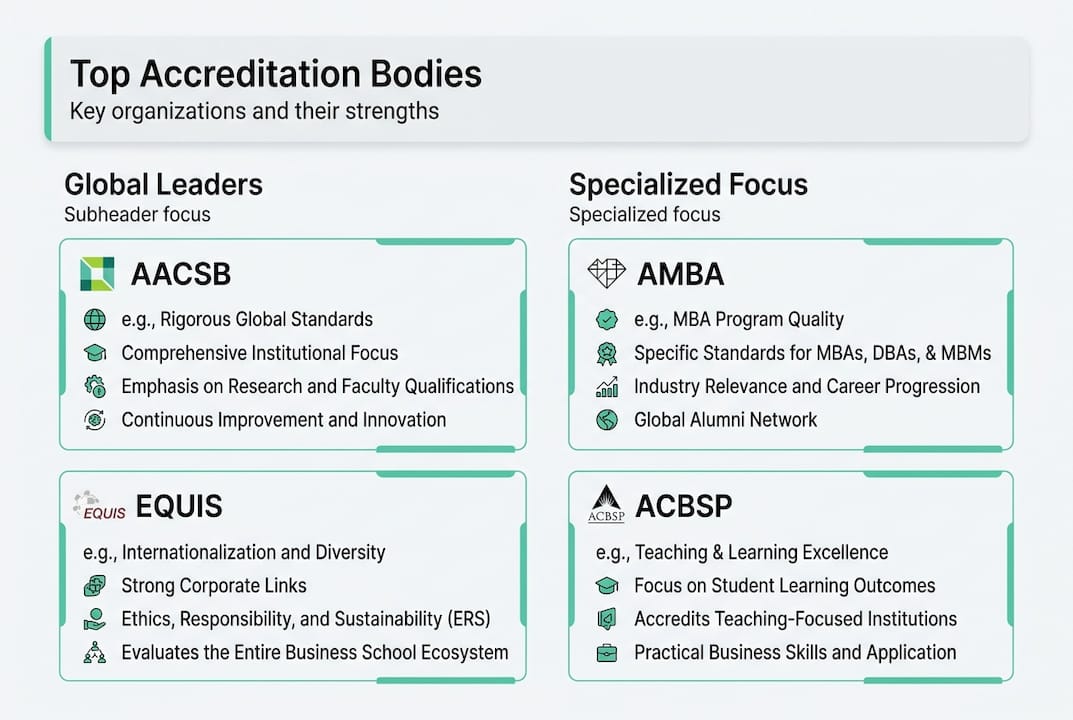
AACSB International (Association to Advance Collegiate Schools of Business) represents the oldest and most prestigious accreditor, particularly influential in North America and Asia. Founded in 1916, AACSB emphasizes research excellence, faculty qualifications with doctoral degrees, and rigorous admission standards. Only about 6% of business schools worldwide hold AACSB accreditation, making it highly selective. The 2025 state of accreditation report confirms AACSB as the gold standard in the US and top schools worldwide.
EQUIS (European Quality Improvement System) operates under the European Foundation for Management Development and brings a European perspective emphasizing internationalization, corporate connections, and ethics. EQUIS evaluates the entire institution rather than individual programs, requiring strong links between research, teaching, and practice. Schools appreciate EQUIS for its holistic approach and emphasis on global diversity.
AMBA (Association of MBAs) focuses exclusively on MBA and postgraduate business programs. Founded in 1967, AMBA prioritizes professional development, career advancement outcomes, and the MBA student experience. Its narrower focus allows deeper evaluation of graduate business education quality.
Triple Crown accreditation refers to schools holding all three designations simultaneously. Fewer than 1% of business schools worldwide achieve this rare distinction, signaling exceptional quality across multiple evaluation frameworks. Triple Crown status demonstrates that a school excels whether judged by American research standards, European internationalization criteria, or MBA-specific professional development metrics.
| Accreditor | Primary focus | Geographic strength | Key differentiator |
|---|---|---|---|
| AACSB | Research, faculty credentials | North America, Asia | Most selective, oldest |
| EQUIS | Internationalization, ethics | Europe, emerging markets | Institutional-level review |
| AMBA | MBA outcomes, career impact | UK, Commonwealth nations | Program-specific for MBAs |
| ACBSP | Teaching excellence, smaller schools | US regional institutions | Accessible for teaching-focused schools |
ACBSP (Accreditation Council for Business Schools and Programs) offers another option, particularly for teaching-focused institutions and smaller schools. While less prestigious than the big three, ACBSP provides legitimate quality assurance for schools prioritizing undergraduate education and regional impact over research output.
Verifying accreditation status requires checking official sources. Visit each accrediting body’s website and search their directory of accredited institutions. School websites may display outdated accreditation information, so confirm directly with the accreditor. When exploring an international business degree, verify which accreditations the program holds and what they mean for global recognition.
Pro Tip: Different accreditations signal different strengths. AACSB suggests research rigor, AMBA indicates strong MBA career outcomes, and EQUIS points to international diversity and corporate partnerships.
Benefits and critiques of business school accreditation
Accreditation delivers tangible advantages for students, yet the system faces legitimate criticism. Understanding both perspectives helps you evaluate how much weight to place on accreditation when choosing programs.
Key benefits for students and professionals:
- Employer recognition: Accreditation signals to recruiters that your degree meets professional standards, particularly important for international job searches where employers may be unfamiliar with specific schools
- Credit transfer: Accredited programs facilitate easier transfer of credits between institutions, valuable if you relocate or pursue additional degrees
- Financial aid eligibility: Many scholarships, government loans, and employer tuition reimbursement programs require accredited enrollment
- Quality assurance: Periodic reviews ensure schools maintain standards rather than declining after initial establishment
- Network effects: Accredited schools typically belong to consortia enabling student exchanges, joint research, and expanded career services
The benefits of accreditation extend beyond the credential itself, creating ecosystem advantages that enhance your educational experience and post-graduation opportunities.

Legitimate criticisms and debates:
Accreditation drives improvement but also criticized as bureaucratic and compliance-heavy, sometimes prioritizing metrics over innovation. Critics argue the process can stifle experimentation with new teaching methods or curriculum designs that don’t fit established templates. The extensive documentation requirements consume administrative resources that could support students directly.
Metric fixation creates perverse incentives. Schools may optimize for measurable accreditation standards like faculty publication counts or starting salaries while neglecting harder-to-quantify outcomes like ethical leadership or social impact. The five to seven year review cycle can lag behind rapid industry changes, leaving standards outdated in fast-evolving fields like digital marketing or fintech.
Rankings influence program reputation more than accreditation for many prospective students, yet rankings themselves face criticism for methodology flaws and gameability. Schools spend enormous resources chasing ranking improvements through tactics like selective admission data reporting or strategic scholarship allocation to boost average test scores. This creates a paradox where both accreditation and rankings distort institutional priorities in different ways.
Some innovative programs struggle with accreditation requirements designed for traditional models. Competency-based education, intensive bootcamp formats, or practice-focused curricula may deliver excellent outcomes but fail to meet standards emphasizing research faculty or credit hour structures.
Pro Tip: Use accreditation as one quality signal among several. Combine accreditation status with graduate employment data, alumni testimonials, curriculum alignment with your goals, and cultural fit when making your final decision.
Applying accreditation knowledge when choosing a business program
Theory becomes valuable only when applied to real decisions. Here’s how to leverage accreditation knowledge during your program search and selection process.
Verification checklist:
- Check official accreditor websites: Search the AACSB, EQUIS, or AMBA directories directly rather than relying solely on school claims
- Confirm current status: Accreditation can be revoked or lapse, so verify the school holds current accreditation, not just historical recognition
- Identify what’s accredited: Some schools hold institutional accreditation but not business-specific accreditation, or only certain programs within the business school are accredited
- Review accreditation reports: Many accreditors publish evaluation reports highlighting strengths and areas for improvement, offering insider perspective on program quality
- Contact accrediting bodies: If you cannot find clear information, email or call the accreditor directly to confirm a school’s status
Your career goals should guide how much weight you place on specific accreditations. Research-focused careers in academia or consulting benefit most from AACSB programs emphasizing scholarly rigor. Corporate leadership tracks may value EQUIS schools with strong industry partnerships. MBA-specific career changers should prioritize AMBA accreditation or programs with demonstrated placement success in target industries.
Teaching quality matters as much as research prestige for many students. ACBSP-accredited schools often excel at undergraduate education and practical skill development despite lower research profiles. If you learn best through hands-on projects and close faculty mentorship rather than large lectures, teaching-focused accreditation may signal better fit than research-oriented credentials.
| Accreditation type | Best for | Global recognition | Key advantage |
|---|---|---|---|
| AACSB | Research careers, top-tier consulting, academia | Highest, especially US/Asia | Most selective, strongest faculty credentials |
| EQUIS | International careers, European markets | High in Europe and emerging markets | Institutional quality, internationalization |
| AMBA | MBA career changers, executive roles | Strong in UK and Commonwealth | MBA-specific outcomes focus |
| ACBSP | Undergraduate students, teaching-focused learning | Regional US recognition | Accessible, teaching excellence |
| Triple Crown | Competitive global careers, maximum prestige | Universal | Validated across all major frameworks |
Combine accreditation data with outcome metrics. Request placement rates, average salaries, and employer hiring lists from programs you’re considering. Strong outcomes from an ACBSP school may outweigh mediocre results from an AACSB program depending on your goals. Geographic location matters too since regional accreditation may carry more weight with local employers than international credentials.
Program fit extends beyond accreditation to culture, format, and support services. Online flexibility, cohort structure, international residencies, and specialization options all impact your experience. When applying for business degree programs, create a decision matrix weighting accreditation alongside these factors based on your priorities.
Pro Tip: Email the admissions office asking specifically which accreditations the program holds and when the most recent review occurred. Responsive, detailed answers signal transparency and confidence in their quality standards.
Explore accredited business programs with SeekStudy
Understanding accreditation empowers better decisions, but finding programs that combine recognized credentials with flexibility and career relevance requires careful research. SeekStudy offers multiple accredited business programs designed for global recognition and accelerated completion timelines. Whether you’re pursuing an executive MBA program to advance your leadership career or a bachelor in business management to build foundational expertise, accredited options provide the quality assurance employers value.
SeekStudy’s programs emphasize international study experiences and UK-recognized degrees, combining online flexibility with rigorous academic standards. Established in 2020 and regulated by Ofqual, the platform delivers fast-track degree options for working professionals who cannot pause careers for traditional full-time study. Accreditation ensures your investment translates to credentials that open doors globally, whether you’re changing industries, seeking promotions, or building entrepreneurial ventures. Explore how study management online benefits align with your goals while maintaining the quality standards that matter most to employers and professional networks.
Frequently asked questions about business school accreditation
What does accreditation guarantee about a business school?
Accreditation confirms a school meets minimum quality standards across curriculum, faculty, resources, and outcomes as evaluated by peer reviewers. It does not guarantee perfect education or career success, but signals the program maintains professional standards and undergoes regular quality reviews. Think of it as a quality floor rather than a ceiling.
How often is accreditation reviewed or renewed?
Most business school accreditations require comprehensive reviews every five to seven years, with interim reports or visits in between. Schools must demonstrate continuous improvement and ongoing compliance with evolving standards. Accreditation can be revoked if quality declines or standards are not met during renewal evaluations.
Can unaccredited schools still offer valuable education?
Yes, particularly for specialized skills training or emerging fields where traditional accreditation frameworks lag innovation. However, unaccredited programs carry higher risk since no independent body verifies quality claims. Employers may question credentials, credit transfer becomes difficult, and financial aid options shrink. Thorough due diligence on outcomes and reputation becomes critical with unaccredited programs.
Which accreditation is most respected worldwide?
AACSB holds the strongest global reputation, particularly in North America and Asia, due to its selectivity and research emphasis. EQUIS carries significant weight in Europe and emerging markets. Triple Crown accreditation (AACSB, EQUIS, and AMBA together) represents the highest prestige universally. The importance of accreditation varies by region and career path, so consider where you plan to work when evaluating which credentials matter most.
How to verify a business school’s accreditation status?
Visit the official website of the accrediting body (AACSB.edu, EFMD.org for EQUIS, or associationofmbas.com for AMBA) and search their directory of accredited institutions. Confirm the specific programs you’re considering hold current accreditation, not just the broader institution. Contact the accreditor directly if information seems unclear or outdated. Never rely solely on claims made on school websites or marketing materials.