

Most prospective students assume that one ranking list tells the whole story. It doesn’t. The Financial Times, QS, Bloomberg Businessweek, and U.S. News each measure different things, weight criteria differently, and serve different audiences. If you’re an international student evaluating fast-track or study abroad programs, picking the wrong ranking as your compass can send you in the wrong direction entirely. This guide breaks down how business school rankings work, what drives them, where they fall short, and how to use them as a smart starting point rather than a final verdict.
Table of Contents
- What is a business school ranking?
- How do rankings work? Key criteria and weighting explained
- What are the official requirements for business school ranking eligibility?
- Ranking dimensions that matter most for international and fast-track students
- Limitations and controversies: What rankings often miss
- How to use rankings wisely: A decision-making roadmap
- Find the right business degree and program with SeekStudy
- Frequently asked questions
Key Takeaways
| Point | Details |
|---|---|
| Understand ranking criteria | Map out the weighted categories to see what matters most for your study goals. |
| Check program eligibility | Only accredited and established programs are listed in reputable rankings. |
| Prioritize relevant dimensions | International students should focus on diversity, mobility, and employability indicators. |
| Beware of ranking limitations | Rankings often overlook teaching quality and personal fit, so always supplement with other research. |
| Use rankings as a starting point | Combine rankings with personal criteria and expert resources to make your best choice. |
What is a business school ranking?
A business school ranking is a comparative list produced by a media organization or evaluation agency that scores and orders business schools based on a set of weighted criteria. These lists exist to help applicants, employers, and institutions compare quality, reputation, and outcomes across hundreds of programs worldwide.
The major players you’ll encounter include:
- Financial Times (FT): Focuses heavily on alumni salary growth and career progression
- QS World University Rankings: Emphasizes employer reputation and academic research
- Bloomberg Businessweek: Prioritizes student satisfaction and post-graduation compensation
- U.S. News & World Report: Widely used for domestic U.S. programs
- Poets&Quants: Aggregates multiple rankings into a composite score
Rankings are annual lists published by these organizations to help prospective students compare quality and outcomes across institutions. Each one uses a different formula, which is exactly why two schools can swap positions dramatically depending on which list you’re reading.
For international students, business school accreditation is a foundational concept to understand before diving into rankings. Accreditation signals that a school meets recognized quality standards, and it’s often a prerequisite for ranking eligibility. The Bloomberg methodology offers a transparent breakdown of how one major ranker builds its list.
“Rankings are tools, not verdicts. The best students use them to open doors, not close their minds.”
How do rankings work? Key criteria and weighting explained
Rankings aren’t magic. They’re built through a structured process involving data collection, surveys, statistical weighting, and normalization. Common methodologies involve 15 to 21 criteria grouped into categories like alumni outcomes, school data, research, employability, and value for money.
Here’s how the process typically unfolds:
- Data collection: Schools submit institutional data (class size, faculty credentials, program length)
- Alumni surveys: Graduates report salary, job placement, and career satisfaction
- Employer surveys: Recruiters rate schools by reputation and graduate quality
- Weighting: Each criterion is assigned a percentage weight
- Normalization: Raw scores are adjusted so schools of different sizes can be compared fairly
- Final ranking: Weighted scores are totaled and schools are ordered
Here’s a simplified comparison of how three major rankings weight key categories:
| Criterion | FT MBA | QS MBA | Bloomberg MBA |
|---|---|---|---|
| Alumni salary/outcomes | ~40% | ~20% | ~35% |
| Employer reputation | ~5% | ~30% | ~15% |
| International diversity | ~25% | ~15% | ~10% |
| Research/faculty | ~10% | ~20% | ~5% |
| Student satisfaction | ~5% | ~5% | ~25% |
Alumni salary data carries enormous weight in most rankings. A school with graduates earning significantly higher salaries will score well even if its teaching quality or student experience is average. For students pursuing global MBA recognition, this matters because salary outcomes in one country may not translate to your target job market.

If you’re comparing fast-track MBA programs, pay close attention to how each ranking handles program length. Some rankings exclude programs shorter than two years from their main lists entirely. The QS methodology explains this in detail.
What are the official requirements for business school ranking eligibility?
Not every business school or program qualifies for a major ranking. There are specific entry requirements that schools must meet before they can even be considered.
Entry requirements include accreditation, minimum alumni survey response rates, program age, and full-time cohort size for certain rankings. Here’s what that looks like in practice:
- Accreditation: Schools typically need AACSB, EQUIS, or AMBA accreditation to qualify for FT or QS rankings
- Program age: Many rankings require a program to have been running for at least four years
- Alumni response rates: A minimum percentage of graduates must complete surveys for data to be valid
- Cohort size: Some rankings require a minimum number of full-time students per intake
- Online program rules: The FT Online MBA ranking requires programs to have been operating for at least four years before eligibility
For students considering fast-track MBA benefits, this is critical. A newer accelerated program may not yet appear in major rankings, but that doesn’t mean it lacks quality. Check Bloomberg eligibility criteria to see exactly what each ranker requires.
Understanding accreditation is your first filter. A school without recognized accreditation won’t appear in credible rankings, and its degree may not be recognized by employers in your target country.
Pro Tip: Before comparing any two programs by ranking position, verify that both programs meet the same eligibility criteria. A ranked program and an unranked one may be more similar in quality than the list suggests.
Ranking dimensions that matter most for international and fast-track students
Not all ranking criteria are equally relevant to your situation. If you’re an international student aiming for a fast-track degree and a global career, some dimensions matter far more than others.
Rankings emphasize international diversity, global mobility, and employability for international students, and fast-track programs may rank separately from traditional two-year MBAs. Here’s what to focus on:
- International student and faculty ratio: Signals how globally oriented the campus culture is
- Employer reputation score: Reflects how recruiters in your target industry view graduates
- Global mobility index: Measures how many graduates work outside their home country after graduation
- Language and visa support: Not always ranked, but critical for study abroad planning
| Dimension | FT weight | QS weight | Bloomberg weight |
|---|---|---|---|
| International diversity | ~25% | ~15% | ~10% |
| Employability/employer rep | ~5% | ~30% | ~15% |
| Global mobility | ~15% | ~10% | ~5% |
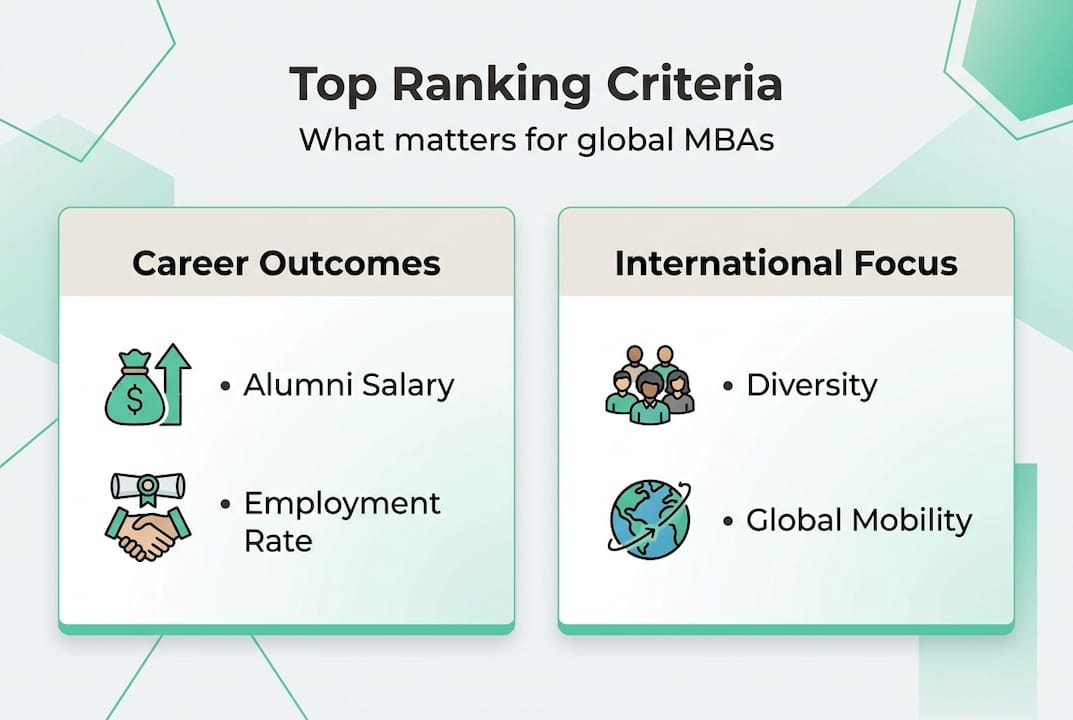
If you’re exploring fast-track MBA programs or weighing one-year MBA benefits, QS is often the most useful ranking because of its strong employer reputation weighting. For a broader view of program formats, the guide to online MBAs offers helpful context on how different delivery models compare. The FT international diversity weights show exactly how much global composition influences final scores.
Pro Tip: Map each ranking’s top criteria to your personal goals. If you want to work in Asia after graduation, prioritize rankings that weight global mobility and employer reputation over those that focus on domestic salary growth.
Limitations and controversies: What rankings often miss
Rankings have real blind spots. Knowing them protects you from making a $50,000 decision based on incomplete data.
Rankings distort incentives, use self-reported data, ignore long-term ROI adjusted for cost and location, and tend to favor elite schools with large alumni networks. Here’s what often gets missed:
- Teaching quality: No major ranking directly measures classroom experience or faculty engagement
- Long-term career ROI: Salary three years out matters more than salary at graduation, but few rankings track it
- Cultural fit: Whether a school’s environment suits your learning style is invisible in any ranking
- Self-reported data risks: Schools submit their own numbers, and verification is inconsistent
- Shifting methodologies: Criteria change year to year, making multi-year comparisons unreliable
“The smartest applicants treat rankings like a map, not a GPS. They show you the terrain, but you still have to choose your own route.”
For deeper business education insights, it’s worth reading beyond the headline numbers. The importance of accreditation is a more stable quality signal than annual ranking shifts. The full ranking controversies debate is worth reading before you finalize any shortlist.
How to use rankings wisely: A decision-making roadmap
Rankings are iterative starting points, not final answers. Use them to open your search, then cross-check employment reports and alumni networks for accredited programs before committing.
Here’s a practical five-step roadmap:
- Shortlist by rankings: Use FT, QS, or Bloomberg to identify 8 to 12 schools that appear consistently across multiple lists
- Verify accreditation: Confirm each school holds AACSB, EQUIS, or AMBA recognition by checking accreditation directly
- Review program specifics: Compare curriculum, duration, delivery format, and international study options
- Contact current students or alumni: Ask about real career outcomes, not just published salary averages
- Factor in study abroad logistics: Visa requirements, language support, and location all affect your actual experience
For students considering executive MBA benefits, the same roadmap applies with added weight on employer reputation and network quality. Additional business school selection advice can help you refine your criteria further.
Pro Tip: For fast-track programs, search specifically for separate online or accelerated MBA rankings rather than assuming your program appears in the main FT or QS lists. Many strong programs have their own dedicated ranking categories.
Find the right business degree and program with SeekStudy
Now that you understand how rankings work and where they fall short, the next step is finding a program that actually fits your goals, timeline, and career ambitions.

SeekStudy offers accredited fast-track business degrees designed for international students who want recognized qualifications without spending four years in a classroom. From the guide to online MBAs to a full breakdown of fast-track business degrees, our resources help you compare programs with the same critical eye this article has given you. If you’re ready to explore a specific path, the Bachelor in Business Management is a strong starting point for students who want a UK-recognized degree on an accelerated timeline. Connect with our advisors to get personalized guidance based on your background, goals, and target career market.
Frequently asked questions
Which business school ranking is best for international students?
FT and QS rankings prioritize international diversity, employability, and global mobility, making them the most relevant starting points for study abroad applicants.
How important is accreditation in business school rankings?
Accreditation is essential. Schools must hold recognized standards like AACSB or EQUIS to qualify for most major global rankings in the first place.
Are fast-track or online MBA programs included in main rankings?
Many fast-track and online MBAs have separate ranking categories or specific eligibility rules, so always check the methodology of each ranking before comparing these options.
Why do schools sometimes move a lot year to year in rankings?
Ranking positions shift annually due to changes in methodology, updated student outcome data, or shifts in how criteria are weighted from one year to the next.
What’s the biggest pitfall of relying only on rankings?
Rankings ignore long-term ROI and personal fit factors like teaching culture and career support, so treating them as your only decision tool can lead you to the wrong program.