

TL;DR:
- Successful university applications require a structured plan, understanding requirements, and timely preparation.
- Start preparing 12 to 18 months in advance, focusing on research, testing, activities, and deadlines.
- Building an authentic profile with depth, storytelling, and clear goals stands out more than superficial involvement.
University admissions can feel like navigating a maze with no map. Deadlines shift, requirements differ by country, and the pressure to stand out is real. But here is the truth: most students who struggle with applications do so not because they lack ability, but because they lack a structured plan. Whether you are applying to a traditional four-year program, exploring a fast-track degree, or considering studying abroad, the same core principles apply. This guide walks you through exactly what universities look for, how to build your timeline, sharpen your profile, and handle special situations so you can move forward with confidence.
Table of Contents
- Understand the basics: What universities look for and global requirements
- Map your timeline: When and how to start your university preparation
- Sharpen your profile: Academics, activities, and essays that stand out
- Explore fast-track and international options: Accelerated paths and country differences
- Special cases: Gaps, mature applicants, and AI in your application
- A fresh perspective: How to prepare smart, what most guides don’t tell you
- Plan your next steps with expert support
- Frequently asked questions
Key Takeaways
| Point | Details |
|---|---|
| Start early | Give yourself at least 12 months to handle tests, references, and essays with low stress. |
| Know your requirements | Each country and program has different admissions rules—check tests, timelines, and documents in advance. |
| Focus for impact | Depth in a few activities and authentic essays make your application more memorable. |
| Explore all options | Fast-track and international routes can accelerate your degree and open global careers. |
| Handle special cases wisely | Gap years or AI tools are acceptable when used honestly and explained in your story. |
Understand the basics: What universities look for and global requirements
Before you write a single essay or register for a test, you need to know what universities actually evaluate. The global application process may look different depending on where you apply, but the core criteria are surprisingly consistent across most countries.
According to a complete college application guide, university preparation involves building a strong academic record, standardized testing, extracurriculars, essays or personal statements, recommendations, and using the right application platform for your target country. In the US, that platform is Common App. In the UK, it is UCAS. Canada uses OUAC, while many other countries require direct applications to individual institutions.
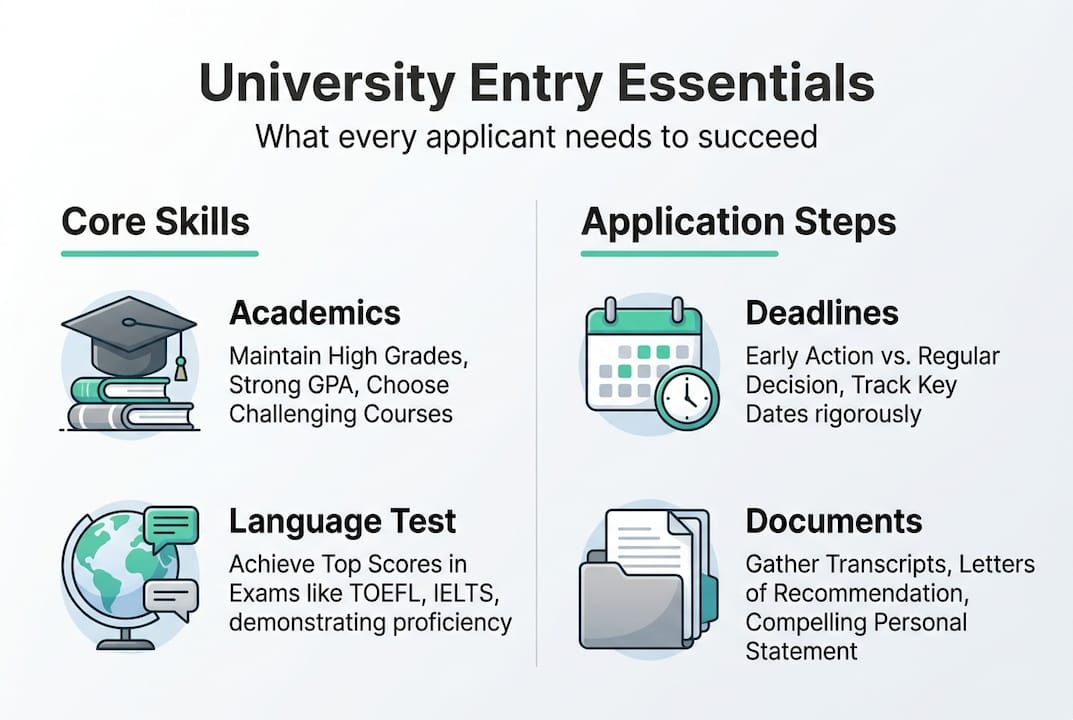
For international students, the checklist gets longer. International applicants must research country-specific platforms, submit English proficiency test scores, arrange credential evaluation, and plan for visa applications. Skipping any of these steps can delay or derail an otherwise strong application.
Here is a quick overview of what major destinations typically require:
| Destination | Primary platform | English test required | Credential evaluation |
|---|---|---|---|
| USA | Common App | Yes (TOEFL/IELTS) | Sometimes |
| UK | UCAS | Yes (IELTS/PTE) | Yes |
| Canada | OUAC / direct | Yes | Yes |
| Australia | Direct | Yes | Yes |
| Singapore/HK | Direct | Yes | Yes |
For students targeting fast-track degree requirements, the bar is higher. These programs often require a stronger GPA, additional departmental assessments, and sometimes a specific essay or interview. Knowing this early lets you prepare strategically rather than scrambling at the last minute.
Key requirements to track by destination:
- Academic transcripts and predicted grades
- Standardized test scores (SAT, ACT, A-levels, or equivalents)
- English proficiency scores for non-native speakers
- Personal statements or essays
- Letters of recommendation from academic sources
- Portfolio or departmental tests for specialized programs
Pro Tip: Build a spreadsheet listing every target university, its platform, deadlines, and required documents. Update it monthly. This single habit saves hours of panic later.
If you are specifically interested in preparing for UK universities, the process has its own rhythm and nuances that are worth understanding in detail before you start.
Map your timeline: When and how to start your university preparation
Once you understand requirements, it is time to organize your journey with a timeline. The biggest mistake students make is underestimating how long each step takes.
International students should start 12 to 18 months ahead of their target intake. That means if you want to start university in September 2027, your preparation should begin no later than early 2026. US Common App opens August 1. The UCAS deadline for most UK courses falls on January 14, 2026. Canada’s fall intake typically accepts applications between January and April, and Australia requires early preparation well before semester start.
Here is how major regions compare:
| Region | Application opens | Key deadline | Notes |
|---|---|---|---|
| USA | August 1 | January 1 (EA/ED earlier) | Rolling or fixed |
| UK | September | January 14, 2026 | UCAS centralized |
| Canada | October | January to April | Rolling by school |
| Australia | July | October to November | Direct to university |
A US-focused junior year roadmap recommends starting essays and summer activities in junior year, roughly 18 months before application deadlines. The same logic applies globally: the earlier you start, the more choices you have.
Here is a practical numbered preparation schedule you can adapt:
- Research phase (18 months out): Identify 8 to 12 target universities, note requirements, and shortlist by fit.
- Test preparation (15 to 12 months out): Register for and sit standardized and English proficiency tests.
- Activity and experience building (12 months out): Deepen involvement in 2 to 3 meaningful extracurriculars.
- Essay drafting (9 to 6 months out): Brainstorm topics, write drafts, revise with a counselor.
- Application submission (3 to 1 month out): Submit forms, pay fees, and confirm receipt.
- Post-submission (1 month to decision): Prepare for interviews if required and track decisions.
Pro Tip: Work backward from each deadline to set your personal milestones. If your UCAS deadline is January 14, your personal statement should be finalized by November 30 at the latest.
For students pursuing online or flexible routes, our UK online application guide and fast-track flexibility tips break down the specific steps for those pathways. Check global application timelines for country-specific nuances beyond the major destinations.
Sharpen your profile: Academics, activities, and essays that stand out
A well-timed plan alone is not enough. Here is how to build a profile that universities notice.

The approach differs significantly by destination. US admissions are holistic, meaning essays, activities, and demonstrated depth can offset a slightly lower GPA. UK admissions are grades-focused, so predicted results carry enormous weight. For fast-track programs, GPA benchmarks and department-specific essays or tests are the deciding factors, and authenticity is what separates similar candidates.
A balanced university list with reach, target, and safety schools gives you options without overextending your effort. Focusing on 2 to 3 quality activities matters far more than joining 10 clubs just to pad a resume.
What a competitive profile looks like:
- Consistent upward academic trend or strong predicted grades
- Two to three extracurriculars with real leadership or measurable impact
- An essay that tells a specific, personal story rather than a generic success narrative
- Recommendations from teachers or professors who know your academic work closely
- Test scores that meet or exceed program benchmarks
“Admissions readers spend an average of 8 minutes per application. Make every element count by being specific, not impressive.”
For your essay, avoid the temptation to use AI to write it for you. Use it to brainstorm or check grammar, but the voice must be yours. Admissions officers read thousands of essays and can spot generic, polished-but-hollow writing immediately.
Pro Tip: Work with an advisor or essay workshop for topic brainstorming only. The writing itself should always come from you. Your specific experience is the one thing no AI can replicate.
If you are working toward a fast-track bachelor checklist or want to understand the UK degree benefits before committing, those resources will help you align your profile with specific program expectations. You can also explore broader college application strategies for additional perspective.
Explore fast-track and international options: Accelerated paths and country differences
For those aiming for a faster career start or studying abroad, let’s break down fast-track and global application options.
Fast-track degrees, including 4+1 and five-year combined BA/MA programs, save time and money for high achievers. They require a higher GPA, special essays or departmental tests, and continuous enrollment without breaks. Missing a semester can disqualify you from the accelerated pathway entirely.
Here is how traditional and fast-track programs compare:
| Factor | Traditional degree | Fast-track degree |
|---|---|---|
| Duration | 3 to 4 years | 1 to 2 years (bachelor) |
| GPA requirement | Standard entry | Higher benchmark |
| Application extras | Standard | Departmental essay/test |
| Flexibility | More breaks allowed | Continuous enrollment |
| Cost | Higher overall | Lower due to shorter duration |
For international students, the added complexity involves global systems such as centralized EU tools, Canada’s rolling application model, and varying English proficiency and credential evaluation requirements by country. Some credential evaluations take 8 to 12 weeks, which means waiting until the last minute is not an option.
Key steps for international fast-track applicants:
- Confirm your home country’s credential is recognized by the target institution
- Book English proficiency tests early since popular slots fill quickly
- Start visa applications as soon as you receive a conditional offer
- Check whether your target program uses centralized or direct application systems
Pro Tip: Start credential and language requirements at least 12 months out. Processing delays are common and can push your application to the next intake cycle.
For a broader look at your options, explore international study options and review international university application tips for practical country-by-country guidance.
Special cases: Gaps, mature applicants, and AI in your application
Not all journeys are traditional. Here is how to tackle unique application situations.
If you took a gap year, it is not a red flag. Admissions teams understand life happens. What they want to see is a gap year narrative that explains how the time contributed to your growth, whether through work, travel, volunteering, or personal development. Vague explanations raise questions. Specific ones build credibility.
Mature students, typically those applying after age 21 outside of the standard school-to-university pipeline, should use academic references wherever possible. If you have been out of education for several years, a reference from a recent course or professional training program carries more weight than one from a former employer. UCAS guidance for mature applicants confirms that academic references are preferred and that gap years are acceptable with a strong supporting narrative.
Common special case scenarios and how to handle them:
- Gap year: Write a clear, specific narrative about what you did and what you learned
- Mature applicant: Source academic references from recent coursework or training
- Conditional offer: Complete a language or foundation program to meet the missing requirement
- AI use in essays: Use it for grammar checks or brainstorming only, never for full essay generation
“In 2026, most universities explicitly prohibit AI-generated essays. Submitting one risks disqualification, not just a lower score.”
Conditional offers are more common than students realize. Many universities will admit you on the condition that you complete a foundation course or meet a language requirement. This is not a rejection. It is a structured pathway to entry.
Pro Tip: Always check the official admissions policy for your specific situation. Document every alternative route you take, including certificates, course completions, and test scores, so nothing falls through the cracks.
If a foundation course or alternative entry route fits your situation, explore alternative entry degrees to see what structured pathways are available.
A fresh perspective: How to prepare smart, what most guides don’t tell you
Most preparation guides focus on checklists. This one does too, but here is what the checklists miss.
Admissions officers are not looking for perfect students. They are looking for interesting ones. A student who started a small community project and failed, learned from it, and tried again tells a more compelling story than one with a flawless GPA and a generic list of clubs. Authenticity and resilience are not soft concepts. They are what differentiate candidates in competitive pools.
Depth beats breadth every time. Two activities where you made a measurable difference outweigh ten where you simply showed up. The same logic applies to your academic focus. A clear sense of direction, even if it evolved over time, signals maturity and purpose.
Smart applicants also treat setbacks as material. A gap year, a failed exam, a school transfer. These are not weaknesses to hide. They are stories waiting to be told well. Students who explore real fast-track preparation stories often find that non-linear paths lead to the most compelling applications.
Start early, adapt often, and resist the urge to follow a rigid plan that was designed for someone else’s goals.
Plan your next steps with expert support
You now have a clear picture of what university preparation involves, from requirements and timelines to profile building and special cases. The next step is making it personal.
At Seekstudy, we specialize in fast-track degree programs in Management and Accounting, with accredited options across the UK, Singapore, Hong Kong, and Australia. Whether you are ready to explore fast-track degrees or need a step-by-step breakdown of the process, our UK university entry guide gives you the targeted, up-to-date information you need. Our programs are Ofqual-regulated and designed for ambitious students who want recognized credentials without spending four years in a traditional setting. Take the next step with resources built specifically for your goals.
Frequently asked questions
When should I start preparing for university entry?
International students should begin preparation 12 to 18 months before their target intake to allow enough time for academics, testing, and application submissions. Starting early also gives you room to retake tests or strengthen weak areas of your profile.
What are the advantages of fast-track degree programs?
Fast-track degrees save time and money for high achievers and allow you to earn a master’s qualification sooner if you meet the higher GPA and continuous enrollment criteria. They are especially valuable for students with a clear career direction who want to enter the workforce faster.
How do I stand out in my university application?
Depth in 2 to 3 activities is more impressive than a long list of surface-level involvement, and authentic essays paired with strong academic references make the biggest difference. Focus on telling a specific, honest story rather than trying to appear perfect.
Can I use AI for my university application essay?
You may use AI for grammar checks or brainstorming, but AI-written essays are prohibited under 2026 guidelines and risk disqualification if detected. Your essay must reflect your own voice and experience.
What if I take a gap year?
A gap year is accepted by most universities as long as you provide a strong, specific narrative explaining how the time contributed to your academic or personal development. Vague explanations tend to raise more questions than they answer.