

Balancing a demanding career across continents can make the idea of a traditional classroom-based MBA feel out of reach. For international professionals, the choice between an online and on-campus MBA is not about academic quality—it is about how each format fits into your busy life. By understanding the fundamental difference in delivery and flexibility between accredited online and on-campus MBAs, you can decide which path aligns with your goals and daily commitments.
Table of Contents
- What Sets Online and On-Campus MBAs Apart
- Learning Formats, Flexibility, and Lifestyle
- Accreditation, Curriculum, and Admission Standards
- Costs, Duration, and Financial Considerations
- Career Outcomes, Recognition, and ROI
Key Takeaways
| Point | Details |
|---|---|
| Delivery Formats Differ | On-campus programs offer fixed schedules and in-person networking, while online programs provide flexible timing and a global peer network. |
| Financial Considerations | Online MBAs generally cost less and allow students to maintain their income, while on-campus options may involve relocation and opportunity costs. |
| Learning Experience Variances | On-campus students benefit from immersive, spontaneous learning, while online students require self-discipline and intentional engagement. |
| Employer Recognition Has Shifted | Online MBAs from accredited institutions are increasingly accepted by employers, emphasizing skills and credentials over format. |
What Sets Online and On-Campus MBAs Apart
The fundamental difference lies in how you experience your MBA, not necessarily in academic rigor. Both formats deliver legitimate, accredited degrees, but the delivery methods shape your entire journey differently.
Delivery Format and Structure
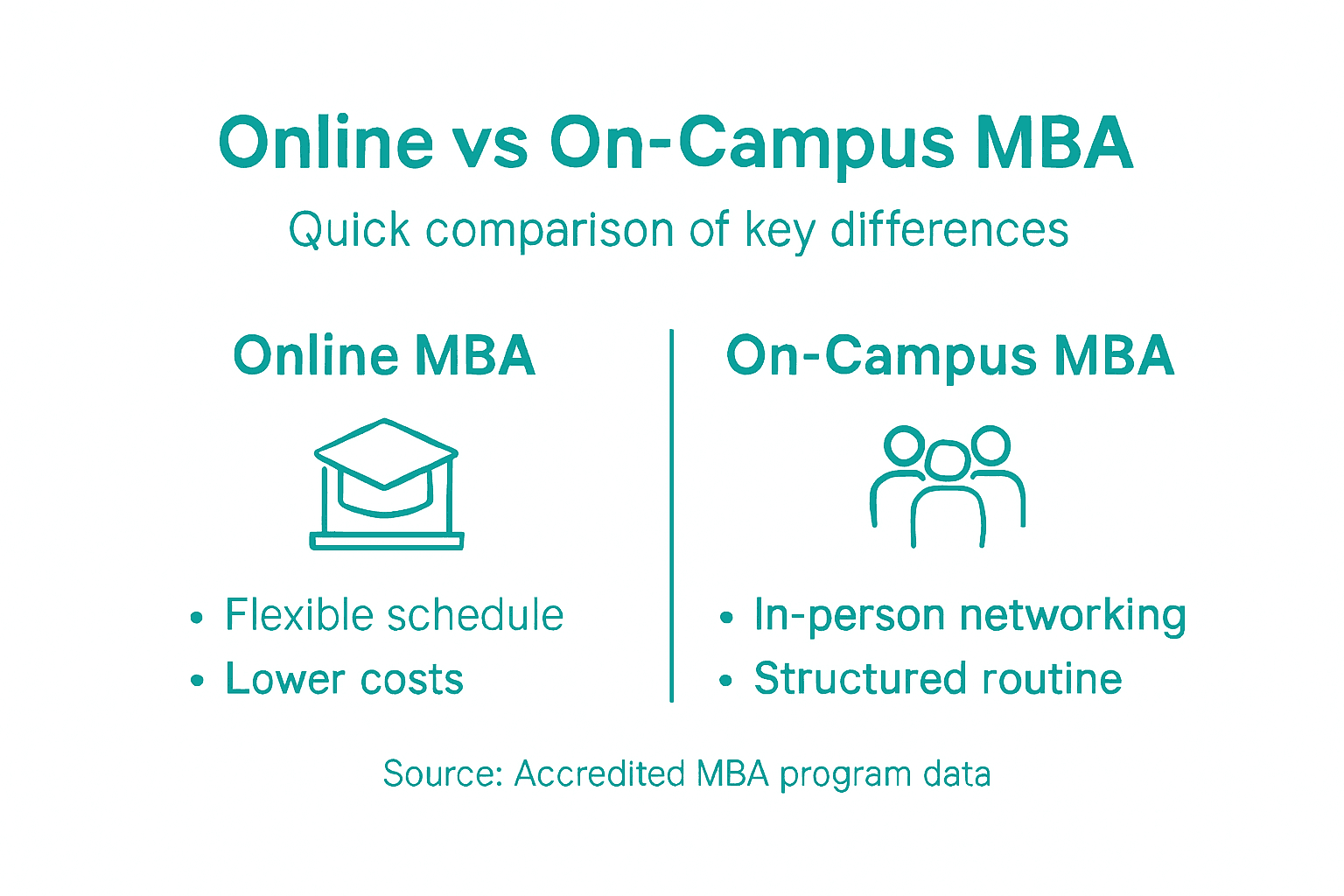
On-campus MBAs require you to be physically present for classes, seminars, and group projects. You attend lectures at scheduled times, participate in real-time discussions, and collaborate with classmates face-to-face. Online MBAs, by contrast, give you recorded lectures, asynchronous forums, and virtual sessions you can access when your schedule permits.
This distinction affects more than just convenience. Your learning rhythm changes entirely. On-campus students move through the program together, creating cohesive peer groups. Online learners juggle their coursework around existing commitments, progressing at variable speeds.
Time Commitment and Flexibility
On-campus MBAs typically demand full-time or significant part-time engagement. Most programs require 2-3 years of structured attendance. If you’re working internationally and managing multiple responsibilities, this presents real logistical challenges. You must coordinate relocation, timing off work, or negotiate flexible employment arrangements.
Online MBAs, particularly fast-track programs like the one-year options, offer genuine flexibility for global working professionals. You maintain your job, your location, and your income while completing coursework. Classes happen in the evenings or weekends. Deadlines adjust to accommodate time zones and work schedules.
- On-campus: Fixed schedules, intensive classroom time, potential career pause
- Online: Self-paced completion, flexible deadlines, work and study simultaneously
The choice between formats often comes down to whether you can pause your career or need to keep earning while advancing your credentials.
Networking and Relationships
On-campus programs create tight-knit networks through constant interaction. You build relationships during classes, coffee breaks, group projects, and social events. These bonds often last throughout your career. Professors know you personally. Classmates become colleagues and lifelong connections.
Online programs offer different networking opportunities. You connect with peers globally through discussion forums and virtual group work. Your network spans continents rather than concentrating locally. Flexible online learning structures enable professionals to maintain existing industry connections while studying, often creating more professionally diverse peer groups.
Neither approach produces “better” relationships. They’re simply different. On-campus networks tend toward local depth. Online networks tend toward global breadth.
Access to Career Services
On-campus MBAs offer immediate career support. Campus recruiting happens regularly. Career coaches meet with you in person. Alumni networks operate within concentrated geographic areas. Interview preparation sessions happen face-to-face.
Online programs increasingly offer robust career services too. Many provide one-on-one coaching, virtual mock interviews, and job placement assistance. However, on-campus recruiting activities may occur less frequently or require travel.
For international working professionals already embedded in career paths, this matters less. You likely aren’t interviewing for entry-level positions. Career services become less critical when you’re gaining promotions within your current organization.
Learning Environment and Engagement
On-campus creates immersive learning experiences. Classroom energy, spontaneous discussions, and immediate peer feedback shape your education. Distractions include commuting and campus logistics.

Online requires self-discipline but removes environmental distractions. You study where you work best, surrounded by your own resources. The tradeoff: less spontaneous interaction, more intentional participation.
What online and on-campus programs differ in is primarily environment and format, not educational quality for accredited providers.
Pro tip: Test your learning preference before committing. Audit free online courses or attend campus open days. Your actual experience matters more than theoretical advantages.
Here is an at-a-glance comparison of the online and on-campus MBA experience:
| Aspect | Online MBA | On-Campus MBA |
|---|---|---|
| Daily Schedule | Adaptable to personal routine | Fixed class hours and locations |
| Peer Interaction | Global, primarily virtual | Local, face-to-face collaboration |
| Program Length | Often 12-18 months | Typically 2-3 years |
| Career Impact | Maintain employment throughout | Likely pause or reduced work hours |
| Learning Rhythm | Self-paced or accelerated | Cohort-based, structured milestones |
| Geographical Flexibility | Study from anywhere | Residence near campus required |
Learning Formats, Flexibility, and Lifestyle
Your daily life looks completely different depending on which format you choose. Online and on-campus MBAs demand different rhythms, routines, and lifestyle adjustments.
Asynchronous vs. Synchronous Learning
Online MBAs operate primarily asynchronously. You watch recorded lectures whenever you want. You post in discussion forums on your schedule. Group projects happen across time zones using collaboration tools. This approach works if you’re scattered across multiple continents or working irregular hours.
On-campus programs follow synchronous structures. Everyone attends class at the same time. Discussions happen live. Collaboration occurs face-to-face. This creates accountability through shared schedules and immediate feedback.
Asynchronous online coursework fits around your existing work and personal obligations without requiring you to pause your career progression.
Work-Life-Study Balance
If you’re working full-time internationally, on-campus programs present real logistical friction. You’re juggling a career, potentially family responsibilities, and now adding fixed classroom hours to your week. Many professionals take leaves of absence or reduce work hours, impacting income and career momentum.
Online formats eliminate this conflict. You keep your job, your salary, and your professional trajectory intact. Study happens in the margins. Evening study sessions, weekend coursework, and flexible deadlines accommodate your existing commitments.
The tradeoff is intensity. On-campus students dive deep for a concentrated period. Online learners progress more gradually while managing multiple demands.
- On-campus: Career pause likely, intensive focus, temporary lifestyle disruption
- Online: Career continuity, distributed effort, sustainable integration
Routine and Structure
On-campus programs impose external structure. Your calendar fills with classes, library hours, and campus activities. This routine builds discipline and creates accountability. Some professionals thrive with this imposed structure.
Online learners must create their own structure. No campus schedules force engagement. You decide when to study, where to study, and how to stay accountable. This requires exceptional self-discipline and intrinsic motivation.
Your personality matters here. Self-starters excel online. People who need external accountability benefit from on-campus rigidity.
Geographic and Lifestyle Freedom
On-campus students become campus residents, at least part-time. You’re anchored to a specific location for 2-3 years. If you’re managing family obligations, aging parents, or specific career timing, this constraint matters.
Online students maintain geographic flexibility. You can study from your current city, move internationally, or travel while completing coursework. This matters enormously for global working professionals managing multiple responsibilities across continents.
Online programs support working professionals with family obligations or those balancing complex personal circumstances while advancing credentials.
Engagement Patterns
On-campus learning involves spontaneous interactions. You bump into classmates, overhear conversations, and build relationships naturally. Energy flows from group presence.
Online engagement requires intentional participation. You must actively join discussions, initiate group chats, and create connection. Relationships form through deliberate effort rather than proximity.
Pro tip: Block specific study times weekly and treat them like unmissable meetings with your boss. Consistency matters more than duration when balancing work and online studies.
Accreditation, Curriculum, and Admission Standards
Here’s what often surprises international working professionals: accreditation and curriculum quality don’t fundamentally differ between online and on-campus MBA programs. The delivery method changes. Academic rigor doesn’t.
Understanding Accreditation
Accreditation is your safeguard. It verifies that a program meets established quality standards, applies rigorous evaluation processes, and maintains consistent academic demands. Both online and on-campus MBAs undergo identical accreditation scrutiny from recognized bodies.
For UK-based programs, accreditation through organizations like Ofqual ensures legitimacy regardless of format. International working professionals should prioritize accredited programs because employers worldwide recognize and respect them. Non-accredited degrees, regardless of how prestigious the institution claims to be, carry limited weight in global job markets.
Accreditation standards apply equally to online and on-campus MBA programs, ensuring comparable academic quality and rigor.
Curriculum Quality and Content
Many institutions use identical curricula for both formats. The same core courses appear. The same electives are available. The same faculty often teach both cohorts. What differs is how you access the material, not what the material covers.
Your MBA covers similar ground regardless of format. You study finance, strategy, management, accounting, and organizational behavior. Real-world case studies, industry projects, and practical applications appear in both versions. The academic demands remain consistent.
Online programs are increasingly aligning curricula with industry needs. Employers recognize online MBA graduates because the coursework reflects current business challenges and skills requirements.
- Shared curriculum elements: Core business courses, electives, capstone projects
- Consistent rigor: Same faculty expertise, equivalent workload, identical learning outcomes
- Industry alignment: Both formats emphasize practical, job-ready skills
Accreditation bodies don’t award different grades based on delivery mode. Either a program meets quality standards or it doesn’t.
Admission Requirements
Admission standards typically remain consistent between formats. Most MBA programs require:
- Bachelor’s degree from accredited institution
- Work experience (usually 3-5 years minimum)
- GMAT or GRE scores
- Professional references
- Statement of purpose
Some programs tailor admission slightly. Online cohorts might accept slightly broader professional backgrounds. On-campus programs might emphasize campus engagement in selection criteria. These variations are marginal, not fundamental.
For international working professionals, this consistency matters. Your credentials carry equal weight whether you pursue online or on-campus options. Admission standards remain generally consistent across delivery modes, though some programs adjust requirements slightly based on format differences.
Employer Recognition
Online MBAs from accredited institutions face minimal recognition gaps today. Employers care about accreditation and your actual skills, not whether you attended campus. A degree from an accredited online program carries equivalent credibility to an on-campus degree from the same institution.
This shift matters for your career trajectory. Online MBA graduates advance into comparable roles, earn similar compensation, and experience equivalent career progression as on-campus graduates. The stigma around online degrees has effectively disappeared for accredited programs.
Pro tip: Before enrolling, verify accreditation through official regulatory bodies like Ofqual for UK programs. Check employer recognition by researching alumni employment outcomes on the institution’s website.
Costs, Duration, and Financial Considerations
Money and time are linked when choosing between online and on-campus MBAs. Your financial situation often determines which format actually works for you.
Program Costs and Tuition
The average MBA costs approximately $60,410, but this masks significant differences between formats. Online programs typically cost less because institutions skip campus overhead expenses. You don’t pay for campus facilities, housing support, or physical infrastructure maintenance.
On-campus programs charge higher tuition to cover campus operations. You’re also paying for access to facilities, libraries, and physical resources. For international working professionals, this cost difference matters substantially when managing multiple financial obligations.
Online MBA programs frequently cost less due to reduced tuition fees and absence of relocation expenses.
Hidden Expenses Beyond Tuition
Tuition tells only part of the story. Consider the full financial picture:
- On-campus relocation: Housing, transportation, meals, visa processing
- Opportunity costs: Reduced work hours or career pause impacts income
- Living expenses: Accommodation near campus runs $15,000-$25,000 annually
- Online expenses: Technology, internet reliability, home office setup
For on-campus programs, opportunity costs hit hardest. If you reduce work hours from full-time to part-time, that’s lost salary. If you pause your career, you miss promotions and raises during those 2-3 years.
Online programs eliminate relocation costs entirely. You maintain full employment income while studying. This advantage compounds significantly over your program duration.
This table summarizes financial factors that influence MBA program choice:
| Cost Factor | Online MBA Impact | On-Campus MBA Impact |
|---|---|---|
| Tuition Fees | Generally lower due to fewer facilities | Higher, includes campus resources |
| Living Expenses | Remain unchanged, no relocation | Additional housing, meals, relocation costs |
| Opportunity Cost | Maintain full salary during studies | Lost income from career break |
| Scholarships & Aid | Growing options for professionals | Traditional scholarships widely available |
| ROI Timeline | Faster due to shorter completion | Delayed, post-graduation salary boost |
Program Duration and Timeline
Online MBAs often compress into 12-18 months. Fast-track one-year programs exist at accredited institutions. You move quickly through coursework while maintaining employment.
On-campus programs typically require 2-3 years. Full-time formats compress completion but demand your complete focus. Part-time formats stretch longer while allowing continued work.
Online formats offer accelerated completion options, often within 12-18 months versus typical two-year on-campus programs.
The duration difference translates directly to financial impact. A year-long program keeps you earning salary faster. Earlier degree completion means earlier career advancement and salary increases.
Financial Aid and Scholarships
Both formats offer scholarships and financial aid. Application processes, eligibility criteria, and award amounts vary by institution. Online programs increasingly offer competitive scholarships as institutions recognize demand from working professionals.
International working professionals should investigate both merit-based scholarships and employer sponsorship. Many companies partially or fully fund MBA completion for high-potential employees. Some programs offer employer partnerships with specific financial advantages.
Calculate your true cost by including tuition, relocation, living expenses, and opportunity costs. The cheapest tuition doesn’t always mean the cheapest MBA.
Return on Investment
Your MBA generates returns through faster promotions, higher salaries, and career transitions. Online graduates entering immediate employment accelerate these returns. On-campus graduates delay returns by pausing careers for 2-3 years.
For most international working professionals, online MBAs deliver superior financial returns because you don’t sacrifice income during studies. The combination of lower costs and maintained employment income creates significant financial advantage.
Pro tip: Calculate total program cost including tuition, living expenses, and lost income. Compare this against expected salary increases post-graduation to understand true return on investment before committing.
Career Outcomes, Recognition, and ROI
The real question isn’t which MBA is “better.” It’s which one accelerates your specific career trajectory faster. Career outcomes depend on your situation, not the format.
Employer Recognition and Acceptance
Employer attitudes toward online MBAs have shifted dramatically. The stigma has largely evaporated for accredited programs. Hiring managers care about your credentials, skills, and experience—not whether you attended campus.
Employers increasingly accept online MBAs as comparable to on-campus degrees, though some still prefer in-person experience for specific roles.
The key distinction: accreditation matters more than format. A degree from an accredited online program carries legitimate weight globally. Non-accredited programs, regardless of format, remain problematic.
For international working professionals, this recognition means your career options don’t narrow because you chose online. You’re not choosing between “MBA or something better.” You’re choosing between two legitimate paths with identical credibility.
Salary Growth and Advancement
Online MBA graduates report meaningful salary increases post-graduation. Career advancement happens at comparable rates to on-campus graduates. The MBA credential itself, not the delivery method, drives salary improvements.
What differs is timing. Online graduates maintain salaries during studies. On-campus graduates often pause careers, creating temporary income loss. This timing advantage compounds over years.
Consider two scenarios: Online graduate completes program while earning $100,000 annually. On-campus graduate pauses work for two years, sacrificing $200,000 in salary. Both graduate with identical MBA credentials. The online graduate’s financial position proves significantly stronger.
Career Continuity and Networking
Online programs enable career continuity. You advance within your current organization while studying. You maintain professional relationships and industry connections. You build your MBA cohort from global peers in your industry.
On-campus programs create tight cohorts but interrupt careers. Your network concentrates among classmates. Industry connections pause during studies. Post-graduation, you restart career building from a temporary pause.
- Online advantages: Maintained employment, industry connections, global peer network
- On-campus advantages: Concentrated local network, intensive peer bonds, structured career support
Your most valuable network connection might be your current boss sponsoring your promotion—something only online formats preserve.
Placement Records and Career Services
On-campus programs emphasize placement services. Campus recruiting happens regularly. Career coaches work closely with students. Alumni networks operate within geographic proximity.
Online programs increasingly match this support through virtual coaching, job boards, and alumni networks. Placement outcomes converge as online programs mature. Many on-campus graduates and online graduates land comparable roles post-graduation.
The difference: on-campus programs hand you structured career support. Online programs require you to actively seek it. For self-directed professionals, this distinction matters less.
Return on Investment Reality
Online MBAs typically deliver superior ROI for working professionals. Lower costs, maintained salary, and faster completion compound financial advantage. You invest less money, sacrifice no income, and graduate faster.
On-campus programs offer ROI through networking depth and career services intensity. These benefits matter for career changers or entry-level professionals. For mid-career professionals, ROI favors online formats.
Online MBAs from quality institutions gain prestige with career recognition growing as employers value flexibility and graduate quality equally across formats.
Pro tip: Focus your decision on institutional accreditation and your specific career goals, not format prejudice. Research alumni outcomes from your target program to understand realistic career advancement and salary expectations.
Unlock Your Career Potential With Flexible, Accredited MBA Options
Are you navigating the challenge of advancing your career while balancing work, family, and international commitments? The decision between an online and on-campus MBA is critical to maintaining your career momentum without sacrificing flexibility or quality. At SeekStudy, we understand how important career continuity and recognized accreditation are for global professionals seeking fast-track degree programs. Our offerings, including a one-year online MBA and internationally recognized courses, are designed to minimize career disruption while maximizing your growth potential.
Explore our Coventry London Campus Archives for insight into programs blending global study experiences and visit our Essex Archives to find flexible learning solutions tailored for your lifestyle. Make the most informed choice today and advance your career without pause by visiting SeekStudy. Take the next step now and transform your professional future with a UK-recognized MBA that fits your life and ambitions.
Frequently Asked Questions
What are the main differences between online and on-campus MBA programs?
The primary differences lie in delivery format, time commitment, and networking opportunities. Online MBAs offer flexible, asynchronous learning with a global peer network, while on-campus MBAs require physical attendance and foster local relationships through face-to-face interaction.
How does the career impact differ between online and on-campus MBAs?
Online MBAs allow you to maintain your job and income while studying, which can lead to quicker career advancement. In contrast, on-campus MBAs often require a career pause, potentially delaying salary growth and professional progress during the study period.
Are career services and networking opportunities different for online and on-campus MBAs?
Yes, on-campus MBAs typically offer more immediate, hands-on career services and networking events, while online MBAs provide virtual support and a diverse global network, requiring more initiative from students to engage.
Do employers view online MBAs as equal to on-campus MBAs?
Yes, most employers now recognize online MBAs from accredited programs as equivalent to on-campus degrees. The focus is more on accreditation and the skills obtained rather than the mode of delivery.