

Trying to balance career growth with family and work commitments often feels impossible for ambitious professionals living outside the United States or United Kingdom. Fast-track degree programs offer a solution by compressing traditional four-year pathways into as little as two years without lowering academic standards. If you want to step into management or accounting roles quickly, discover how accelerated online study unlocks early career advancement and saves both time and money while you study from your home country.
Table of Contents
- Defining Fast-Track Degree Programs
- Types of Fast-Track Degrees Available
- Enrollment Requirements and Qualifications
- How Fast-Track Programs Operate Online
- Comparing Fast-Track and Traditional Degrees
Key Takeaways
| Point | Details |
|---|---|
| Fast-Track Program Overview | Fast-track degree programs condense traditional timelines, allowing students to earn degrees in two to three years while maintaining academic integrity. |
| Ideal for Working Professionals | These programs enable professionals aged 25-40 to achieve career advancement sooner, reducing the time spent in school and supporting faster entry into management roles. |
| Diverse Options Available | Options include single-degree, dual-degree, and combined programs, each designed to fit varying career goals and existing qualifications. |
| Critical Admission Requirements | Applicants typically need a strong GPA, relevant work experience, and may need to demonstrate English proficiency and readiness for intensive study. |
Defining Fast-Track Degree Programs
Fast-track degree programs compress the traditional timeline by packing more coursework into fewer years. Instead of spreading classes over four years, you complete your degree in two or three years without sacrificing academic quality.
These programs work by increasing your course load each term and reducing vacation breaks. You’re essentially studying at a higher intensity, but you emerge with the same credential as your peers who took the traditional route.
How Fast-Track Programs Work
Fast-track degrees condense coursework into shorter timeframes while maintaining rigorous academic standards. The core strategy involves:
- Eliminating extended semester breaks and summer holidays
- Offering year-round study with shorter vacation periods
- Organizing courses into intensive modules or compressed semesters
- Focusing on full-time commitment from enrolled students
- Maintaining the same credit requirements as conventional degrees
You’re not getting a “watered down” degree. You’re simply following a more efficient learning pathway. The content remains identical; only the timing changes.
Why Working Professionals Choose Fast-Track Programs
If you’re 25-40 and working full-time, a traditional four-year degree means waiting until your mid-40s to advance. Fast-track programs let you graduate in half the time, getting you to senior management or specialized roles sooner.

Time matters in your career. Every year spent in school is a year you’re not earning a promotion or higher salary. Completing your degree two years faster means entering your next career phase at 27 instead of 29, or 35 instead of 37.
Cost savings also add up quickly. Fewer years of tuition, accommodation, and living expenses reduce your total investment significantly. You return to the workforce earning increased compensation faster.
Key Characteristics of Fast-Track Programs
Not all accelerated programs are created equal. Look for these features:
- Online or hybrid delivery to study alongside work commitments
- UK-accredited qualifications that employers worldwide recognize
- Flexible scheduling allowing evening or weekend classes
- Professional focus on business management, accounting, or similar fields
- International recognition from institutions with established reputations
Fast-track degrees maintain academic standards while compressing timelines. You’re not cutting corners—you’re eliminating unnecessary delays.
When evaluating programs, verify that your degree carries the same regulatory recognition as traditional programs. Accreditation from bodies like Ofqual matters for career advancement and further study opportunities.
Pro tip: When comparing programs, check whether your degree allows international study experiences. Some fast-track programs combine studies across multiple countries (like the UK and Singapore), giving you a global credential and network while maintaining accelerated timelines.
Types of Fast-Track Degrees Available
Fast-track programs aren’t one-size-fits-all. Different formats exist to match your career goals, timeline, and current qualifications. Understanding the options helps you choose the right path.
The main distinction comes down to what you’re studying and how far along you already are. Are you completing your first degree or advancing to postgraduate qualifications? Do you want one credential or multiple degrees simultaneously?
Single Degree Programs
Accelerated bachelor’s degrees compress four-year programs into three years or even less. You complete all required coursework in a condensed timeframe with higher course intensity each semester.
Accelerated master’s programs are even faster. Many top business schools now offer one-year MBA programs designed for working professionals. You finish your graduate degree in 12 months instead of the traditional two years.
These single-degree options work best if you’re targeting a specific credential quickly. You focus exclusively on one qualification without juggling multiple degree requirements.
Dual Degree and Combined Programs
Dual degree programs let you earn two qualifications faster than pursuing them separately. Instead of completing a bachelor’s degree, then starting a master’s from scratch, you overlap coursework between programs.
For example, you might combine a bachelor’s degree in business with a master’s in management. Certain credits count toward both degrees, eliminating redundancy. This approach typically saves six months to one year compared to traditional sequential study.
Combined programs appeal to ambitious professionals seeking multiple credentials for director-level or C-suite positions. You gain comprehensive expertise while maintaining accelerated timelines.
Credit Flexibility Options
Many fast-track programs accelerate further through credit recognition strategies:
- Prior learning credits for professional experience or certifications
- Advanced placement exams that test out of foundational courses
- Professional qualifications counting toward degree requirements
- Transfer credits from previous study at accredited institutions
- Competency-based assessments recognizing workplace skills
These mechanisms reduce coursework without lowering standards. You skip courses you’ve already mastered and move directly to advanced material.
The fastest track isn’t always the best track for your situation. Match program structure to your work schedule and learning preferences.
Choosing Between Program Types
Consider your career objective first. A single master’s degree might serve you better than juggling two qualifications if you’re targeting a specific senior role.
Evaluate your existing qualifications next. If you hold relevant professional certifications or prior degrees, programs recognizing prior learning compress your timeline significantly.
Finally, assess your work commitments. Online or hybrid fast-track programs with flexible scheduling suit working professionals better than intensive full-time formats requiring campus attendance.
Pro tip: Look for programs combining online delivery with optional international study experiences. This structure maximizes flexibility while building global credentials that accelerate advancement in multinational organizations.
Enrollment Requirements and Qualifications
Fast-track programs aren’t open to everyone. Schools maintain admission standards to ensure students can handle the intensity. Understanding what you need before applying saves time and prevents rejection disappointment.
Requirements vary by program type and institution, but most share common expectations. Academic performance, relevant qualifications, and readiness for demanding coursework matter most.
Academic Prerequisites
Most fast-track programs require a minimum GPA from your previous studies. Typical thresholds range from 3.0 to 3.5 on a 4.0 scale, though competitive programs demand higher.
Your academic record demonstrates your ability to succeed in accelerated study. Schools want proof you’ve performed well consistently, not just occasionally.
Accelerated degree programs often seek candidates with minimum GPA requirements and demonstrated academic focus. If your GPA falls below the threshold, some programs offer conditional admission or preparatory coursework to strengthen your profile.
Work Experience and Career Readiness
Many programs targeting working professionals like yourself prioritize career focus and motivation over perfect grades. They want students who know why they’re pursuing the degree.
Your professional background strengthens applications significantly. Three to five years of relevant work experience shows maturity and clarifies your career direction. Schools prefer admitting students who understand how the degree fits their advancement plans.
Demonstrate your readiness through your application narrative. Explain specific career goals and how this degree enables them. Be concrete, not vague.
Application Materials and Assessment
Expect to submit standard documentation:
- Official transcripts from previous institutions
- Completed application form with essays or personal statements
- Professional references (often two to three)
- Resume highlighting relevant work experience
- Identification documents verifying credentials
Many programs require entrance assessments or interviews. These evaluate your readiness for intensive study and your communication abilities. Interviews aren’t meant to intimidate—they’re conversations confirming you understand the commitment.
Admission officers assess whether you can handle the workload, not just whether you meet minimum scores. Show them you’re prepared mentally and practically.
Prior Learning and Credit Recognition
If you hold professional certifications, relevant degrees, or advanced qualifications, mention them. Many accelerated programs accommodate prior learning through credit transfer or competency assessment.
Prior learning recognition can reduce your program length further. Instead of starting from scratch, you skip foundational content and advance to specialized material matching your experience level.
Gather documentation of any credentials, certifications, or completed coursework during application preparation. Professional qualifications in accounting, management, or business are particularly valuable.
Language and Residency Requirements
If you’re studying an English-taught program, schools may require English proficiency proof. Tests like IELTS or TOEFL demonstrate your ability to succeed in English-language coursework.
Some programs require you to be in a specific country physically for certain modules or exams. Verify whether online delivery is truly flexible or if campus attendance is mandatory during certain periods.
This table outlines typical enrollment requirements for accelerated programs:
| Requirement | Why It Matters | Common Standards |
|---|---|---|
| Minimum GPA | Ensures academic readiness | 3.0–3.5 on a 4.0 scale |
| Professional Experience | Shows career focus & maturity | 3–5 years in relevant field |
| English Proficiency | Success in English-language study | IELTS/TOEFL scores if applicable |
| Prior Credentials | Speeds up completion | Certifications, degrees, transfers |
| Personal Statement | Clarifies career goals | Required for most applications |
Pro tip: Start gathering your documents now, even if you’re not applying immediately. Organize transcripts, references, and certifications in a dedicated folder. When you’re ready to apply, you’ll submit materials quickly without scrambling to contact old employers or schools for copies.
How Fast-Track Programs Operate Online
Online fast-track programs work differently from traditional online degrees. They compress timelines aggressively while maintaining academic rigor. Understanding how they function helps you prepare for the demanding schedule ahead.
These programs leverage technology to deliver content efficiently without sacrificing interaction or quality. Your experience depends heavily on how the institution structures courses and support systems.
Learning Delivery Methods
Online fast-track programs use blended coursework combining asynchronous and synchronous learning. Asynchronous means you watch lectures and complete work on your schedule. Synchronous means real-time classes where you interact with instructors and peers live.
This hybrid approach balances flexibility with accountability. You’re not sitting alone watching videos for months. You attend live sessions, participate in discussions, and receive immediate feedback from instructors.
Intensive Course Scheduling
Fast-track online programs operate on continuous enrollment with minimal breaks. Instead of traditional semesters with three-month gaps, you might complete courses every six weeks or eight weeks year-round.
Shorter course cycles mean you focus intensely on one or two classes at a time. Instead of juggling five classes simultaneously, you take two intensive courses. This concentration deepens learning without overwhelming your schedule.
Many programs offer courses starting monthly or even weekly. This flexibility lets you begin when you’re ready rather than waiting for the next semester.
Technology Platforms and Support
Your learning happens through dedicated online platforms providing:
- Interactive video lectures with discussion forums
- Real-time virtual classrooms for live instruction
- Assignment submission and grading systems
- Peer collaboration tools for group projects
- Access to library resources and academic databases
- Email and chat support from instructors and advisors
Quality platforms should feel intuitive. You shouldn’t struggle with technology—you should focus on coursework. Test the platform during orientation to ensure it matches your technical comfort level.
Technology enables fast-track delivery, but human interaction ensures you’re not just clicking through content. Your instructors remain accessible despite compressed timelines.
Balancing Work and Study
Online programs designed for working professionals offer flexibility that campus-based programs cannot match. You attend class when convenient, not when the schedule dictates.
This flexibility comes with responsibility. You must self-manage your time rigorously. Fast-track online requires discipline because no one forces you to log in or submit work.
Plan realistically. If you work 50 hours weekly, a program requiring 25-30 hours of study leaves minimal margin for error. Life interruptions will happen.
International Study Experiences
Some online fast-track programs include optional in-person modules abroad. You study online from home, then attend intensive workshops in Singapore, the United Kingdom, or Australia during scheduled breaks.
This model combines flexibility with global exposure. You build international networks and earn credentials recognized worldwide. Physical campus time remains minimal—often just two weeks annually.
Pro tip: Schedule your most demanding assignments and exams during lighter work weeks. If your job involves seasonal intensity, time your course enrollment to avoid peak periods. Communicate with your employer about study commitments—many support employee development with flexible hours during exam weeks.
Comparing Fast-Track and Traditional Degrees
Both paths lead to the same credential, but the journey differs significantly. Choosing between them requires honest assessment of your priorities, timeline, and lifestyle.
The decision isn’t about which is “better”—it’s about which fits your situation. Your career stage, financial position, and personal circumstances matter more than the program type itself.
Timeline and Cost Differences
Fast-track degrees compress study into two years instead of four. You graduate sooner, earning promotions and higher salaries faster. Traditional degrees spread the experience over longer periods with extended breaks.
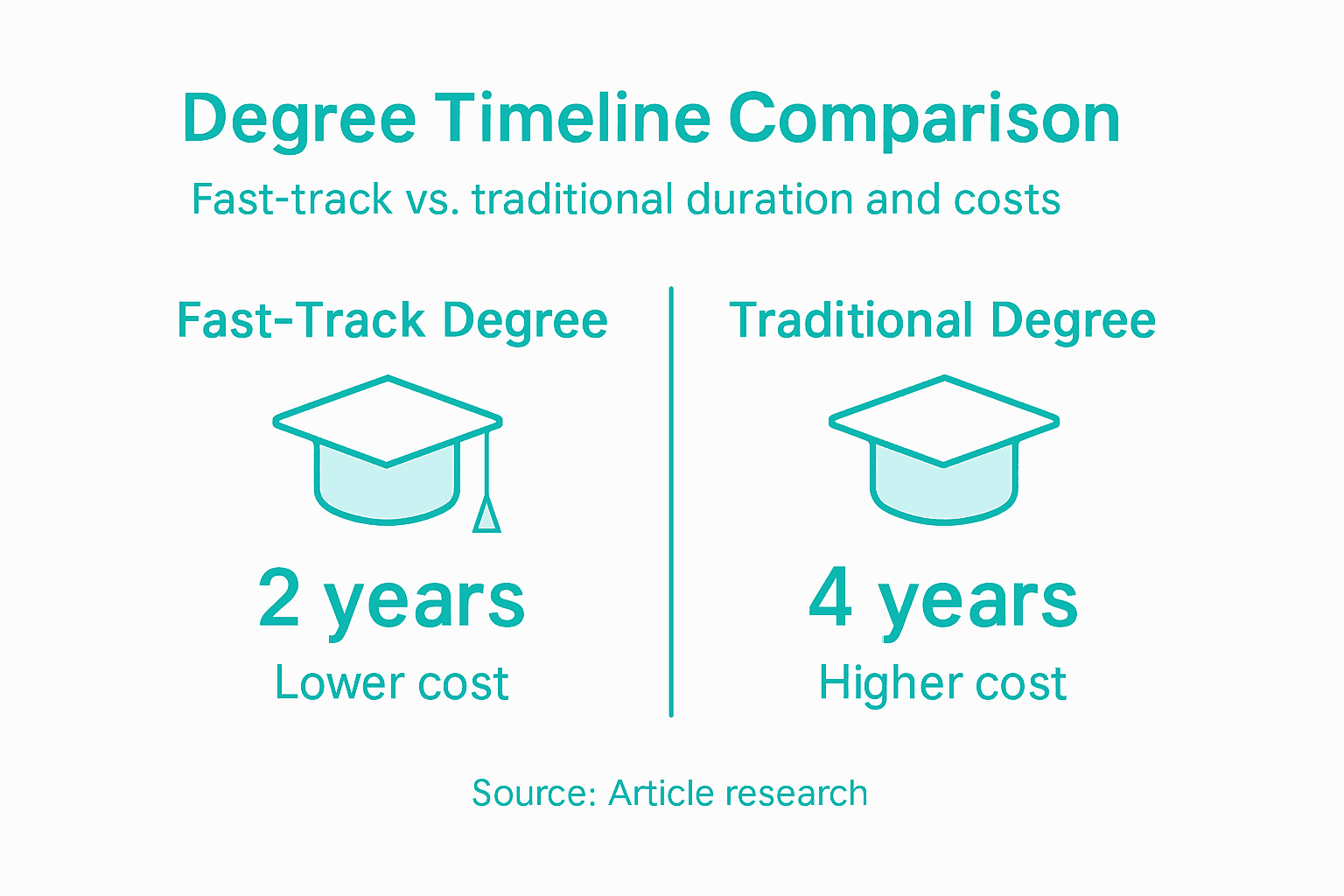
Cost savings with fast-track programs are substantial. Two years of tuition, housing, and living expenses versus four years creates significant financial difference. You also begin earning your professional salary two years earlier, multiplying the financial advantage.
Fast-track degrees reduce tuition costs while allowing earlier workforce entry compared to traditional degrees. For working professionals, this acceleration directly impacts career progression and lifetime earnings.
Here’s how fast-track and traditional degrees differ in key areas:
| Aspect | Fast-Track Degree | Traditional Degree |
|---|---|---|
| Completion Time | 2-3 years | 4 years |
| Course Intensity | High workload, year-round | Moderate, spread over semesters |
| Time in Workforce | Enter career sooner | Delayed entry |
| Networking | Limited campus/networking time | More time for networking |
| Financial Cost | Lower overall cost | Higher due to longer duration |
| Career Advancement | Faster access to promotions | Slower due to extended study |
Workload and Pacing
Traditional degrees spread coursework evenly, allowing time for reflection and skill development. Fast-track degrees require intense, concentrated effort. You’re studying harder each week, with fewer vacation breaks.
This intensity suits some personalities and not others. If you thrive under pressure and manage time well, fast-track intensity feels manageable. If you prefer steady pacing and extended thinking time, traditional programs feel less stressful.
Consider your current job demands. If you work 60-hour weeks, can you realistically add 25-30 hours of intensive study? Traditional programs offer flexibility you might need.
Employer Recognition
Here’s the straightforward answer: employers recognize both equally when quality is equivalent. A fast-track degree from an accredited institution carries the same weight as a traditional degree from the same school.
The institution and accreditation matter. A fast-track MBA from a respected university impresses employers. A fast-track degree from an unaccredited school doesn’t.
Verify accreditation before enrolling. Ofqual recognition in the United Kingdom matters globally for your credential’s value.
Skill Development and Networking
Traditional degrees offer more time for:
- Building deep relationships with classmates and professors
- Participating in extracurricular clubs and organizations
- Interning or working part-time in your field
- Developing well-rounded professional networks
- Exploring career interests before specializing
Fast-track programs compress these opportunities. You focus narrowly on coursework with less time for exploration or networking activities. However, you enter the workforce sooner and begin building your professional network in your actual career.
Which matters more depends on your goals. Early career entry means networking through work experience rather than campus activities.
Fast-track degrees aren’t inferior—they’re different. The right choice depends on whether you prioritize time savings or a broader college experience.
Making Your Decision
Ask yourself these questions:
- Do you have clear career goals, or are you still exploring?
- Can you handle intense, concentrated study for two years?
- Do you need to earn a higher salary immediately?
- Are you working full-time while studying?
- Do you value campus experience and networking opportunities?
Fast-track suits professionals with clear goals, proven work ethic, and pressing timeline needs. Traditional degrees suit students wanting broader exploration and steadier pacing.
Pro tip: Research specific employers in your target industry. Some value the career progression you gain by fast-tracking; others weight the extended networking of traditional programs. Your choice should align with what your target employers actually value, not general assumptions.
Fast-Track Your Success with Seekstudy’s Accredited Degrees
Facing the challenge of balancing full-time work and ambitious career goals means you need a solution that respects your time and accelerates your advancement. If you want to achieve higher management or specialized roles faster, avoid waiting through traditional four-year degrees and explore fast-track programs that compress your learning without cutting corners. With key concepts like online delivery, international recognition, and flexible scheduling guiding your decisions, Seekstudy offers exactly what you need to overcome these hurdles.
Discover Seekstudy’s range of accredited bachelor’s and master’s degrees tailored for busy professionals. Whether you are interested in a two-year bachelor’s degree in business management or an intensive one-year MBA, our programs combine quality, speed, and global exposure through studies in the United Kingdom and Singapore. Take the next step now by visiting Seekstudy and start your journey toward fast-tracking your career. Don’t let time hold you back. Learn more about our online MBA program and business management degrees designed to fit your lifestyle and ambitions today.
Frequently Asked Questions
What are fast-track degree programs?
Fast-track degree programs are accelerated educational pathways that allow students to complete degrees in a shorter timeframe, typically two to three years, without sacrificing academic quality.
How do fast-track programs benefit working professionals?
Fast-track programs enable working professionals to graduate sooner, allowing them to secure promotions and increase their salaries faster by reducing the time spent in school.
What types of fast-track degrees are available?
There are various types of fast-track degrees, including single degree programs (accelerated bachelor’s and master’s degrees), dual degree programs that allow students to earn two qualifications simultaneously, and programs offering credit flexibility for prior learning and experience.
What are the enrollment requirements for fast-track degree programs?
Enrollment requirements typically include a minimum GPA, relevant work experience, a personal statement explaining career goals, and proof of English proficiency if applicable. Many programs also consider prior learning and professional certifications for credit recognition.