

Applying for a UK degree online shouldn’t feel like solving a puzzle in the dark. Many international students struggle with confusing requirements, endless paperwork, and worrying about whether their degree will be recognized globally. The good news? Fast-track online UK degrees in Management and Accounting let you earn an accredited qualification without relocating, often in just two years. This guide walks you through exactly what you need to know, from prerequisites to acceptance, so you can start your application with confidence.
Table of Contents
- Understanding Online UK Degree Options And Fast-Track Programs
- Prerequisites And What You Need To Prepare Before Applying
- Step-By-Step Application Process For UK Online Degrees
- Common Mistakes, Trouble Spots, And How To Avoid Them
- Costs, Timelines, And What To Expect After Applying
- Accreditation, Recognition, And Studying Without Relocation
- Explore Accelerated UK Degrees Online With SeekStudy
- Frequently Asked Questions
Key takeaways
| Point | Details |
|---|---|
| Fast-track programs save time | Complete a UK bachelor’s degree in 2 years instead of 3, entirely online. |
| Entry requirements are specific | Academic qualifications and English proficiency (typically IELTS 6.0) are mandatory. |
| Complete applications win | Submitting certified documents early and monitoring status improves acceptance rates. |
| Accreditation ensures recognition | Ofqual-regulated degrees are recognized worldwide for career and further study. |
| Common mistakes are avoidable | Missing deadlines, incomplete documents, and weak English scores cause most rejections. |
Understanding online UK degree options and fast-track programs
Not all UK online degrees are created equal. Traditional bachelor’s programs take three years, but fast-track degree programs compress the same curriculum into two years without sacrificing quality. This accelerated path is ideal for working professionals and international students who want to advance their careers quickly.
You’ll find two main delivery formats. Fully online programs let you study from anywhere with internet access, attending virtual lectures and completing assignments on your schedule. Hybrid models combine online coursework with short residential components, sometimes in international locations. Some programs even offer opportunities to study in Singapore and the UK, giving you international experience while earning your degree.
Management and Accounting specializations dominate the fast-track landscape for good reason. These fields have clear career pathways, strong employer demand, and skills that translate across industries. Whether you’re aiming for financial analysis, business leadership, or entrepreneurship, focused programs prepare you better than generic degrees.
Here’s what makes fast-track programs worth considering:
- Complete your degree in 2 years instead of 3, entering the job market sooner
- Study from your home country, avoiding visa complications and relocation costs
- Maintain your current job while studying, with flexible schedules designed for working adults
- Access the same curriculum and accreditation as traditional on-campus programs
- Graduate with a UK qualification recognized by employers and universities worldwide
The accelerated format means more intensive study periods, but you’re not cramming inferior content. Fast-track programs restructure the academic calendar, removing long breaks between terms and optimizing course sequencing. You’ll work harder, but you’ll finish faster with the same credential.
Prerequisites and what you need to prepare before applying
Before you click submit on any application, make sure you meet the baseline requirements. UK universities maintain strict academic standards, even for online programs. Your previous education must be equivalent to UK qualifications, typically A-levels for bachelor’s programs or a bachelor’s degree for master’s programs.
English proficiency isn’t negotiable. Almost every UK program requires minimum IELTS 6.0 or equivalent scores. Alternative tests like TOEFL, PTE Academic, or Cambridge English are usually accepted, but check specific program requirements. If your previous education was conducted entirely in English, some universities waive this requirement, but don’t assume it.
Not quite meeting the entry standards? Foundation or preparatory courses bridge the gap. These programs take a few months to a year and prepare you academically and linguistically for degree-level work. Many business schools offer integrated pathways where successful foundation completion guarantees degree program entry.
Gather these documents before starting your application:
- Certified copies of all academic transcripts and certificates, translated to English if necessary
- Valid passport or government-issued photo ID
- English language test scores from the past two years
- Professional CV or resume highlighting work experience
- Two academic or professional references with contact information
- Personal statement explaining your motivation and goals
Technical requirements matter too. You’ll need reliable high-speed internet, a computer with webcam and microphone, and basic digital literacy. Online learning platforms require regular video conferencing, document uploads, and online collaboration. Test your setup before applying to avoid surprises.

Pro Tip: Start your English test preparation three months before applying. Retaking tests delays applications and costs money. Benefits of fast-track MBA programs include condensed timelines, but you still need to meet language requirements upfront.
Financial preparation deserves attention early. While online programs cost less than on-campus study, you’ll still need tuition funds. Research scholarship opportunities, employer sponsorship programs, and payment plans. Some providers let you pay per module rather than upfront for the entire year.
Step-by-step application process for UK online degrees
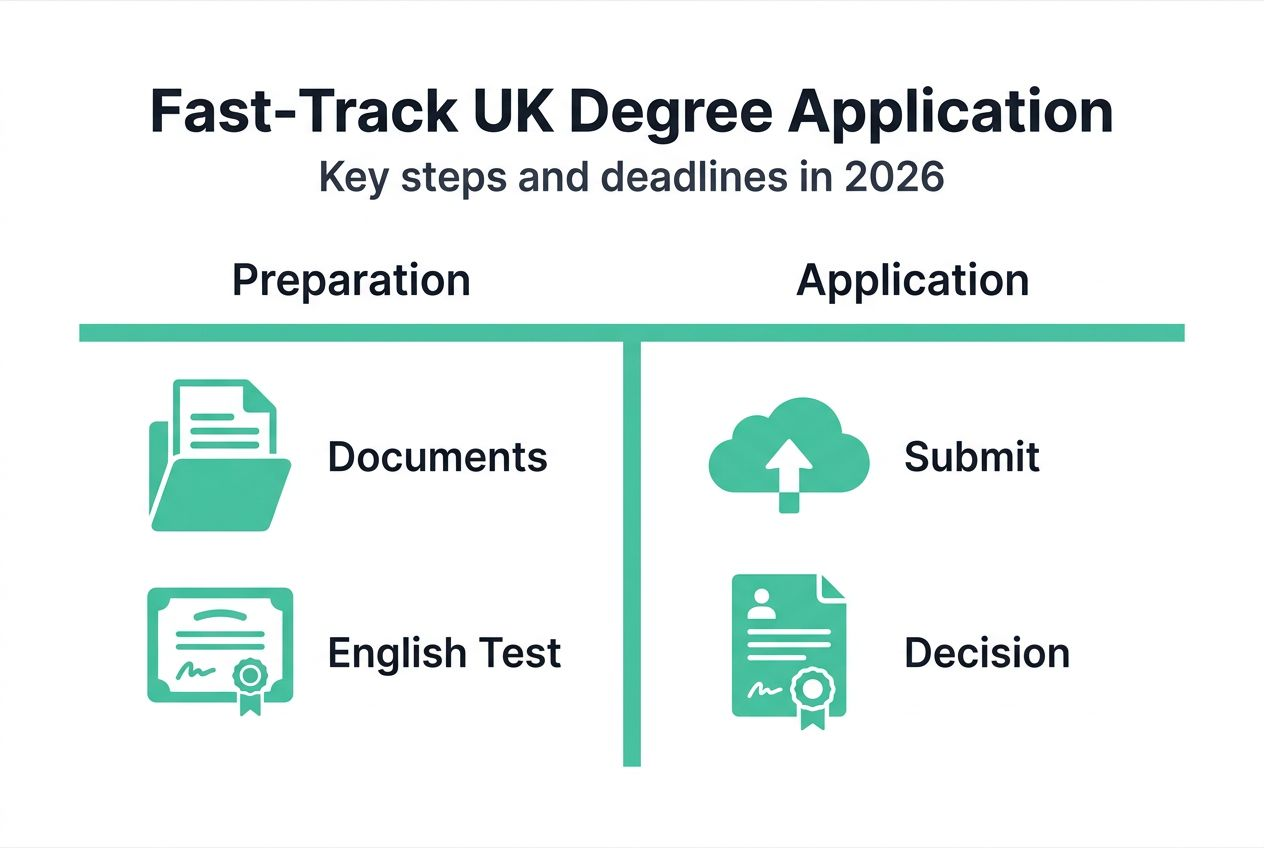
The application process feels less overwhelming when you break it into clear steps. Here’s your roadmap from research to enrollment for UK online degrees in 2026.
-
Evaluate your qualifications against program requirements. Check if your previous education meets UK equivalency standards and whether your English test scores are current and sufficient. Don’t guess, contact admissions teams with specific questions about your credentials.
-
Research programs thoroughly. Compare bachelor’s in business management options across providers, looking at accreditation, specializations, costs, and graduate outcomes. Read student reviews and verify Ofqual regulation status.
-
Gather and certify all documents. Official transcripts must come directly from your previous institutions or be certified by authorized bodies. Translations need professional certification. Many applications fail because of document issues, so start this process two months before deadlines.
-
Write a compelling personal statement. UK universities want to understand your motivation, career goals, and why their program fits your plans. Avoid generic statements. Be specific about how the program aligns with your professional direction and what unique perspectives you bring.
-
Complete your CV or resume. Focus on achievements and responsibilities rather than job duties. Quantify accomplishments when possible. Include relevant volunteer work, leadership roles, and any business or accounting experience.
-
Submit through the correct channel. Some UK programs use UCAS application portals, while others accept direct applications through their websites. Follow instructions exactly. Missing steps or using wrong formats causes processing delays.
-
Pay application fees promptly. Most UK programs charge between £50 and £150 per application. Keep payment receipts as proof of submission.
-
Monitor your application status. Set up email alerts and check portals weekly. Universities may request additional information or interviews. Respond within 48 hours to avoid appearing uninterested.
-
Prepare for interviews if required. Some competitive programs conduct video interviews assessing your communication skills, motivation, and program fit. Practice common questions and test your technology beforehand.
-
Accept your offer and confirm enrollment. Once accepted, you’ll receive an offer letter with conditions, deadlines, and next steps. Confirm your place quickly, as spaces can be limited, especially for fast-track intakes.
Pro Tip: Apply to multiple programs simultaneously. Acceptance rates vary, and having options gives you negotiating power for scholarships or start dates. Just ensure you can meet all deadlines without compromising application quality.
Timeline matters significantly. Most online UK programs have multiple intake points throughout the year, but popular Management and Accounting programs fill early. Submit applications at least three months before your desired start date to allow for processing, document verification, and any additional requirements.
Common mistakes, trouble spots, and how to avoid them
Even qualified applicants get rejected due to avoidable errors. Understanding common pitfalls helps you sidestep problems that derail applications.
Incomplete or uncertified documents sink more applications than low grades. Universities need official verification of your academic history. Photocopies of certificates won’t work. Transcripts sent directly from your previous institution or certified by authorized notaries are mandatory. Budget time and money for this process.
English language requirements trip up many candidates. About 25% of international UK applications fail because of insufficient English scores. Taking a practice test months before applying reveals if you need additional preparation. Don’t assume your English is good enough without objective proof.
Missing deadlines seems obvious, but it happens constantly. Set calendar reminders for application deadlines, document submission dates, and offer response timeframes. Universities won’t wait for late materials, regardless of your excuse. Build in buffer time for unexpected delays.
Applying to non-accredited programs wastes money and time while damaging your career prospects. Always verify accreditation status before applying. Legitimate UK programs are regulated by Ofqual and validated by recognized universities. Degree mills and fake accreditation bodies operate online, targeting international students who don’t know how to verify credentials.
Here’s how to protect yourself:
- Check Ofqual’s register of regulated qualifications online before applying
- Verify university partnerships and validation agreements on official university websites
- Look for transparent information about accreditation, not vague claims about recognition
- Research program reviews from actual graduates on independent platforms
- Contact professional bodies in your field to confirm if the degree meets their requirements
Weak personal statements hurt otherwise strong applications. Generic statements about loving business or wanting to help people don’t distinguish you. Connect your specific experiences to program offerings. Explain how this degree advances concrete career goals you’ve already started pursuing.
Neglecting communication with admissions teams creates unnecessary problems. If you have questions about requirements, unusual circumstances, or need clarification, ask directly. Admissions officers would rather answer questions early than reject applications later for misunderstandings you could have cleared up.
Critical Statistic: Universities report that incomplete applications take 40% longer to process and face rejection rates nearly double those of complete submissions. Starting early and double-checking everything before submission dramatically improves your chances.
Costs, timelines, and what to expect after applying
Budgeting accurately prevents financial surprises halfway through your degree. Online UK fast-track programs typically cost between £8,000 and £15,000 total for a two-year bachelor’s degree. That’s significantly less than traditional three-year on-campus programs when you factor in accommodation, transportation, and living costs.
Payment structures vary by provider. Some require full annual payment upfront, while others offer per-module payment plans or semester installments. Factor in technology costs, textbooks, and any exam or certification fees beyond tuition.
Application processing usually takes 4 to 8 weeks from submission to decision. Incomplete applications or peak application periods extend timelines. Some programs offer expedited review for additional fees if you’re working against tight deadlines.
Here’s a realistic timeline breakdown:
| Stage | Timeframe | Key Activities |
|---|---|---|
| Research and preparation | 2-3 months | Compare programs, gather documents, take English tests |
| Application submission | 2-4 weeks | Complete forms, write statements, submit materials |
| Processing and review | 4-8 weeks | University reviews application, may request interviews |
| Offer and enrollment | 2-4 weeks | Accept offer, pay deposits, complete enrollment |
| Pre-study preparation | 4-8 weeks | Complete pre-course materials, set up technology |
Successful applicants receive an offer letter detailing program start dates, tuition payment schedules, enrollment procedures, and any conditional requirements. Conditional offers might require you to complete a preparatory course, improve English scores, or submit additional documents before full acceptance.
Once enrolled, expect regular online classes, assignment deadlines, and exam periods structured around your program’s academic calendar. Fast-track formats mean less downtime between modules, so you’ll maintain steady momentum throughout your studies.
Graduates from accelerated business programs see measurable outcomes. Career advancement happens faster when you complete your degree sooner. Many students report promotions, salary increases, or career transitions within months of graduation. UK degrees carry global recognition, opening doors in international markets.
Pro Tip: Research whether your employer offers educational assistance or reimbursement programs. Many companies support employees pursuing relevant degrees, especially in business and accounting. Some cover full tuition in exchange for continued employment after graduation.
Financial aid options exist even for international online students. Merit-based scholarships, country-specific funding, and payment plans make programs more accessible. Some providers partner with financing companies offering student loans to international applicants. Explore all options before assuming you can’t afford a program. A diploma in business management might also serve as an affordable stepping stone to a full degree.
Accreditation, recognition, and studying without relocation
Accreditation makes the difference between a valuable credential and expensive paper. UK degrees gain credibility through Ofqual regulation and university validation. Ofqual-accredited programs enable 100% remote study while maintaining the same standards as on-campus programs.
Ofqual regulates qualifications in England, ensuring programs meet rigorous quality standards. When a program carries Ofqual accreditation, employers and universities worldwide recognize it as legitimate. This matters especially for international students whose degrees will be evaluated in different countries.
Global recognition extends beyond just having a UK degree. Professional bodies, immigration authorities, and multinational employers specifically look for properly accredited qualifications. UK-recognized degrees open pathways to chartered status in accounting, advanced management roles, and further study including PhD programs.
Studying online from your home country removes massive barriers that prevent many talented students from pursuing UK education. You avoid visa applications, relocation costs, culture shock, and being away from family and professional networks. Yet you still earn the same degree as on-campus students.
International partnerships strengthen online program quality. Many accredited providers collaborate with universities in multiple countries, offering diverse perspectives and global networking opportunities. Some programs include optional short-term international components where you can meet classmates and faculty in person without committing to full relocation.
Here’s how accredited online programs compare to traditional options:
| Factor | Accredited Online Programs | Traditional On-Campus |
|---|---|---|
| Accreditation | Ofqual-regulated, university-validated | Ofqual-regulated, university-validated |
| Global recognition | Identical to on-campus degrees | Identical to online degrees |
| Relocation required | No, study from anywhere | Yes, visa and accommodation needed |
| Cost | £8,000-£15,000 total | £20,000-£40,000+ including living costs |
| Duration | 2 years (fast-track) | 3 years (standard) |
| Work flexibility | Study while working full time | Limited work rights on student visa |
Choosing accredited programs protects you from degree fraud and ensures your investment pays off. Employers increasingly value online degrees equally to traditional ones, especially when accreditation is clear. The stigma around online education has largely disappeared as major universities and respected institutions offer online programs.
Verification is straightforward. Check the Ofqual register online to confirm your program appears in their database. Look for transparent partnerships with recognized UK universities. Legitimate providers prominently display their accreditation and regulatory status because it’s their strongest selling point.
For international students, this model solves the biggest challenge: accessing quality UK education without the complications of international relocation. You maintain your current job, family responsibilities, and professional network while earning a degree that advances your career globally.
Explore accelerated UK degrees online with SeekStudy
Ready to turn your career ambitions into reality? SeekStudy specializes in exactly what this guide describes: fully accredited fast-track UK business degrees designed for international students and working professionals who can’t relocate.
Our programs cut through the complexity. Two-year bachelor’s degrees in business management and one-year MBA options let you earn UK-recognized qualifications faster than traditional routes. Every program carries full Ofqual accreditation, ensuring your degree holds value wherever your career takes you.
You’ll study entirely online or choose hybrid options combining remote learning with international components. Our flexible schedules work around your job and life commitments. We’ve designed every aspect of our programs specifically for busy professionals who need practical, career-focused education.
Explore how accelerated business degrees boost career placement by 75% compared to traditional programs. Our bachelor’s in business management prepares you for leadership roles across industries. Learn more about how fast-track degrees accelerate career advancement and transform professional trajectories.
Your application journey starts today. With clear requirements, streamlined processes, and dedicated support, SeekStudy makes UK degree access straightforward for international students in 2026.
Frequently asked questions
How long does it take to get an admission decision after applying?
Most UK online programs respond within 4 to 8 weeks after receiving your complete application. Processing times extend if documents are missing or during peak application periods. Some providers offer expedited review services for urgent deadlines, though these typically cost extra.
What English tests do UK universities accept besides IELTS?
UK programs commonly accept TOEFL iBT (typically 80+ total), PTE Academic (58+ overall), and Cambridge English qualifications. Some universities waive English tests if your previous degree was taught entirely in English. Always verify specific requirements with your target program.
Does accreditation really matter for international career opportunities?
Absolutely. Employers and professional bodies worldwide verify degree accreditation before considering candidates. Ofqual-regulated UK degrees carry automatic recognition in most countries. Non-accredited degrees often can’t be used for professional licensing, further study, or immigration purposes.
Can I study part-time in fast-track online UK programs?
Fast-track programs are intensive by design, but many offer flexible scheduling rather than strict part-time or full-time classifications. You’ll complete the same curriculum faster, typically requiring 15 to 20 hours weekly. Some providers offer extended timelines at part-time pace if you need reduced intensity.
What happens if I need to defer or withdraw after applying?
Deferral policies vary by institution. Most allow one-time deferrals to the next intake period if you request before the term starts, though you may need to reconfirm your English scores remain valid. Refund policies for withdrawals depend on timing. Applications withdrawn before acceptance usually receive full refunds minus administrative fees. Withdrawals after enrollment follows the institution’s published refund schedule.
Are online UK degrees recognized by employers the same as traditional degrees?
Yes, when properly accredited. Employers focus on accreditation status and university reputation, not delivery format. Major corporations, government agencies, and international organizations now actively recruit from online programs. The key is ensuring your degree carries proper Ofqual regulation and university validation, making it indistinguishable from campus-based programs in terms of recognition.