

One-year MBA programs enable professionals to earn advanced business credentials while maintaining career momentum, offering 50% less downtime than traditional programs. For international working professionals seeking accelerated advancement without lengthy employment interruptions, these intensive programs deliver comprehensive business management education in 12 months. This guide explains how one-year MBAs combine academic rigor with flexibility, making them ideal for experienced professionals targeting leadership roles globally.
Table of Contents
- Introduction To One-Year MBA Programs
- Academic Rigor And Curriculum Structure
- Cost, Time Efficiency, And Return On Investment
- Flexibility And Learning Modalities For Working Professionals
- Career Advancement And Practical Application
- Global Recognition And Networking Benefits
- Common Misconceptions About One-Year MBAs
- Is A One-Year MBA Right For You? Candidate Profiles And Decision Factors
- Conclusion: Leveraging A One-Year MBA For Global Career Success
- Explore Accelerated And Flexible MBA Programs At SeekStudy
Key Takeaways
| Point | Details |
|---|---|
| Career Downtime Reduced | One-year MBAs cut career interruption by 66% versus traditional two-year programs. |
| Academic Excellence Maintained | Accredited programs preserve rigorous standards equivalent to longer MBAs. |
| Flexible Learning Options | Online, hybrid, and modular formats suit working professionals across time zones. |
| International Networking | Diverse cohorts with 95% international students enhance global connections significantly. |
| Ideal Candidate Profile | Professionals with 3-5+ years experience and clear advancement goals benefit most. |
Introduction to One-Year MBA Programs
One-year MBA programs compress traditional two-year curricula into 12 intensive months, delivering the same core business disciplines through accelerated formats. Unlike conventional MBAs requiring 18-24 months, these programs maintain academic depth while eliminating summer breaks and optional electives. European institutions pioneered this model decades ago, but online delivery has made one-year MBA options globally accessible to working professionals.
These programs target experienced managers and entrepreneurs who prioritize efficiency over extended campus immersion. Rather than career changers seeking internships, one-year MBAs attract professionals advancing within established fields. The condensed timeline demands higher weekly time commitments but returns graduates to leadership positions faster, maximizing salary growth potential.
Key differences distinguish one-year from traditional MBA formats:
- Total duration of 12 months versus 18-24 months for standard programs
- No summer internships or extended breaks between academic terms
- Higher weekly course load requiring 25-30 hours of study time
- Focus on experienced professionals rather than recent graduates
- Reduced total tuition costs and living expenses due to shorter timeframe
- Immediate workforce return enabling faster ROI realization
The model suits professionals unwilling to pause careers for two years yet committed to rigorous academic challenge. Geographic flexibility through online delivery removes relocation barriers for international students.
Academic Rigor and Curriculum Structure
Accredited one-year MBA programs maintain rigorous curriculum standards equivalent to traditional programs, covering identical core business disciplines. Institutions compress content through modular intensive delivery, where students complete each subject in focused 4-6 week blocks. This structure enables deep engagement with finance, marketing, operations, strategy, and leadership without sacrificing depth.
Global accreditation bodies like AACSB, EQUIS, and AMBA apply identical standards to one-year and two-year programs. Faculty credentials, learning outcomes, and assessment rigor remain constant regardless of duration. The difference lies in pacing, not content quality or comprehensiveness.
Core subjects include:
- Financial management and corporate finance fundamentals
- Strategic marketing and customer analytics
- Operations management and supply chain optimization
- Organizational leadership and human capital development
- Business strategy and competitive positioning
- Data-driven decision making and business analytics
Pro Tip: Create dedicated study blocks matching your peak productivity hours, treating coursework like non-negotiable business meetings to maintain momentum without burnout.
Modular delivery allows working professionals to balance employment with studies more effectively than semester-based systems. Completing one intensive module before starting the next prevents workload overlap. Many curriculum standards in one-year MBAs mirror traditional formats but eliminate elective padding, focusing entirely on essential business competencies.
Cost, Time Efficiency, and Return on Investment
One-year MBA programs deliver substantial financial advantages by eliminating a second year of tuition, fees, and living expenses. International students save 12 months of accommodation costs and avoid extended visa expenses. More significantly, reducing career interruption downtime by 50% means graduates resume earning salaries and pursuing promotions a full year earlier than two-year counterparts.

The opportunity cost calculation strongly favors shorter programs. Professionals earning $80,000 annually who complete an MBA in one year instead of two preserve $80,000 in foregone salary while spending roughly 40% less on total program costs. This dual savings accelerates break-even timelines significantly.
| Factor | One-Year MBA | Two-Year MBA |
|---|---|---|
| Average Duration | 12 months | 21 months |
| Typical Tuition Range | $40,000-$90,000 | $60,000-$140,000 |
| Salary Interruption | 1 year max | 2 years typical |
| Time to ROI Break-Even | 2-3 years | 4-5 years |
Key financial benefits for international working professionals include:
- Single year of tuition and program fees versus two years of payments
- Reduced visa duration requirements and associated costs
- 12 months earlier salary increases and promotion eligibility
- Lower total living expenses through shorter program commitment
- Faster access to enhanced earning potential post-graduation
Compare one-year MBA ROI scenarios against your current salary and target roles to calculate personalized break-even timelines. Time saved translates directly into career momentum that compounds over subsequent years.
Flexibility and Learning Modalities for Working Professionals
One-year MBA programs increasingly offer online and hybrid formats with modular scheduling ideal for working professionals, enabling study without relocating or resigning. Fully online programs deliver live virtual classes across time zones, while hybrid models combine distance learning with brief international residencies. This flexibility allows professionals to maintain employment throughout their studies.
Modular course structures break the year into manageable segments, typically 6-8 intensive modules covering distinct subjects. Students complete one module before beginning the next, preventing overwhelming workload accumulation. This approach suits professionals balancing client demands and project deadlines alongside academic commitments.
International residency components in hybrid programs provide immersive networking opportunities without requiring year-long relocation. One-week intensive sessions in global business hubs deliver face-to-face collaboration while preserving employment continuity. Technology-enabled learning environments support asynchronous content access, accommodating diverse schedules and locations.
Flexible study options include:
- Fully online programs with live virtual classes and recorded lectures
- Hybrid models combining distance learning with short residencies
- Weekend-intensive formats for regional students
- Asynchronous content access enabling study during personal peak hours
- Mobile learning platforms supporting study during business travel
Pro Tip: Block calendar time for coursework like client meetings, scheduling study sessions weeks in advance to prevent last-minute cramming that compromises learning quality.
Explore online and hybrid MBA options that align with your travel demands and preferred learning style. The best programs offer multiple modality choices within the same credential, adapting to evolving professional circumstances.
Career Advancement and Practical Application
Accelerated one-year MBAs allow career advancement 12 months sooner than traditional MBAs by minimizing time away from employment, enabling faster promotion eligibility and salary increases. Employers increasingly recognize one-year credentials as equivalent to longer programs, valuing the efficiency and determination required to complete intensive curricula.
Working professionals applying new strategic frameworks immediately to current roles reinforce learning through practical application. Unlike recent graduates, experienced managers contextualize academic concepts within real organizational challenges. This simultaneous application and study creates powerful feedback loops that deepen understanding.
Research shows 66% of prospective MBA students worry about career interruption; one-year MBAs reduce this downtime by half, addressing the primary concern of working professionals. Faster workforce return preserves momentum, maintains industry relationships, and positions graduates for leadership opportunities competitors pursuing two-year programs miss.
Career advantages for international professionals include:
- 12 months faster eligibility for senior management promotions
- Immediate application of strategic thinking to current responsibilities
- Maintained industry visibility and professional network engagement
- Earlier access to post-MBA salary increases averaging 20-40%
- Preserved employer relationships supporting internal advancement
66% Faster Career Trajectory: One-year MBA graduates return to leadership roles a full year ahead of traditional program peers, compounding advancement opportunities over entire careers.
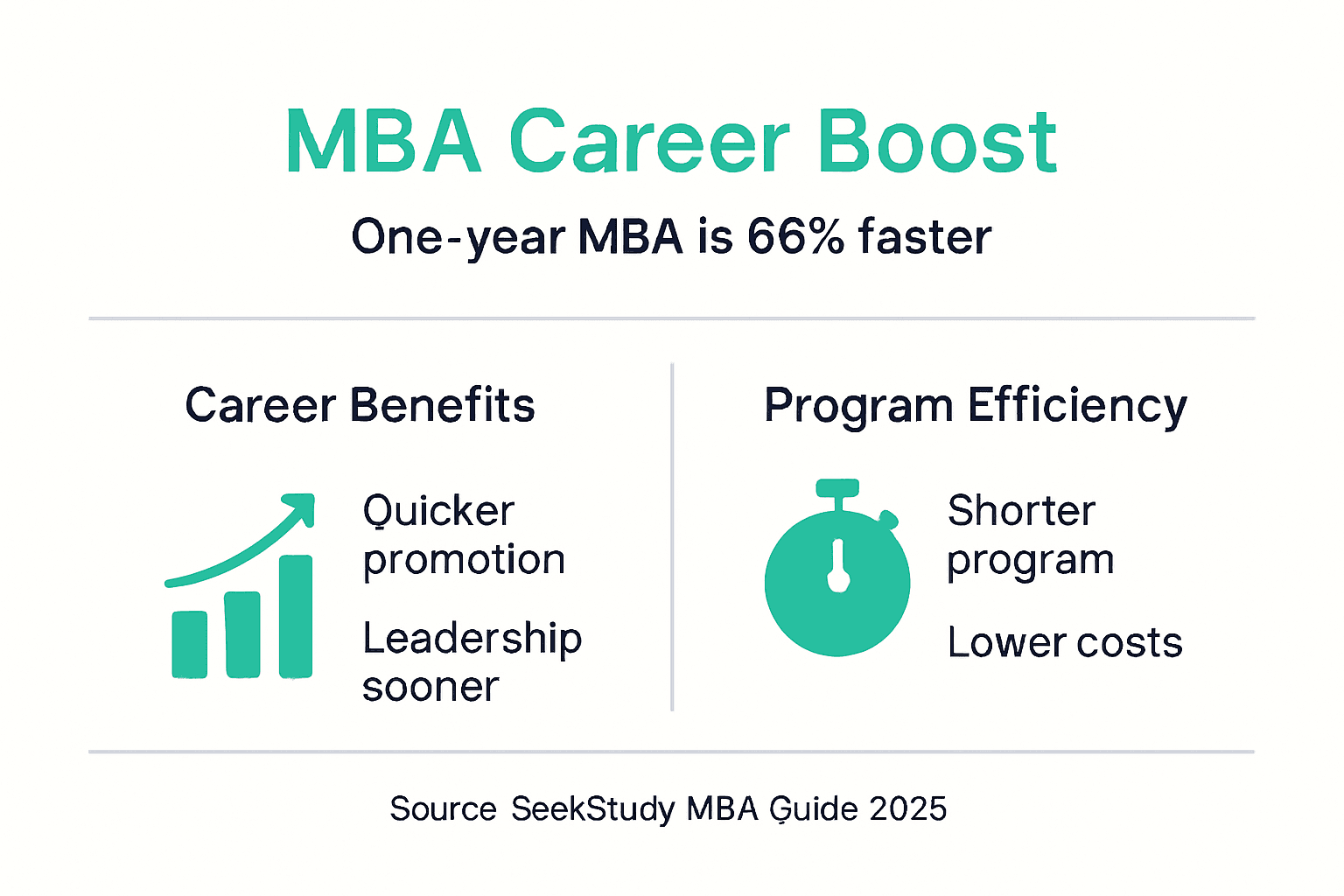
Explore career benefits of accelerated MBAs to understand how faster completion translates into measurable professional gains. The time savings multiply across subsequent career stages.
Global Recognition and Networking Benefits
Accreditation by prestigious bodies like AACSB, EQUIS, and AMBA ensures one-year MBA degrees receive identical international recognition as traditional programs. Employers worldwide evaluate credentials based on accreditation status and institutional reputation, not program duration. Quality one-year MBAs from respected universities carry equivalent weight in global job markets.
One-year MBA cohorts are highly international, with institutions like INSEAD reporting 95% international student bodies, creating rich cross-cultural learning environments. Diverse classmates bring varied industry experiences and geographic perspectives that broaden strategic thinking. These connections translate into lasting professional networks spanning continents.
Alumni networks from accelerated programs provide ongoing career support, introductions, and partnership opportunities. Despite shorter campus time, the intensity of one-year programs often creates stronger cohort bonds than extended formats where students spread across multiple years and elective tracks.
Networking advantages unique to one-year formats include:
- Concentrated cohort interaction building deeper relationships faster
- International classmate diversity exceeding 90% at top programs
- Alumni networks spanning 50+ countries for global opportunities
- Executive guest speakers and industry mentors engaging intensively
- Lifelong professional connections across industries and geographies
The networking benefits in MBA programs often prove as valuable as academic content for career advancement. International diversity expands opportunity scope beyond single-market limitations.
Common Misconceptions About One-Year MBAs
Many professionals hesitate to pursue one-year MBAs based on outdated assumptions about program quality and networking limitations. Clearing these misconceptions helps candidates make informed decisions grounded in current realities rather than myths.
Myth: One-year MBAs sacrifice academic rigor for speed. Reality: Accredited one-year MBAs hold academic rigor equal to two-year programs through identical accreditation standards and faculty requirements. Core content remains comprehensive; only optional electives and summer breaks are eliminated.
Myth: Shorter duration limits networking opportunities. Reality: Intensive interaction during compressed timelines often builds stronger cohort relationships than extended programs where students pursue divergent elective tracks. International diversity in one-year cohorts typically exceeds traditional MBA programs.
Myth: Only career changers benefit from MBAs. Reality: One-year programs specifically target career accelerators, professionals advancing within established fields rather than pivoting industries. The format suits experienced managers seeking leadership roles in current sectors.
Key facts correcting common misunderstandings:
- Accreditation requirements ensure identical academic standards regardless of duration
- 95% international cohorts provide richer networking than domestic-focused programs
- Career accelerators gain more from intensive study than internship-seeking changers
- Employer recognition depends on accreditation and school reputation, not length
- Modular intensity builds cohort cohesion faster than semester-based formats
Review resources debunking one-year MBA myths to separate fact from fiction when evaluating program options.
Is a One-Year MBA Right for You? Candidate Profiles and Decision Factors
Ideal candidates for one-year MBAs have 3-5+ years experience and clear career paths, favoring speed and flexibility over internships. These professionals understand their industries, seek strategic leadership skills, and prioritize minimal career interruption. Strong time management abilities and self-discipline prove essential for success in accelerated formats.
Trade-offs exist between breadth and depth. Two-year programs offer extensive elective exploration and summer work opportunities. One-year formats focus tightly on core competencies, eliminating exploratory coursework. Professionals with established career direction benefit most from this focused approach.
Steps to evaluate personal fit:
- Assess your relevant work experience against the 3-5 year minimum threshold
- Clarify specific career goals and confirm an MBA advances those objectives
- Evaluate your capacity for intensive study alongside work commitments
- Consider family and personal circumstances affecting time availability
- Review financial resources and ROI timelines for different program lengths
- Research accreditation and reputation of target institutions thoroughly
| Candidate Scenario | One-Year MBA Fit | Alternative Consideration |
|---|---|---|
| 5+ years experience, clear advancement path | Excellent fit | Executive MBA if unable to reduce work hours |
| Recent graduate seeking career change | Poor fit | Traditional two-year MBA with internships |
| Entrepreneur scaling business | Good fit | Part-time MBA if business demands fluctuate |
| International professional, time-constrained | Excellent fit | Online one-year format optimal |
Consider whether you value breadth of electives or speed to completion. Professionals confident in their industry who seek strategic frameworks benefit most from concentrated one-year curricula. Explore candidate suitability factors to match program types with personal circumstances.
Conclusion: Leveraging a One-Year MBA for Global Career Success
One-year MBA programs deliver time efficiency, cost savings, and flexible learning options that align perfectly with international working professionals’ needs in 2026. By preserving career momentum while building strategic business capabilities, these accelerated credentials enable faster advancement without the extended interruptions traditional programs demand.
Selecting accredited, quality programs ensures your investment yields globally recognized credentials and valuable networks. The combination of rigorous academics, international cohorts, and immediate practical application creates powerful career acceleration that compounds over time.
Proactive planning for 2026 enrollment positions you to capitalize on enhanced leadership opportunities and salary growth. The strategic advantage of completing an MBA 12 months faster than peers pursuing traditional formats creates lasting competitive benefits throughout your career.
International professionals ready to advance should view one-year MBAs as smart investments in 2026, balancing ambition with practical constraints. The accelerated path delivers comprehensive business education without sacrificing quality or recognition.
Explore Accelerated and Flexible MBA Programs at SeekStudy
SeekStudy specializes in fast-track degree programs designed for international professionals balancing career demands with educational goals. Our accelerated MBA options combine rigorous UK-accredited curricula with flexible online delivery, enabling you to earn recognized credentials without relocating or resigning.
Explore our comprehensive online MBA guide detailing program structures, admission requirements, and career outcomes. We offer pathways from post-graduate diplomas to full MBA credentials, accommodating diverse starting points and objectives. Our international partnerships across UK, Singapore, Hong Kong, and Australia provide globally recognized degrees through convenient formats.
Pro Tip: Review SeekStudy’s modular scheduling options to identify programs matching your specific work commitments and geographic preferences, maximizing flexibility without compromising academic quality.
Frequently Asked Questions About One-Year MBA Programs
What types of professionals benefit most from a one-year MBA?
Professionals with 3-5+ years of relevant experience seeking career acceleration within established industries gain maximum value. Those with clear advancement goals prioritizing time efficiency over exploratory internships find one-year formats ideal. Entrepreneurs and managers unable to pause careers for two years particularly benefit from condensed delivery.
How do one-year MBAs compare to Executive MBAs?
One-year MBAs require full-time commitment with reduced work hours, while Executive MBAs accommodate full-time employment through weekend or evening schedules. One-year programs typically target mid-career professionals; Executive MBAs serve senior leaders with 10+ years experience. Both deliver equivalent credentials, differing primarily in scheduling flexibility and cohort seniority.
Can I work full-time while completing a one-year MBA online?
Online and hybrid one-year MBAs enable part-time employment, though most require 25-30 weekly study hours. Full-time work proves challenging during intensive modules but manageable with strong time management. Many professionals reduce hours to 30-35 weekly or arrange flexible schedules with employers during the program year.
Are one-year MBA degrees recognized internationally?
Accredited one-year MBAs receive identical international recognition as traditional two-year programs. Employers evaluate credentials based on accreditation status and institutional reputation, not duration. Graduates from AACSB, EQUIS, or AMBA accredited programs enjoy equivalent global recognition and career opportunities.
What are key factors when choosing a one-year MBA program?
Prioritize accreditation by recognized bodies ensuring quality and recognition. Evaluate delivery format alignment with work commitments and learning preferences. Research cohort diversity and alumni network strength for networking value. Compare total costs including tuition, fees, and opportunity costs. Verify curriculum coverage of essential business disciplines relevant to career goals.