

Balancing career growth with higher education can feel impossible when you’re already working full time. Many professionals dream of earning a recognized business degree but struggle to find programs that fit demanding schedules and deliver real-world value. Singapore and the UK have emerged as leading destinations for accelerated management and accounting degrees, offering flexible pathways that combine quality education with practical experience. This guide walks you through prerequisites, application strategies, study format options, and career outcomes to help you make informed decisions about advancing your qualifications while maintaining your professional momentum.
Table of Contents
- Preparing To Study In Singapore And The UK
- How To Apply For Accelerated Degrees In Management And Accounting
- Navigating Study Options: Full-Time, Part-Time, Online, And Hybrid Formats
- Expected Career Outcomes And Internships For Singapore And UK Graduates
- Flexible Accelerated Business Degrees: Take The Next Step
Key takeaways
| Point | Details |
|---|---|
| Flexible study formats | Accelerated degrees in Singapore and the UK offer part-time, online, and hybrid options designed for working professionals. |
| Strong employment outcomes | Singapore Management University graduates achieved a 91.4% employment rate within six months of graduation in 2026. |
| Internship advantage | Mandatory internships provide direct pathways to employment, with nearly half of graduates securing offers during their programs. |
| Global recognition | UK degrees offer worldwide employability while Singapore programs provide strong regional industry connections. |
| Accessible entry | Clear prerequisites including English proficiency and prior qualifications make accelerated programs attainable for international learners. |
Preparing to study in Singapore and the UK
Before you submit applications, understanding entry requirements saves time and prevents costly mistakes. Both Singapore and UK institutions maintain specific standards for accelerated business programs, but these prerequisites remain achievable for most working professionals and recent graduates.
Educational background forms the foundation of your application. Most accelerated bachelor’s programs require a high school diploma or equivalent credential with strong grades in mathematics and English. If you’re targeting master’s degrees, you’ll need a recognized undergraduate degree, though some programs accept extensive work experience as partial qualification. A business management diploma can strengthen your application and demonstrate foundational knowledge in core concepts.
English proficiency requirements protect both you and the institution. Singapore universities typically require IELTS scores of 6.5 to 7.0 or TOEFL iBT scores of 90 to 100. UK institutions maintain similar standards, though some online programs offer slightly more flexible thresholds. Native English speakers or graduates from English-medium institutions may receive exemptions, but you’ll need official documentation proving your previous instruction language.
Visa and study permit processes differ significantly between destinations. Singapore’s Student Pass requires proof of acceptance, financial capability, and completed medical examinations. UK student visas demand confirmation of acceptance for studies, evidence of funds covering tuition and living costs, and tuberculosis testing for certain nationalities. Start these processes early because processing times can stretch to eight weeks during peak application seasons.
Document preparation requires careful attention to detail. You’ll need:
- Official transcripts from all previous educational institutions
- Passport-quality photographs meeting specific dimension requirements
- Personal statements explaining your academic goals and career aspirations
- Letters of recommendation from academic or professional references
- Proof of financial resources covering at least one year of study
- Updated resume highlighting relevant work experience
Pro Tip: Create a master checklist tracking every requirement for each program you’re considering, then gather documents in digital and physical formats simultaneously to avoid last-minute scrambling.
Aligning your qualifications with program expectations prevents application rejection. Review each institution’s specific entry criteria because accelerated programs often have higher GPA thresholds than traditional tracks. Some universities offer foundation courses or preparatory programs if your credentials fall slightly short, providing an alternative pathway rather than outright denial.
How to apply for accelerated degrees in management and accounting
The application process demands strategic planning and attention to institutional differences. Singapore and UK universities maintain distinct systems, but understanding core similarities helps you navigate both efficiently.
Research forms your competitive advantage. Start by identifying universities offering accelerated flexible programs in your target specialization. Singapore Management University stands out for management and accounting, while UK institutions like University of London and various online providers offer recognized qualifications. Compare program duration, total costs including living expenses, and specific curriculum focus areas to match your career goals.
Application submission follows these essential steps:
- Create accounts on university application portals at least three months before deadlines
- Complete online forms with accurate personal and educational information
- Upload required documents in specified formats, typically PDF files under 5MB
- Pay non-refundable application fees ranging from $50 to $150 depending on institution
- Submit applications and save confirmation emails as proof of timely submission
- Monitor your email and portal regularly for requests for additional information
- Prepare for potential interviews by researching common questions and practicing responses
Deadlines vary significantly across institutions and intake periods. Singapore universities typically have main intakes in August with applications closing in February or March. UK programs often offer multiple start dates throughout the year, especially for online formats. Missing deadlines eliminates your chances regardless of qualification strength, so mark calendar reminders at 30, 14, and 7 days before each critical date.
Understanding internship requirements separates prepared candidates from disappointed ones. SMU’s mandatory internship program contributes to workplace relevance and plays a decisive role in preparing students for competitive job markets. When applying, demonstrate awareness of these practical components and explain how your current employment or professional network supports completion.
Pro Tip: Use your application essay to connect your specific career goals with the program’s unique strengths, showing research depth beyond generic statements about wanting to advance your career.
Common application mistakes derail otherwise qualified candidates. Avoid submitting generic personal statements that could apply to any program. Don’t underestimate recommendation letter importance by asking referees at the last minute. Never exaggerate qualifications or work experience because verification processes catch inconsistencies. Finally, proofread everything multiple times because grammar errors and typos suggest carelessness that admissions committees notice.
For detailed guidance on navigating fast-track application processes, review the comprehensive business degree fast-track guide covering timeline optimization and strategic positioning.
Navigating study options: full-time, part-time, online, and hybrid formats
Choosing the right study format determines whether you successfully complete your degree or struggle with unsustainable workload pressure. Accelerated programs offer unprecedented flexibility, but each format carries distinct advantages and challenges.

Full-time accelerated programs compress traditional three or four-year degrees into 18 to 24 months through intensive coursework and year-round study. You’ll attend classes or complete assignments almost daily, leaving limited time for employment. This format suits career changers, recent graduates, or professionals taking sabbaticals who can dedicate complete focus to academics.
Part-time programs extend duration to three or four years while reducing weekly time commitment to 15 to 20 hours. You maintain full-time employment while progressing toward your qualification. Evening classes, weekend sessions, and flexible assignment deadlines accommodate work schedules. This format works best for professionals in stable positions who want gradual advancement without career interruption.
Online formats revolutionize accessibility for international students and working professionals. You access lectures, complete assignments, and participate in discussions entirely through digital platforms. Studying management online eliminates commuting time and geographic barriers while maintaining academic rigor. Asynchronous content lets you study during early mornings, lunch breaks, or late evenings based on personal productivity patterns.
Hybrid models combine online learning with periodic in-person intensives or examinations. You might complete 80% of coursework remotely then attend one-week residential sessions each semester. This balance provides networking opportunities and hands-on workshops while preserving day-to-day flexibility.
| Format | Typical Duration | Weekly Time Commitment | Career Impact | Best For |
|---|---|---|---|---|
| Full-time accelerated | 18-24 months | 40+ hours | Fastest credential, career change | Career breakers, recent graduates |
| Part-time | 3-4 years | 15-20 hours | Gradual advancement | Employed professionals |
| Online | 2-4 years | 10-25 hours | Maximum flexibility | Remote workers, international students |
| Hybrid | 2-3 years | 15-30 hours | Networking plus flexibility | Mid-career professionals |
Balancing study workload with job and personal commitments requires honest self-assessment. Calculate your current discretionary time by tracking one typical week, noting hours available after work, family obligations, and essential personal care. Compare this realistic availability against program expectations rather than aspirational schedules you hope to maintain.
Time management strategies that successful working students employ include:
- Blocking specific study hours in your calendar as non-negotiable appointments
- Communicating your educational goals with employers to negotiate occasional flexibility
- Using commute time for reading assignments or listening to recorded lectures
- Batching similar tasks like reading all weekly materials in one session
- Building buffer time into your schedule for unexpected work or family demands
Pro Tip: Prioritize programs that maximize internship or practical experience exposure because graduates with industry exposure and applied skills remain in demand even during cautious hiring periods.
Expected career outcomes and internships for Singapore and UK graduates
Investing time and money in accelerated degrees makes sense only when employment outcomes justify the commitment. Recent data from Singapore and UK institutions demonstrates strong returns for management and accounting graduates who complete recognized programs.
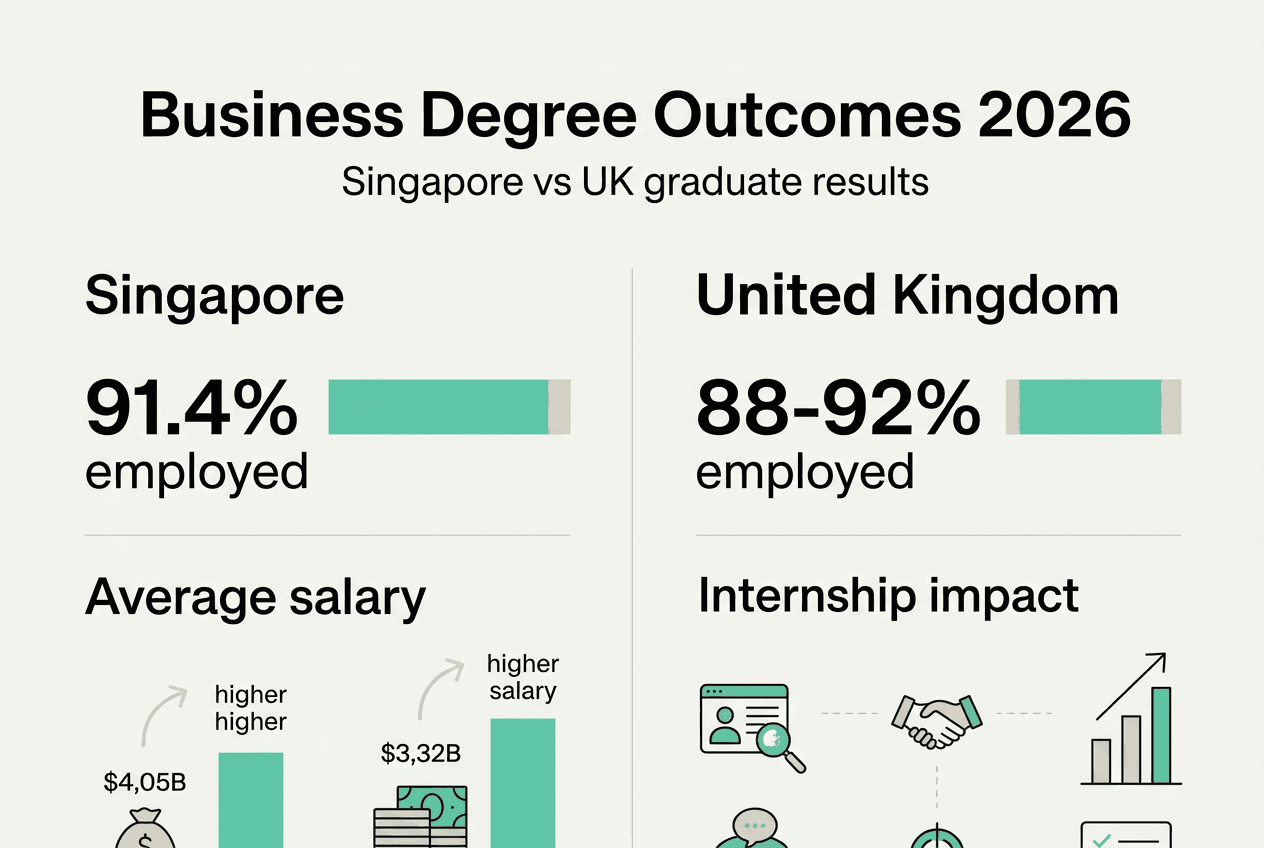
SMU graduates secured a 91.4% employment rate within six months of graduation in 2026, outperforming many global benchmarks during an uncertain economic climate. This success stems partly from curriculum design emphasizing practical skills and partly from mandatory internship requirements connecting students directly with hiring companies.
Salary expectations provide concrete metrics for measuring degree value. The average gross monthly salary for SMU graduates rose to $5,116 in 2026, reflecting strong demand for qualified business professionals. Accounting and finance graduates often command premium salaries, with specialized roles in financial analysis, auditing, and management consulting offering even higher compensation.
Internship impact on employment offers cannot be overstated. Nearly half of SMU graduates received full-time permanent employment offers during or after their penultimate-year internship, converting temporary placements into career launches. Companies use internships as extended interview periods, evaluating cultural fit and work quality before making hiring commitments.
| Metric | Singapore (SMU) 2026 | UK Average 2026 |
|---|---|---|
| Employment rate (6 months) | 91.4% | 88-92% |
| Average starting salary | $5,116/month | £28,000-32,000/year |
| Internship to job conversion | Nearly 50% | 35-45% |
| Further study rate | 8-12% | 15-20% |
UK degrees offer distinct advantages for global employability and career progression. British qualifications receive recognition across Commonwealth countries, European markets, and increasingly in Asia and North America. The reputation of UK business education opens doors in multinational corporations and provides credibility when relocating internationally. Explore comprehensive insights on benefits of earning a UK degree abroad to understand long-term career implications.
Post-graduation career strategies that maximize your accelerated degree investment include:
- Leveraging alumni networks from your institution for job referrals and mentorship
- Obtaining professional certifications like CPA, ACCA, or CFA to complement your degree
- Targeting companies that value continuous learning and promote from within
- Building a strong LinkedIn presence highlighting your international education experience
- Considering graduate schemes and management trainee programs for accelerated advancement
- Maintaining relationships with internship supervisors who can provide references
Company retention rates for internship participants demonstrate employer confidence in program quality. Organizations investing in student internships typically offer permanent positions to top performers, creating seamless school-to-work transitions that bypass competitive graduate hiring processes.
Flexible accelerated business degrees: take the next step
You’ve explored the requirements, application processes, study formats, and career outcomes for accelerated business degrees in Singapore and the UK. Now it’s time to translate this knowledge into action that advances your professional trajectory.
SeekStudy specializes in flexible accelerated degrees tailored specifically for working professionals and international students who refuse to choose between career progress and educational advancement. Our programs combine UK-recognized qualifications with practical experience opportunities, including pathways that integrate Singapore-based learning with British degree credentials.
Whether you’re targeting a foundational business qualification or an advanced management credential, SeekStudy’s accelerated business degrees provide structured pathways that fit demanding schedules. Our Bachelor in Business Management program delivers comprehensive business education in an intensive two-year format, while our online MBA for professionals offers executive-level credentials in just one year.
Explore your options today and discover how the right accelerated program transforms your career timeline without derailing your current professional commitments.
FAQ
Is studying in Singapore or the UK better for international business degrees?
Both destinations offer internationally recognized qualifications with distinct advantages. Singapore provides exceptional regional industry connections, particularly in finance and technology sectors, plus mandatory internships that create direct employment pathways. The UK delivers broader global brand recognition and diverse specialization options across hundreds of institutions. Your optimal choice depends on target career markets, budget considerations, preferred study format, and whether you prioritize Asian business networks or European and global opportunities. Many students benefit from programs combining Singapore and UK components for maximum geographic flexibility.
How do internships influence job prospects after graduation?
Internships dramatically improve employment outcomes by providing practical experience, professional networks, and direct hiring pathways. Nearly half of SMU graduates received full-time employment offers during or after their penultimate-year internship, demonstrating how temporary placements convert to permanent positions. Employers use internships as extended evaluation periods, assessing cultural fit and work quality before making hiring commitments. Students gain industry-specific skills, professional references, and often receive return offers that bypass competitive graduate recruitment processes entirely.
Can working professionals study part-time and still earn a UK degree?
Absolutely. Many UK degree programs specifically design part-time and online formats for working professionals who cannot pause careers for full-time study. These flexible options allow you to progress academically while maintaining employment, typically extending program duration to three or four years with reduced weekly time commitments of 15 to 20 hours. Online management programs eliminate geographic barriers entirely, letting you earn British qualifications from anywhere globally. Employers increasingly value candidates who demonstrate the discipline and time management required to complete degrees while working full-time.
What are the salary expectations after completing accelerated business degrees?
The average gross monthly salary for SMU graduates reached $5,116 in 2026, providing a concrete benchmark for Singapore-based careers. UK graduates typically earn between £28,000 and £32,000 annually in starting positions, with accounting and finance specializations commanding premium compensation. Actual salaries vary based on industry sector, geographic location, company size, and individual negotiation skills. Accelerated degrees enhance earning potential by reducing time to qualification, letting you access higher-paying roles years earlier than traditional program graduates. Specialized certifications combined with your degree can further boost compensation in competitive fields like financial analysis and management consulting.