

Most people assume a two-year bachelor’s degree means starting from zero and finishing in half the time. That’s rarely how it works. Only 44% of bachelor’s graduates in the US finish within four years, and the students who complete a bachelor’s in two years almost always bring prior credits to the table. This guide breaks down exactly what these programs require, who qualifies, how employers view them, and how international students and working professionals can use them to accelerate their careers without wasting time or money.
Table of Contents
- What is a two-year bachelor’s degree program?
- Who is it for? Ideal candidates and use cases
- Admission requirements and credit transfer essentials
- How do two-year bachelor’s programs work? Pace, formats, and delivery
- Global recognition, employer perception, and credential evaluation
- Benefits and risks: Costs, speed, and what to watch out for
- Making the most of your fast-track business degree: Expert tips for global achievers
- Explore your fast-track degree options for global success
- Frequently asked questions
Key Takeaways
| Point | Details |
|---|---|
| Degree completion focus | A two-year bachelor’s is for those with substantial prior credits, not beginners starting from scratch. |
| Flexible formats | Most programs offer online and accelerated learning, ideal for working professionals and international students. |
| Global employer recognition | Choose accredited programs and secure proper credential evaluation to maximize global acceptance. |
| Intense workload | Expect a demanding study schedule, increased intensity, and a need for strong time management skills. |
| Plan for career advantage | With preparation and the right program choice, a two-year bachelor’s can safely boost your career worldwide. |
What is a two-year bachelor’s degree program?
A two-year bachelor’s degree is not a traditional four-year program cut in half. It is a degree-completion program designed for students who already have college-level credits and want to finish their bachelor’s faster. Think of it as the final stretch, not the full race.
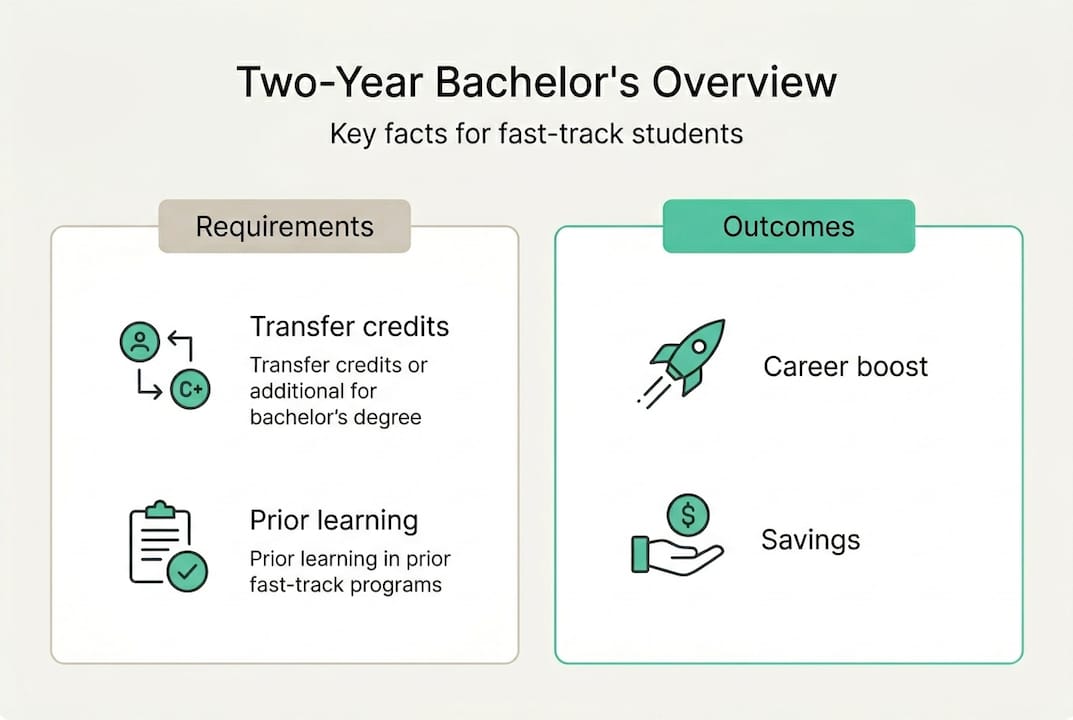
Two-year bachelor’s programs require 30 to 90 prior transferable credits before you can even enroll. Those credits can come from an associate degree, Advanced Placement exams, CLEP tests, or recognized professional qualifications. Without them, you are looking at a standard three to four year timeline.
Here is a quick breakdown of how these programs compare to traditional degrees:
| Feature | Two-year bachelor’s | Traditional four-year |
|---|---|---|
| Prior credits required | 30 to 90 | None |
| Typical duration | 2 to 2.5 years | 4 years |
| Format | Online, hybrid, CBE | On-campus, online |
| Best for | Transfer students, professionals | First-time students |
| Cost | Lower overall | Higher overall |
Common sources of transferable credit include:
- Associate degrees from accredited community colleges
- CLEP or AP exam scores recognized by the receiving institution
- Professional certifications evaluated for academic credit
- Prior learning assessments based on documented work experience
Pro Tip: Before applying anywhere, request a free credit evaluation from your target school. Knowing exactly how many credits transfer saves you from enrolling in a program that will actually take three years.
For students who qualify, the faster career success potential is real. But the key word is qualify.
Who is it for? Ideal candidates and use cases
Not every student is a good fit for a two-year bachelor’s program. The ideal candidate already has academic or professional experience that counts toward a degree. Accelerated students prioritize speed and flexibility, and these programs are built around people who have work or family commitments alongside their studies.
Here is how different student profiles compare:
| Student type | Typical background | Main motivation |
|---|---|---|
| Transfer student | Associate degree holder | Finish faster, save money |
| Working professional | 5+ years industry experience | Career advancement |
| International applicant | Foreign qualifications | UK or US recognized degree |
| Career changer | Unrelated prior degree | New field credentials |
The accelerated bachelor’s benefits are strongest for people who already know what they want. A working professional in finance who wants a business management degree, for example, may have years of relevant experience that translates directly into credit. An international student with a diploma from a recognized institution abroad may qualify to enter at an advanced stage.

For professionals eyeing leadership roles, the professional advantages of holding an accredited bachelor’s before pursuing an MBA are significant. Employers and graduate schools both take notice.
Admission requirements and credit transfer essentials
Getting into a two-year bachelor’s program requires more paperwork than a standard application. Here is what you typically need to prepare:
- Official transcripts from every institution you have attended, translated into English if necessary
- Credit evaluation report from a recognized body such as WES or NACES for international qualifications
- Proof of English proficiency via IELTS, TOEFL, or equivalent for non-native speakers
- Prior learning documentation including work certificates, professional licenses, or employer letters
- Standardized exam scores if using CLEP or AP credits toward your transfer total
Programs require transfer of 30 to 90 credits from prior learning, often including work assessments and CLEP exams. The exact number varies by school and program, so check each institution’s transfer policy before applying.
International applicants face an extra step: credential evaluation. A foreign diploma or certificate must be assessed by an approved evaluator to determine its US or UK equivalent. This process can take two to six weeks, so start early.
Pro Tip: Use the degree prep checklist to organize your documents before applying. Missing one item can delay your start date by an entire semester.
If you are unsure whether your background qualifies, resources on how to prepare for fast-track online study can help you assess your readiness before committing.
How do two-year bachelor’s programs work? Pace, formats, and delivery
Once admitted, the structure of your program depends heavily on the format you choose. Most accelerated programs run on compressed schedules, meaning you cover the same material as a traditional course but in eight weeks instead of sixteen.
Average completion runs 2 to 2.5 years with adequate transfer credits, and formats range from intensive eight-week terms to fully asynchronous online delivery. The three main formats are:
- Asynchronous online: Study on your own schedule, no fixed class times. Best for professionals in different time zones.
- Hybrid campus: Mix of online coursework and occasional in-person sessions. Common in programs with international study components.
- Competency-based education (CBE): Progress by demonstrating mastery of skills, not by seat time. Fastest option for experienced professionals.
For more detail on each model, the program formats explained resource walks through what to expect in each.
“The biggest adjustment for most accelerated students is not the content, it is the pace. You have roughly half the time to absorb the same material, which means falling behind in week two can feel like falling behind in month two of a traditional program.”
Workload is real. Expect 15 to 20 hours of study per week on top of any job or family responsibilities. Strong time management is not optional here.
Global recognition, employer perception, and credential evaluation
A degree is only as valuable as its recognition. For international students and professionals working across borders, this is the section that matters most.
Employers and graduate schools verify credentials in several ways:
- Credential evaluation services such as WES and Scholaro translate foreign or accelerated degrees into a recognized standard
- Official transcripts sent directly from the institution confirm authenticity
- Accreditation checks verify that the school meets national or regional quality standards
- LinkedIn and background screening tools cross-reference degree details with institutional records
Employers verify foreign and accelerated credentials via evaluators, official transcripts, and accreditation checks, and skepticism exists for programs that lack proper accreditation. This is not a reason to avoid accelerated degrees. It is a reason to choose carefully.
“Accreditation is the single most important factor in whether your degree opens doors or raises eyebrows.”
Experts recommend regional or ACBSP accreditation for business programs to maximize recognition and minimize employer skepticism. ACBSP (Accreditation Council for Business Schools and Programs) is specifically designed for business education and is widely respected by hiring managers globally.
Choosing accredited programs from the start protects your investment and ensures your degree holds up under scrutiny anywhere in the world.
Benefits and risks: Costs, speed, and what to watch out for
Two-year bachelor’s programs offer genuine advantages, but they are not the right choice for everyone. Here is an honest look at both sides.
Benefits:
- Finish your degree in roughly half the time of a traditional program
- Pay significantly less in tuition and living costs overall
- Enter the job market or pursue a master’s degree sooner
- Flexible formats support full-time work during study
Risks:
- Intense workload increases the risk of burnout, especially without a support system
- Not every employer recognizes all accelerated or online credentials equally
- Programs without proper accreditation can damage rather than help your career
Pros include substantial cost and time savings and better career momentum, while cons include workload intensity and possible skepticism from some employers. Intense workload can cause burnout in accelerated programs, particularly for students who underestimate the pace.
Pro Tip: Before enrolling, honestly assess your current workload. If you are already working 50-plus hours a week, a CBE or asynchronous format gives you more control than a fixed-schedule intensive program.
For students who are ready, the career advancement data shows that graduates of accredited accelerated programs move into management roles faster than those who delay their degree.
Making the most of your fast-track business degree: Expert tips for global achievers
Getting admitted is step one. Finishing strong and landing the career you want requires a clear strategy from day one.
- Arrange credential evaluation before applying. Do not wait until after acceptance to find out how many credits transfer. Get credential evaluation early and choose regionally or ACBSP-accredited schools to keep proof of experience on file.
- Document all prior learning thoroughly. Work certificates, performance reviews, and professional licenses can all support a prior learning assessment and reduce your remaining credit load.
- Build a weekly study schedule and protect it. Treat your study hours like a work meeting. Block them in your calendar and communicate your availability to family and colleagues.
- Connect with a peer network early. Accelerated programs move fast. Having two or three classmates you can message when you are stuck makes a measurable difference in completion rates.
- Prioritize accredited business programs. For global careers, accreditation is not a bonus feature. It is the baseline requirement for your degree to be taken seriously by employers and graduate schools.
Pro Tip: Use the preparation tips resource to build your study plan before your first course starts. Students who prepare in advance consistently outperform those who figure it out as they go.
Explore your fast-track degree options for global success
If you have read this far, you already know more about two-year bachelor’s programs than most applicants do when they start. That knowledge is an advantage.
At Seekstudy, we offer fast-track programs explained in detail, including our two-year bachelor’s degree in business management built for international students and working professionals. Our programs are Ofqual-regulated and delivered in partnership with institutions across the UK, Singapore, Hong Kong, and Australia. Whether you are looking at career advancement degree options or need guidance on international student preparation, we have resources designed specifically for your situation. Explore your options and take the next step toward a globally recognized business degree on your schedule.
Frequently asked questions
Can I start a two-year bachelor’s degree with no prior credits?
Nearly all two-year bachelor’s programs are degree-completion programs requiring prior credits. True from-scratch two-year bachelor’s degrees are extremely rare and not widely recognized.
Are two-year bachelor’s degrees recognized by employers worldwide?
Recognition depends on accreditation and credential verification. Employers verify accelerated credentials through evaluators and accreditation checks, and ACBSP-accredited programs are widely accepted globally.
Is the workload for a two-year bachelor’s degree more intense than a traditional four-year program?
Yes. Accelerated programs cause burnout when students underestimate the pace. Expect a heavier weekly workload and faster assignment turnaround than a standard program.
What is the average time to finish with transfer credits?
Average completion is 2 to 2.5 years for students who maximize their transfer credits before enrolling.
Do online two-year degrees qualify for F-1 visas in the US?
Most do not. US law restricts fully online study for F-1 visa holders, and some programs exclude international students due to these restrictions. Check visa eligibility before applying to any fully online US program.