

Most people assume business school explainer videos are locked behind enrollment portals, reserved for paying students already deep into their coursework. That assumption is wrong, and it costs prospective students a real advantage. These short, focused videos are publicly available tools that reveal how a school thinks, what it teaches, and whether its approach matches your learning goals. If you are comparing accelerated degree programs across countries, understanding what a business school explainer is and how to use it could be the clearest signal you get before committing to a program.
Table of Contents
- What exactly is a business school explainer?
- Why do business schools create explainer videos?
- Examples of top business school explainer topics
- How business school explainers guide program selection and study abroad planning
- Pros and cons: Do all business schools offer explainer videos?
- Explore your accelerated business degree options
- Frequently asked questions
Key Takeaways
| Point | Details |
|---|---|
| Explainers defined | Business school explainers are short, expert-made videos that clarify essential business concepts in a few minutes. |
| Admissions advantage | Watching explainers helps you quickly preview coursework and teaching style at top business schools. |
| Wide variety | Explainers cover diverse topics—from entrepreneurship to AI—that match accelerated degree content. |
| Limitations | Not all schools offer such videos; use other official content to fill the gap when researching programs. |
| Action step | Leverage explainers alongside program research for smarter, faster decisions about international study options. |
What exactly is a business school explainer?
A business school explainer is not a promotional video. It is not a campus tour or a student testimonial reel. It is something more specific and more useful. A business school explainer is a short educational video, typically under two minutes, produced by a business school to define and break down important business concepts in plain language. Stanford Graduate School of Business runs one of the most recognized series of this kind.
These videos are built around a single concept per episode. The format is tight, the language is accessible, and the goal is clarity. Topics covered in Stanford GSB’s series include “What is a Unicorn?” and “What is Machine Learning?”, which span entrepreneurship, marketing, and technology. That range tells you something important: explainers are not just for beginners. They cover concepts that appear in graduate-level coursework.
Here is what separates a true explainer from general marketing content:
- It focuses on one concept per video
- It runs under two minutes
- It uses clear, jargon-free language
- It is produced by faculty or academic staff, not a marketing team
- It connects to real course content or research
“A business school explainer defines and breaks down important business concepts in less than two minutes, making complex ideas accessible to any audience.”
If you are exploring what an executive MBA explained program actually covers before applying, this format gives you a direct window into the academic culture of a school.
Why do business schools create explainer videos?
Now that we know what an explainer is, why do elite business schools produce them in the first place? The answer is both educational and strategic.
Business schools have a dual mission. They train enrolled students, but they also shape public understanding of business as a discipline. Explainer videos are part of broader content strategies by business schools to educate prospective students and the public on key business ideas. That public-facing goal is exactly why these videos are free and openly accessible.
Here are the four core reasons schools invest in explainer content:
- Demonstrate faculty expertise without requiring a campus visit or application
- Attract qualified applicants by showing the depth and range of program content
- Support program selection for prospective students comparing schools across countries
- Build brand authority in a competitive global education market
For you as a prospective student, point three is the most valuable. Watching a school’s explainer series gives you a fast, honest preview of how that institution communicates complex ideas. If the content feels engaging and relevant, that is a strong signal the teaching style will suit you.

Pro Tip: Watch at least three explainers from any school you are seriously considering. If the explanations feel clear and the topics connect to your career goals, that school’s teaching approach is likely a good fit for your learning style.
This matters especially if you are weighing the benefits of a fast-track MBA against a traditional two-year program. Explainers can reveal whether a school prioritizes depth or breadth, which directly affects your experience in an accelerated format.
Examples of top business school explainer topics
To see how these explainers benefit your decision process, let’s look at the topics they actually cover. The range is wider than most prospective students expect.
Stanford GSB’s series includes topics like “What is A/B Testing?” “What is AI Complementarity?” and “What is Carbon Reporting?”, covering marketing analytics, artificial intelligence, and sustainability. Each topic maps directly to a discipline taught in modern business programs.
| Explainer topic | Business discipline | Relevant to accelerated programs? |
|---|---|---|
| What is a Unicorn? | Entrepreneurship | Yes, startup strategy modules |
| What is A/B Testing? | Marketing analytics | Yes, data-driven marketing courses |
| What is AI Complementarity? | Technology and AI | Yes, digital transformation electives |
| What is Carbon Reporting? | Sustainability | Yes, ESG and governance modules |
| What is Machine Learning? | Technology and AI | Yes, business analytics core courses |
Notice the pattern. These are not abstract academic exercises. They are the exact concepts that appear in core and elective modules of a one-year MBA or a two-year bachelor’s in business management. When you watch an explainer on carbon reporting, you are previewing what a sustainability module in a real program looks like.
This is the hidden value most prospective students miss. Explainers are not just educational content. They are a curriculum preview in disguise.
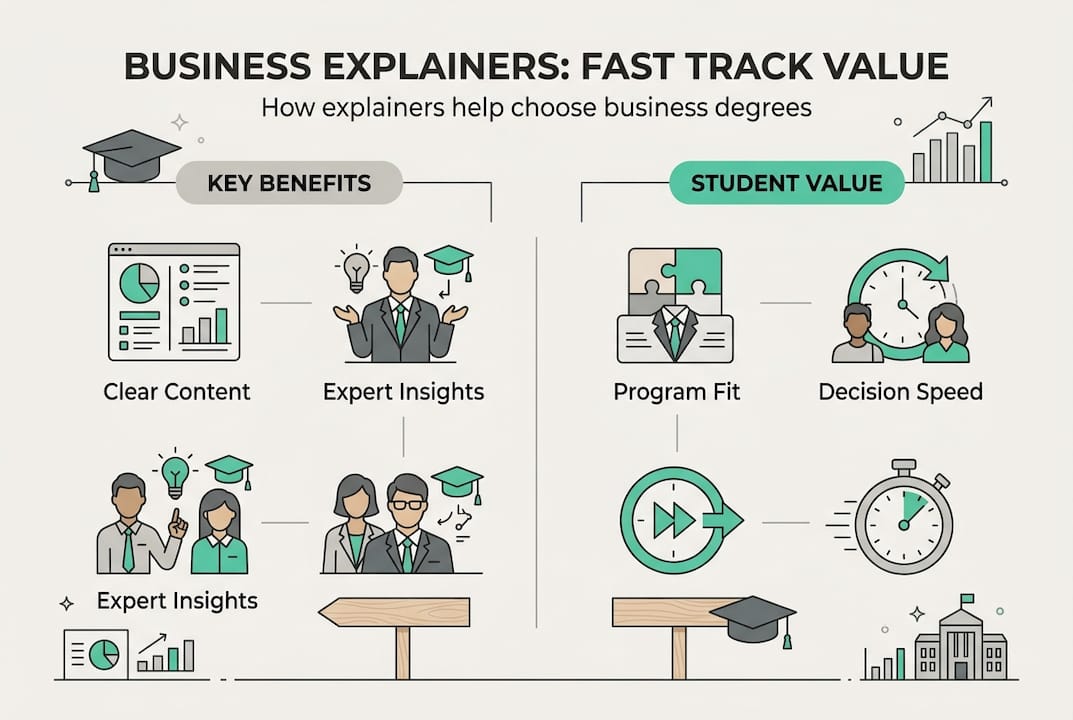
How business school explainers guide program selection and study abroad planning
Now, let’s detail how explainer videos inform your search for the right accelerated degree, especially for study abroad. This is where the format becomes genuinely practical.
Business school explainers provide accessible introductions to concepts taught in accelerated degrees, helping students evaluate fit for international qualifications. That fit question is critical when you are choosing between programs in different countries with different academic cultures.
“The teaching style you see in a school’s public content is usually the teaching style you will experience inside the classroom.”
Here is a practical comparison of how explainers help you evaluate different program types:
| Program type | What explainers reveal | What to look for |
|---|---|---|
| One-year accelerated MBA | Pace, concept density, faculty communication style | Fast explanations, minimal repetition |
| Two-year traditional MBA | Depth, case study emphasis, networking culture | Narrative-heavy, relationship-focused content |
| Online international MBA | Digital delivery quality, global topic relevance | Clear visuals, globally applicable examples |
| Bachelor’s in business management | Foundational breadth, practical application | Accessible language, real-world examples |
For students considering accelerated business degrees that combine study in multiple countries, explainers also signal how globally oriented a school’s curriculum is. A school producing content on AI, sustainability, and global entrepreneurship is signaling that its program reflects current international business realities.
Pro Tip: If a school does not publish explainer videos, look for sample lecture recordings or student-led webinars on their official YouTube channel. These serve the same purpose and give you an equally honest preview of teaching quality.
Not every school makes this research easy. Some rely entirely on brochures and rankings. In those cases, use the guide to online MBA resources and look for alumni panels or open-day recordings. The goal is always the same: find real academic content before you commit. Exploring fast-track degrees across multiple schools becomes far more efficient when you have actual teaching samples to compare.
Pros and cons: Do all business schools offer explainer videos?
Finally, before you rely fully on explainer videos, let’s examine where this approach works best and its real limitations.
The honest answer is that most schools do not offer a dedicated explainer series. Stanford GSB’s series is prominent and widely recognized, but many top-ranked schools rely on other formats entirely. Some use long-form faculty interviews. Others publish written thought leadership. A few offer nothing publicly accessible at all.
Here is a realistic breakdown of what you will find across schools:
- Schools with dedicated explainer series: Rare. Stanford GSB is the clearest example.
- Schools with sample lectures or open courseware: More common. MIT OpenCourseWare is a well-known example outside the MBA space.
- Schools with webinars and alumni panels: Very common. Most accredited programs offer these around application season.
- Schools with no public academic content: Still exist, particularly among newer or regionally focused institutions.
The absence of an explainer series does not mean a school is weak. It may simply reflect a different outreach strategy. However, the absence of any public academic content is a red flag worth noting.
Pro Tip: When researching benefits of online MBA programs, treat the quality of a school’s public content as a proxy for the quality of its online delivery. Schools that communicate clearly in public tend to teach clearly online.
The key takeaway is this: use explainers as one data point among several. Combine them with rankings, accreditation checks, alumni reviews, and direct conversations with admissions teams. No single source gives you the full picture.
Explore your accelerated business degree options
You now know how to read a business school’s public content like an insider. That knowledge is most useful when you apply it to real program research.
At Seekstudy, we build our programs around the same principles that make great explainers work: clarity, relevance, and real-world application. Our accelerated business degrees are Ofqual-regulated and internationally recognized, combining online flexibility with study experiences across Singapore and the UK. Whether you are starting with a Bachelor in Business Management or evaluating graduate options, our program pages give you the transparent curriculum detail you have been looking for. Explore the full range of types of business degrees we offer and find the path that fits your timeline and career goals.
Frequently asked questions
Are business school explainer videos only for enrolled students?
No. Explainer videos are designed for anyone interested in business topics, including prospective students and the general public. They are free and openly accessible on school websites and YouTube channels.
Can an explainer video help me decide on a business degree?
Yes. Watching explainers gives you a fast sense of a school’s teaching style and program content. Explainers provide accessible introductions to concepts taught in real programs, helping you evaluate whether the approach fits your learning goals.
What if a school doesn’t publish explainers? How else can I learn about programs?
Look for sample lectures, open-day webinars, or alumni panels on official school sites and YouTube. Not all business schools have dedicated explainer series, but most accredited programs offer some form of public academic content.
Do explainers cover advanced business topics or just basics?
Many start with foundational concepts, but select videos cover current topics in technology, sustainability, and management. Explainer topics include entrepreneurship, AI, carbon reporting, and machine learning, which are graduate-level subjects in most business programs.