

Many prospective students believe business management degrees focus only on abstract theory. Modern bachelor in business management programs combine foundational business knowledge with leadership development, ethical practice, and hands-on experience. This guide explains the degree structure, curriculum requirements, practical training opportunities, and career outcomes to help you decide if this path matches your professional goals in 2026.
Table of Contents
- Understanding The Bachelor’s In Business Management Degree
- Core Curriculum And Areas Of Specialization
- Gaining Practical Experience: Internships And Real-World Projects
- Career Opportunities And Skills Developed
- Explore Fast-Track Business Management Degrees With SeekStudy
- Frequently Asked Questions
Key takeaways
| Point | Details |
|---|---|
| Credit requirement | About 120 credit hours including core business and general education courses. |
| Core competencies | Programs emphasize leadership, ethics, communication, and global business awareness throughout coursework. |
| Practical experience | Internships and real-world projects build career readiness and may earn academic credit. |
| Career diversity | Graduates work as managers, analysts, consultants, and HR specialists across multiple industries worldwide. |
| Flexible formats | Online and accelerated options support international students and working professionals. |
Understanding the bachelor’s in business management degree
The bachelor in business management is a comprehensive undergraduate program that prepares students for leadership roles across diverse business sectors. Programs typically require 120 credit hours to complete, combining general education with specialized business coursework. Students develop foundational competencies in critical thinking, quantitative analysis, communication, ethical decision making, and global business awareness.
The degree structure allows for concentration areas after core courses so students can focus on specific management disciplines that match their career interests. This flexibility enables learners to build expertise in project management, operations, human resources, or other specialized areas while maintaining broad business knowledge. Most programs also enforce 30-credit residency requirements to ensure academic quality and institutional standards.
Core competencies equip graduates with versatile skills applicable across business contexts:
- Leadership and team management capabilities for supervising diverse workforces
- Ethical reasoning frameworks for responsible business decisions
- Communication proficiency for presenting ideas to stakeholders and clients
- Quantitative analysis skills for interpreting financial and operational data
- Global business perspectives for working in international markets
Understanding what is business management helps prospective students recognize how these programs differ from narrower business degrees. The curriculum balances theoretical frameworks with practical application, preparing graduates to adapt to changing business environments and technological disruptions.
Core curriculum and areas of specialization
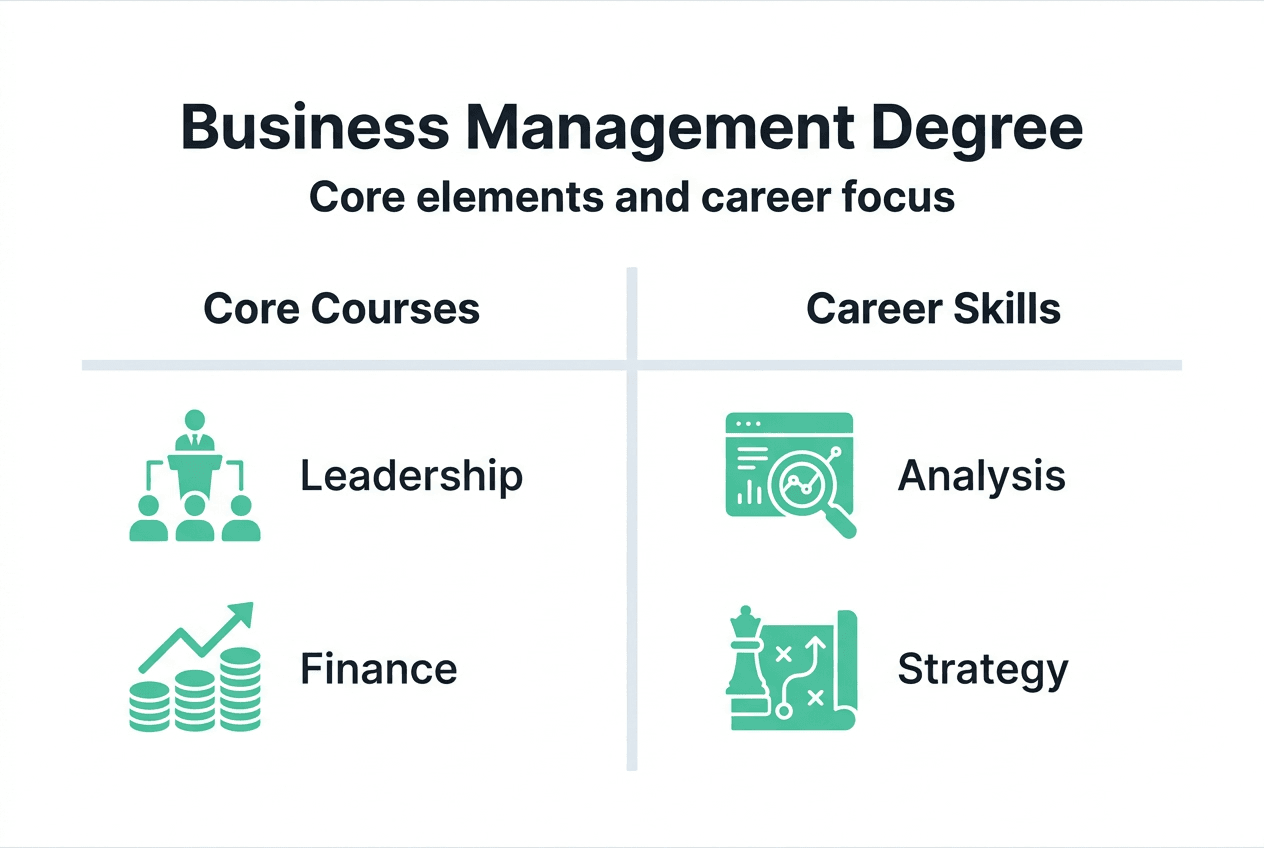
Business management bachelor’s programs follow a structured curriculum that builds from foundational business principles to specialized knowledge areas. Core courses cover finance, marketing, operations, human resources, information technology, and entrepreneurship before students declare concentrations. This broad exposure ensures graduates understand how different business functions interconnect and influence organizational success.
The curriculum emphasizes ethical and global awareness, communication skills, and critical thinking throughout all coursework. Students learn to analyze complex business problems from multiple perspectives, considering stakeholder impacts and long-term sustainability. These themes integrate into courses rather than existing as standalone topics, reinforcing their importance across all business disciplines.
After completing core requirements, students select specializations that align with career goals. Common concentration areas include:
- Project management for coordinating cross-functional initiatives
- Operations management for optimizing production and service delivery
- Human resource management for talent acquisition and development
- International business for global market entry and expansion
- Entrepreneurship for launching and scaling new ventures
Flexible study formats accommodate international and working students who need to balance education with other commitments. A diploma in business management may serve as a stepping stone toward the bachelor’s degree for students building credentials progressively. Online programs deliver the same rigorous curriculum as on-campus options while offering location independence.
| Curriculum Component | Typical Credit Hours | Primary Focus |
|---|---|---|
| General education | 30-40 credits | Critical thinking, communication, quantitative skills |
| Business core | 40-50 credits | Finance, marketing, operations, management fundamentals |
| Specialization courses | 15-20 credits | Concentrated expertise in chosen management area |
| Electives and capstone | 10-20 credits | Applied projects, internships, additional interests |
This curriculum structure ensures students develop both breadth and depth in business knowledge, preparing them for entry-level management positions and continued professional growth.
Gaining practical experience: internships and real-world projects
Theoretical knowledge alone does not prepare students for workplace challenges. Hands-on courses and labs provide real-world experiences through partnerships with actual companies, allowing students to apply classroom concepts to live business problems. These experiential learning opportunities develop problem-solving skills, professional judgment, and confidence in uncertain situations.

Internships and externships enhance career preparation and academic transcripts, with many programs offering academic credit for structured work experiences. Internships typically involve several months of supervised work at host organizations, while externships offer shorter, observation-focused experiences. Both formats expose students to industry practices, workplace dynamics, and professional networking opportunities that classroom learning cannot replicate.
Engagement with industry partners creates multiple benefits for students:
- Direct exposure to current business practices and emerging trends
- Networking connections that often lead to job offers after graduation
- Resume credentials that distinguish candidates in competitive job markets
- Opportunities to test career interests before committing to specific paths
- Mentorship from experienced professionals who provide guidance and feedback
Pro Tip: Seek internships aligned with your specialization during your final year to maximize career relevance and build targeted experience that employers value. Start researching opportunities at least six months before your preferred start date, as competitive positions fill quickly.
Students pursuing international business degree paths should prioritize internships with global companies or organizations with cross-border operations. These experiences build cultural competence and international business awareness that classroom instruction alone cannot develop. The SeekStudy blog offers additional guidance on finding and securing internships that match your career aspirations.
Many programs require capstone projects where students tackle real business challenges presented by industry partners. These projects integrate knowledge from multiple courses, develop teamwork skills, and produce tangible deliverables that students can showcase to prospective employers.
Career opportunities and skills developed
Bachelor’s programs equip students with leadership, critical thinking, and analytical decision-making skills that employers across industries value. Graduates gain the ability to analyze complex situations, develop strategic solutions, and communicate recommendations effectively to diverse audiences. These transferable competencies enable career mobility and advancement across different sectors and geographic markets.
Management majors get hired as business analysts, account executives, assistant managers, operations managers, HR managers, employment interviewers, and consultants in organizations ranging from startups to multinational corporations. Career paths span government agencies, manufacturing firms, retail chains, banking institutions, healthcare systems, and technology companies. This diversity reflects the universal need for skilled managers who can coordinate resources, lead teams, and drive organizational performance.
Graduates develop several critical attributes that enhance employability:
- Adaptability to changing business conditions and technological disruptions
- Ethical decision-making frameworks for navigating complex stakeholder interests
- Data literacy for interpreting analytics and supporting decisions with evidence
- Cross-cultural competence for working in diverse and global teams
- Strategic thinking for connecting daily operations to long-term organizational goals
Fast-track and online degree formats improve career placement prospects by reducing time to degree completion and minimizing career interruptions. Students can apply new knowledge immediately in their current roles while building credentials for advancement. Accelerated business degrees career boost potential by allowing graduates to enter competitive job markets sooner with relevant, up-to-date skills.
| Career Path | Typical Entry Role | Key Responsibilities | Industries |
|---|---|---|---|
| Management track | Assistant manager | Team supervision, operational coordination | Retail, hospitality, manufacturing |
| Human resources | HR coordinator | Recruitment, employee relations, training | All sectors |
| Business analysis | Junior analyst | Data analysis, process improvement, reporting | Finance, consulting, technology |
| Operations | Operations specialist | Supply chain, logistics, quality management | Manufacturing, distribution |
| Consulting | Associate consultant | Client projects, research, presentation support | Professional services |
Pro Tip: Develop proficiency in data analysis tools and project management software during your studies to differentiate yourself in the job market. Employers increasingly expect entry-level managers to work comfortably with business intelligence platforms and collaboration technologies.
Business management best practices fast track degrees 2026 emphasize continuous learning and professional development beyond the bachelor’s degree. Many graduates pursue certifications, specialized training, or advanced degrees as they progress in their careers and target senior leadership positions.
Explore fast-track business management degrees with SeekStudy
Ready to accelerate your career with a globally recognized business management degree? SeekStudy offers fast track degree programs designed specifically for international learners and working professionals who need flexibility without sacrificing quality. Our accredited bachelor’s programs integrate leadership development, ethical practice, communication skills, and real-world business applications into streamlined curricula.

Our programs compress traditional four-year degrees into accelerated timelines while maintaining rigorous academic standards and practical training components. Students benefit from partnerships with UK, Hong Kong, Singapore, and Australian institutions that provide international study experiences and globally recognized credentials. Whether you’re starting your business education or advancing from a diploma, SeekStudy’s flexible formats accommodate your schedule and learning preferences. Discover how accelerated business degrees career boost your professional trajectory and learn how to prepare for fast track degrees online abroad to start your journey in 2026.
Frequently asked questions
What is the credit hour requirement for a bachelor’s in business management?
Most programs require approximately 120 credit hours including general education, core business courses, specialization coursework, and electives. Many institutions also enforce 30-credit residency requirements to ensure students complete sufficient work under direct institutional supervision.
Can I complete a bachelor’s in business management online and internationally?
Yes, many accredited programs offer fully online formats designed for international students and working professionals. These flexible options provide the same rigorous curriculum as traditional on-campus programs while accommodating diverse schedules and geographic locations. Why study management online explores the specific advantages of digital learning formats for business education.
What career paths are available with this degree?
Graduates pursue roles as business analysts, operations managers, HR managers, consultants, assistant managers, and account executives across multiple industries. The degree opens opportunities in retail, government, manufacturing, banking, healthcare, and technology sectors worldwide. Business management best practices fast track degrees 2026 provides detailed career pathway guidance for recent graduates.
How important are internships during the degree?
Internships greatly enhance career preparation by providing practical experience, professional networking, and resume credentials that distinguish candidates in competitive job markets. Many programs allow internships to fulfill academic requirements, earning credit while building career-relevant skills. Students who complete internships typically receive more job offers and higher starting salaries than those without practical experience.