

Balancing a fast-paced career with studies can leave you wondering how modern organizations stay efficient and competitive. The world of business management is more than decisions in a British boardroom—it centers on the practical application of core functions like strategy, planning, and team leadership. Understanding the core functions of management will help you map out your own pathway toward a UK-accredited degree, giving you real skills to manage both teams and challenges in a rapidly changing, global environment.
Table of Contents
- Defining Business Management And Its Core Principles
- Major Types Of Business Management Explained
- Key Functions And Responsibilities In Practice
- Skills, Qualifications, And Career Pathways
- Common Challenges And Global Considerations
Key Takeaways
| Point | Details |
|---|---|
| Core Functions of Management | Effective business management relies on five key functions: Planning, Organizing, Directing, Controlling, and Strategy Development. Understanding these functions is essential for successful management practice. |
| Emphasis on Human Element | Successful management hinges on human resource development and cultivating psychological safety within teams, fostering an environment where people can excel. |
| Specialized Management Types | Awareness of various management types—Strategic, Operational, Financial, Human Resource, Marketing, Project, and Risk Management—allows managers to tailor their approaches to specific organizational needs. |
| Adaptability to Change | Managers must be adaptable to remain effective in the face of globalization, technological advances, and evolving workforce expectations, balancing control with flexibility to navigate challenges. |
Defining Business Management and Its Core Principles
Business management isn’t just about making decisions from a corner office. It’s the practical application of core functions that keep organizations running smoothly, from strategy development to daily team leadership.
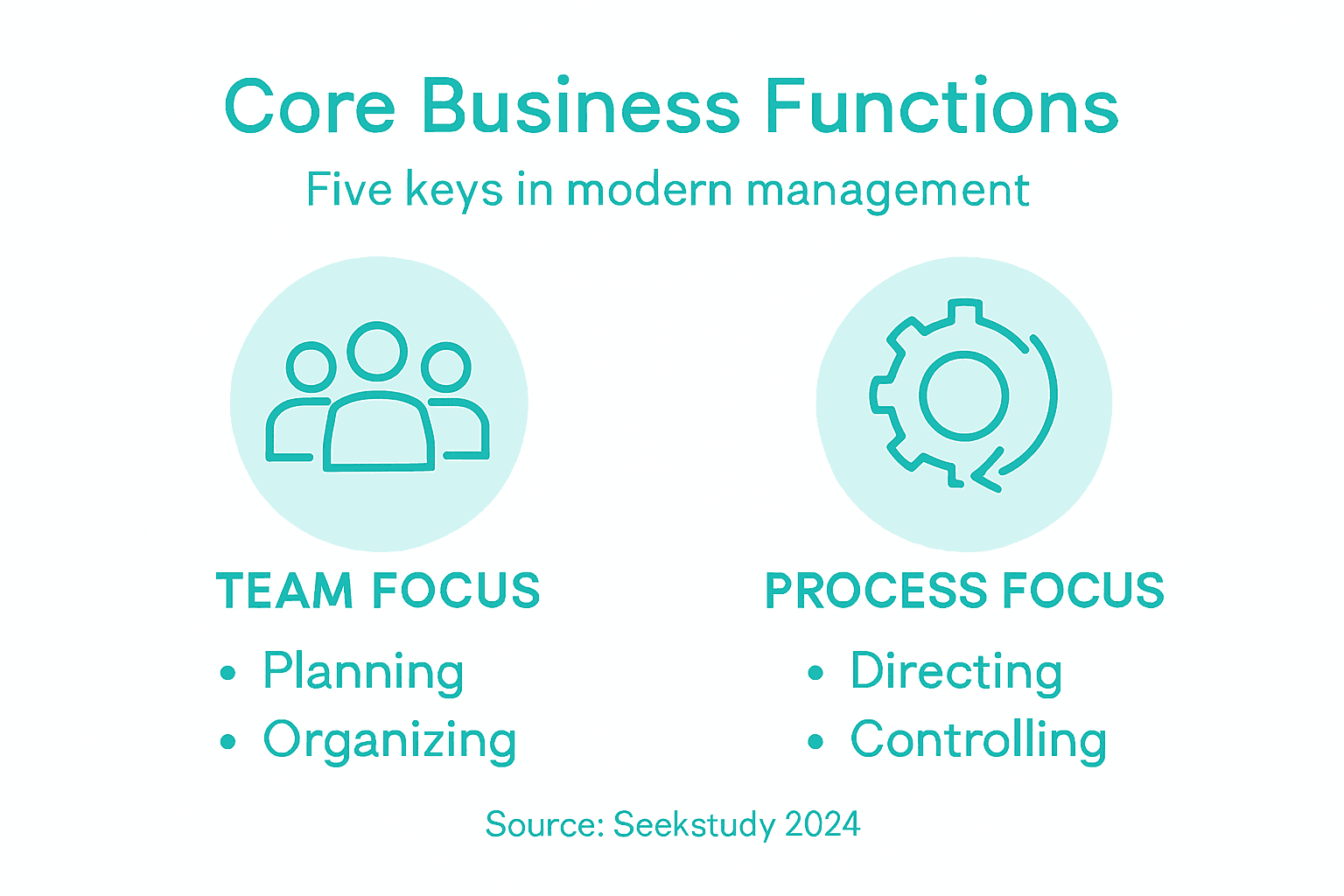
At its foundation, business management revolves around five critical functions:
- Planning: Setting goals and determining how to achieve them
- Organizing: Structuring resources and assigning responsibilities
- Directing: Leading and motivating teams toward objectives
- Controlling: Monitoring performance and making adjustments
- Strategy development: Ensuring long-term competitive advantage
These principles have remained consistent for decades, even as technology transforms how managers work. Today’s managers use analytics and metrics beyond traditional financial data—customer satisfaction, quality measurements, and operational efficiency metrics all shape decisions.
The Human Element
Management is fundamentally about people. You can have perfect systems and budgets, but without effective human resource development and mentoring, organizations stagnate.
This means:
- Building team capabilities through training and mentorship
- Creating psychological safety where people take informed risks
- Recognizing cultural differences in global teams (especially relevant when you’re working across time zones)
- Adapting to international standards like ISO certifications
Management today isn’t about control—it’s about enabling people to do their best work while achieving organizational goals.
Beyond Traditional Thinking
Contemporary business management extends beyond the traditional view of managerial power. Modern frameworks recognize six dimensions including management as participation, responsive action, and meaning-making.
This matters for you because it means effective managers aren’t just directive leaders—they’re collaborators, listeners, and strategic communicators. Whether you’re managing a remote team or working across Singapore and UK offices, this adaptive approach to leadership becomes your competitive advantage.
Why This Matters Now
Globalization and technological change have accelerated the need for managers who understand these principles deeply. Organizations face constant disruption, which means managers must balance control with flexibility, tradition with innovation, and centralized strategy with localized execution.
You’re entering a field where these core principles form your foundation, but how you apply them determines your effectiveness.
Pro tip: Start mapping how these five core management functions apply in your current role or industry—this clarity will help you understand management in action rather than just theory.
Major Types of Business Management Explained
Business management isn’t a one-size-fits-all discipline. Different organizational functions require specialized management approaches, each addressing unique challenges and objectives.
Here are the primary types you’ll encounter:
- Strategic management: Defines long-term vision and competitive positioning
- Operational management: Handles day-to-day activities and resource optimization
- Financial management: Oversees budgeting, investments, and financial health
- Human resource management: Manages recruitment, development, and employee engagement
- Marketing management: Builds brand presence and drives customer acquisition
- Project management: Oversees specific initiatives with defined timelines and budgets
- Risk management: Anticipates challenges and develops mitigation strategies
Strategic vs. Operational
These two types form the backbone of organizational structure. Strategic management focuses on where the company goes long-term, while operational management ensures efficiency in executing daily operations.
For international students balancing studies with work, understanding this distinction matters. Strategic roles require broader organizational perspective, while operational roles focus on immediate execution and measurable outcomes.
Managing People and Money
Human resource management directly impacts team performance and retention. This includes hiring, training, and creating workplace culture.
Financial management ensures resources are allocated wisely:
- Budgeting for departments and projects
- Investment decision-making
- Monitoring profitability and cash flow
- Planning for long-term financial sustainability
These functions interconnect—poorly trained teams waste financial resources, while poor financial planning limits development opportunities.
Here’s a quick comparison of major business management types and their specific organizational impact:
| Management Type | Key Objective | Typical Outcome | Where It’s Most Critical |
|---|---|---|---|
| Strategic Management | Define long-term direction | Sustained competitive advantage | Leadership, executive planning |
| Operational Management | Optimize daily processes | Greater efficiency and productivity | Manufacturing, service delivery |
| Financial Management | Steward financial resources | Stability and scalable growth | Finance, investment decisions |
| Human Resource Management | Build capable teams | High engagement and retention | Talent-driven organizations |
| Marketing Management | Grow brand and sales | Customer loyalty and market share | Retail, consumer marketing |
| Project Management | Drive completion of projects | Successful product launches | Tech, construction, consulting |
| Risk Management | Minimize vulnerabilities | Improved resilience and compliance | Global operations, finance |
Each management type serves a specific organizational need, but they work together to create sustainable business success.
Innovation, Projects, and Sustainability
Change and innovation management helps organizations adapt to market shifts. This becomes critical in fast-moving industries where standing still means falling behind.

Project management handles time-bound initiatives—launching new products, implementing systems, or expanding operations. It’s distinct from operational management because projects have clear endpoints.
Environmental and sustainability management addresses corporate responsibility and regulatory compliance. This increasingly influences hiring, investment, and brand decisions.
Why These Distinctions Matter
When pursuing a business management qualification, understanding these specialized areas helps you identify your career direction. Some people thrive in strategic roles requiring big-picture thinking. Others excel in project management’s structured, deadline-driven environment. Still others find fulfillment in human resources or financial analysis.
Your career path depends partly on which management type aligns with your strengths and interests.
Pro tip: Identify which two management types most appeal to you, then seek projects or internships specifically in those areas—this focused experience makes you more marketable than general management exposure.
Key Functions and Responsibilities in Practice
Management sounds abstract until you see it in action. Real managers spend their days juggling multiple responsibilities that directly impact organizational performance.
Core responsibilities include:
- Strategic planning: Setting objectives based on market research and competitive analysis
- Resource allocation: Distributing budgets, personnel, and tools across departments
- Team leadership: Motivating employees and fostering collaboration
- Decision-making: Evaluating risks and opportunities with available information
- Progress monitoring: Tracking performance against objectives and adjusting course
- Cross-departmental communication: Ensuring alignment between teams and functions
Planning That Actually Works
Strategic planning requires setting objectives based on market research and organizational capabilities. You can’t set goals in a vacuum—effective managers analyze competitors, understand customer needs, and assess internal strengths.
For international students managing coursework alongside professional responsibilities, this mirrors your own planning. You set realistic goals based on your available time, competing priorities, and learning capacity.
Organizing and Leading
Organizing means structuring workflows so people understand their roles and how they contribute to larger goals. Confusion breeds inefficiency.
Leadership goes beyond giving orders. Effective managers:
- Communicate clearly why tasks matter
- Recognize team contributions publicly
- Provide feedback that develops capabilities
- Create psychological safety for honest conversations
- Model the behaviors they expect
These sound simple but require constant practice and self-awareness.
The difference between a manager and a leader is visibility—managers oversee processes; leaders inspire people to care about outcomes.
Making Decisions Under Uncertainty
Managers rarely have perfect information. You analyze available data, consult stakeholders, and decide with incomplete certainty. This requires combining analytical skills with judgment.
Good decisions balance multiple considerations:
- Financial impact and feasibility
- Team capacity and development
- Customer or stakeholder needs
- Strategic alignment
- Risk tolerance and contingencies
You’ll make wrong calls sometimes. What matters is learning quickly and adjusting.
Communication Across Boundaries
Managers are organizational translators. You communicate strategic vision to operational teams, then translate team feedback upward to executives. Different audiences need different messages.
Clear communication prevents:
- Duplicated effort across departments
- Missed deadlines from misaligned expectations
- Conflict from misunderstandings
- Lost institutional knowledge when people leave
For remote and international teams, this skill becomes even more critical since you lack informal hallway conversations.
Continuous Improvement
Monitoring progress isn’t just about catching problems—it’s about identifying improvement opportunities. Managers ask what’s working, what isn’t, and how to do better next time.
This mindset of continuous improvement compounds over time, turning good teams into exceptional ones.
Pro tip: Start documenting one responsibility you handle well and one that frustrates you, then identify what skills would make each easier—this self-awareness accelerates your management development.
Skills, Qualifications, and Career Pathways
Management careers don’t follow a single linear path. Your qualifications, specialized skills, and chosen focus area shape where you can go and how quickly you advance.
Essential skills across all management roles include:
- Leadership: Inspiring and directing teams toward objectives
- Strategic thinking: Seeing patterns and planning for future scenarios
- Decision-making: Analyzing data and making calls with incomplete information
- Communication: Translating complex ideas for different audiences
- Analytical ability: Using data to support recommendations
- Emotional intelligence: Understanding and managing relationships effectively
Specializations Shape Your Career
Your career direction depends partly on which area fascinates you. Popular specializations include marketing management, financial management, human resource management, and international business, each developing unique expertise.
Choosing a specialization early helps you stand out. You become the person who understands not just management broadly, but deeply in one critical function. This matters when competing for roles and building your professional reputation.
Building Qualifications
A business management degree provides foundational knowledge, but employers want more. They look for candidates who combine academic credentials with practical experience.
Strengthen your qualifications through:
- Internships or part-time roles in your target specialization
- Professional certifications (Project Management Professional, HR certifications)
- Leadership projects where you’ve managed teams or budgets
- Cross-functional projects demonstrating adaptability
- Industry-specific training aligned with your career goals
The most employable graduates combine solid academic foundations with real-world experience proving they can execute in actual business environments.
Diverse Career Options
A business management qualification opens doors across industries. Possible career paths include:
- Business analyst evaluating processes and recommending improvements
- Management consultant advising organizations on strategy
- Project manager overseeing specific initiatives
- Operations manager optimizing daily workflows
- Supply chain manager coordinating procurement and logistics
- Corporate investment banker analyzing financial deals
Each path requires slightly different skill emphasis and experience.
Fast-Track Progression
If you’re balancing work and study, fast-track degree programs let you accelerate your qualifications without sacrificing your current career momentum. Completing your degree in two years instead of four means you reach management roles faster, which compounds over your career.
This acceleration matters especially for international students juggling multiple responsibilities. You earn your credential, prove your capability, and advance within your organization sooner.
The Experience Advantage
Employers consistently rank work experience higher than degree prestige. Someone with three years of operational experience managing budgets beats someone with a pristine degree but no hands-on exposure.
Seek roles where you progressively take on more responsibility. Entry-level coordinator roles teach you systems. Supervisor positions teach you team dynamics. Manager roles teach you strategic thinking. Each step builds capability for the next.
Pro tip: Choose your first management-adjacent role based on which specialization interests you most, not just salary—the skills you develop and network you build in year one determine opportunities available in year five.
Common Challenges and Global Considerations
Managing in today’s environment means navigating complexity at every level. Global operations, technological disruption, and evolving workforce expectations create challenges that didn’t exist a decade ago.
Key challenges managers face include:
- Cultural differences: Communication styles, decision-making norms, and work expectations vary significantly across regions
- Regulatory complexity: Different countries have different labor laws, tax requirements, and compliance standards
- Operational efficiency: Coordinating work across time zones and maintaining quality standards globally
- Talent management: Attracting, developing, and retaining skilled people in competitive markets
- Technological disruption: AI, automation, and digital transformation reshaping workflows constantly
- Sustainability pressures: Stakeholders expect environmental and social responsibility
The Global Management Reality
Managing teams across borders requires more than just business knowledge. Global business management faces challenges including cultural differences, legal compliance, and quality assurance across borders, all while maintaining customer satisfaction and organizational reputation.
For international students building careers across multiple countries, this directly affects you. You’ll navigate different work cultures, legal systems, and management styles simultaneously. This exposure becomes your competitive advantage if you develop genuine cultural competence.
Technology and Rapid Change
Artificial intelligence and automation reshape job roles faster than organizations can retrain workers. Managers must balance efficiency gains with employee anxiety about job security.
Digital transformation impacts marketing, operations, and customer service. Social media influences brand perception instantly. Remote work has become permanent for many organizations, shifting how teams collaborate.
Adaptability isn’t optional anymore—it’s your baseline skill requirement in any management role.
Workforce and Culture Shifts
Contemporary management requires addressing:
- Remote and hybrid work arrangements
- Diversity and inclusion expectations
- Generational differences in work values
- Mental health and work-life balance concerns
- Skills gaps from rapid technological change
Managers who ignore these shifts lose talented people to competitors who value them.
This table summarizes global management challenges and the essential traits for managers to overcome them:
| Challenge | Typical Problems | Essential Manager Trait |
|---|---|---|
| Cultural Differences | Miscommunication, conflict | Cultural awareness, adaptability |
| Regulatory Complexity | Compliance, legal risk | Attention to detail, diligence |
| Operational Efficiency | Time zone delays, quality | Process optimization, flexibility |
| Talent Management | Retention, skill shortages | Empathy, talent development |
| Technological Disruption | Resistance to change | Tech-savvy, open-mindedness |
| Sustainability Pressure | Reputation, stakeholder push | Ethical leadership, foresight |
Sustainability and Social Responsibility
Organizations face increasing pressure on environmental and ethical practices. Employees, customers, and regulators all demand accountability.
This means managers must balance profit with purpose. You can’t ignore sustainability, diversity, or ethical concerns anymore. These aren’t nice additions—they’re business requirements.
Navigating Complexity Successfully
Effective managers in this environment share common traits: they stay informed about industry changes, seek diverse perspectives, adapt quickly when conditions shift, and build teams resilient enough to handle uncertainty.
The managers thriving aren’t those with all the answers. They’re the ones asking good questions, learning continuously, and creating psychological safety for their teams to experiment and fail constructively.
Pro tip: When facing a challenge unfamiliar to you, start by seeking perspectives from people with different backgrounds and experiences—your international education position gives you natural access to diverse viewpoints that solve problems faster than individual expertise alone.
Accelerate Your Business Management Career with Seekstudy
Understanding core business management principles like planning, organizing, and strategic decision-making is essential in today’s fast-paced global environment. If you are looking to overcome challenges such as balancing operational efficiency with innovation or mastering cross-cultural leadership, Seekstudy offers fast-track degree programs designed to equip you with these critical skills. Whether you aim to specialize in strategic management, human resources, or financial management, our accredited bachelor’s and master’s degrees bring practical knowledge directly to your fingertips.

Take the next step toward transforming your future with a two-year bachelor’s degree in business management or an online one-year MBA. Benefit from international study options combining Singapore and the UK, and gain a UK-recognized degree without relocating. Explore how our programs solve the exact challenges highlighted in “What Is Business Management and Why It Matters” by developing your leadership, decision-making, and global management skills. Visit Seekstudy now and start shaping your successful management career today.
Frequently Asked Questions
What are the core functions of business management?
Business management revolves around five critical functions: planning, organizing, directing, controlling, and strategy development. These functions ensure organizations run smoothly and achieve their objectives.
Why is the human element important in business management?
The human element is vital because management is fundamentally about people. Effective human resource development, mentorship, and creating a psychologically safe environment are essential for fostering team capabilities and achieving organizational goals.
How do strategic and operational management differ?
Strategic management focuses on long-term vision and competitive positioning, while operational management ensures efficiency in day-to-day activities and resource optimization. Both are essential for an organization’s success but serve different purposes.
What challenges do managers face in a global business environment?
Managers face challenges including cultural differences, regulatory complexity, operational efficiency, talent management, technological disruption, and sustainability pressures. Successfully navigating these complexities requires adaptability and strong leadership skills.