

Starting your business career in a single country can feel limiting when opportunities now cross every border and time zone. For students looking to move quickly into the global job market, international business degree programs offer practical skills matched to today’s interconnected economies. These programs blend business fundamentals with cultural intelligence, and flexible options including fast-track timelines, online learning, and trusted partnerships between the UK and Asia make earning a recognized degree more accessible than ever.
Table of Contents
- Defining International Business Degree Programs
- Types of International Business Degrees Explained
- Key Curriculum and Study Experiences
- Admission Criteria and Qualifications Needed
- Career Outcomes and Practical Benefits
Key Takeaways
| Point | Details |
|---|---|
| International Business Degrees Prepare for Global Careers | These programs combine business fundamentals with skills necessary for managing operations in multinational environments. |
| Real-World Experience is Essential | Internships and study abroad components are crucial for developing practical skills and cultural understanding. |
| Various Degree Options Available | Programs include bachelor’s, master’s, and executive formats, catering to different career stages and goals. |
| Strong Career Opportunities Across Industries | Graduates are in demand for roles requiring cross-cultural communication and analytical skills, ensuring job security and competitive salaries. |
Defining International Business Degree Programs
An international business degree prepares you for careers that cross borders, currencies, and cultures. These programs teach you how global economies work and how to operate effectively in multinational environments.
International business degree programs focus on practical skills you’ll actually use. You learn global marketing strategies, international finance, and how to manage teams across different countries. The curriculum blends business fundamentals with cultural intelligence and geopolitical awareness.
What Sets These Programs Apart
Unlike standard business degrees, international programs emphasize:
- Cross-cultural communication and intercultural competence
- Global economics and how international trade shapes business
- Strategic planning for multinational operations and expansion
- Language skills or at least cultural fluency in major markets
- Real-world experience through internships, case studies, or study abroad components
Many programs combine classroom learning with practical exposure. You might study business management in the UK, then complete coursework in Singapore or Hong Kong. This combination gives you direct experience with different business environments and regulatory systems.
International business degrees equip you with skills for the global economy and careers with multinational corporations that dominate today’s business landscape.
The Core Focus Areas
Most programs center on preparing managers and professionals for multinational business environments. You’ll explore topics like international human resource management, global supply chain operations, and cross-border negotiations. These aren’t abstract concepts—they’re skills companies actively need.

Programs also stress diplomacy and cultural sensitivity. Understanding political systems, trade agreements, and cultural nuances isn’t optional anymore. Companies expanding globally need employees who can navigate these complexities without creating costly mistakes.
The analytical and communication skills developed in these programs matter significantly. You learn to interpret global markets, present findings to diverse audiences, and write proposals that work across cultural contexts. These competencies directly transfer to management roles at international firms.
Program Formats Available
You have flexibility in how you study:
- Full-time on-campus programs (typically 3-4 years for bachelor’s degrees)
- Online or hybrid options allowing you to study while working
- Fast-track programs completing degrees in 2 years instead of 4
- Master’s degrees (1-2 years) for career advancement
Fast-track international business degrees have gained momentum with international students. They maintain the same rigor and accreditation while condensing timelines. Combined with online flexibility and partnerships across UK, Asia, and Australia, these programs offer genuine accessibility without compromising quality.
Pro tip: When evaluating programs, check whether they include real international study components—not just online coursework. Actual time in different business environments teaches cultural navigation that classroom alone cannot provide.
Types of International Business Degrees Explained
International business degrees come in different formats, each designed for different career stages and goals. Understanding the distinctions helps you choose the right program for your timeline and ambitions.
Bachelor’s Degrees in International Business
A bachelor’s degree in international business is your entry point into global careers. These programs typically run three to four years, though fast-track options compress the timeline to two years. You’ll build foundational knowledge in accounting, economics, and business fundamentals while specializing in international dimensions.
Bachelor’s programs emphasize:
- Core business skills applicable across industries
- Cultural awareness and language exposure
- Internship opportunities with multinational companies
- Study abroad components in major business hubs
- Entry-level readiness for analyst or coordinator roles
Many universities now offer flexible bachelor’s programs combining online coursework with international study blocks. You might complete foundation courses online, then study in the UK for one semester and Asia for another, finishing with a UK-recognized degree.
Master’s Programs: MBA vs. Master of International Business
At the graduate level, you have two primary paths. A traditional MBA focuses on general management across functions. A Master of International Business focuses specifically on multinational corporations and cross-cultural management.
The Master of International Business (MIB) includes specialized coursework:
- International political economy and trade law
- Multinational business strategy and operations
- Global marketing and finance
- Language studies or cultural competency
- International human resource management
MBA programs work well if you want broader career flexibility. MIB programs suit professionals targeting international firms, expansion roles, or global management positions specifically.
Here is a quick comparison of international business degree options and their key advantages:
| Degree Type | Typical Duration | Best For | Distinguishing Feature |
|---|---|---|---|
| Bachelor’s | 3-4 years (2 for fast-track) | High school graduates | Foundational business and cultural skills |
| Master of Int’l Business | 1-2 years | Early- to mid-career professionals | Multinational-focused curriculum |
| MBA | 1-2 years | Career advancers across functions | Broad management skillset |
| Executive MBA | 18-24 months (part-time) | Working professionals | Network with experienced peers |
Master’s degrees in international business compress two years of intensive study into focused, career-accelerating timelines that deliver immediate professional impact.
Executive MBA Programs
If you’re already working, an executive MBA maintains your income while advancing credentials. These programs run evenings, weekends, or intensive blocks. Cohort-based learning means you study alongside experienced professionals from different industries.
Executive programs compress 18 to 24 months of study. You gain international business expertise without pausing your career. Many professionals use executive programs to transition into international roles or lead global operations at their current company.
Fast-Track Options
Fast-track programs complete degrees in two years instead of the traditional three or four. They maintain academic rigor and accreditation while accelerating pace through:
- Condensed course schedules
- Year-round study rather than semester breaks
- Online components reducing travel requirements
- Prerequisite knowledge allowing advanced course loads
Fast-track bachelor’s degrees paired with online flexibility make international education accessible. You earn a UK-recognized business management degree without waiting four years or relocating permanently.
Pro tip: Compare program structures before enrolling—some “fast-track” programs simply pack more courses into the same time, while others genuinely condense content. Programs offering international study components alongside accelerated timelines deliver the strongest competitive advantage.
Key Curriculum and Study Experiences
The curriculum in international business degrees balances theoretical knowledge with hands-on skills. You won’t just read about global markets—you’ll analyze them, solve real problems, and work across cultural boundaries.
Core Coursework
Every international business program covers foundational subjects that prepare you for multinational environments. Global marketing strategy, international economics, and intercultural business form the backbone of most curricula.
You’ll study:
- International finance and foreign exchange markets
- Global supply chain management and logistics
- Comparative business law across jurisdictions
- International trade policy and agreements
- Strategic management in multinational corporations
- Cross-cultural negotiation and communication
These courses teach you how markets actually work across borders. You learn why a pricing strategy that works in London might fail in Singapore, and how to anticipate regulatory changes affecting global operations.
Practical Analysis and Problem-Solving
Courses emphasize data analysis, risk evaluation, and opportunity identification. You’re not memorizing facts; you’re developing judgment. Case studies place you in real business scenarios where you must analyze financial data, assess political risks, and recommend strategies.
Assignments might ask you to evaluate a company’s expansion into a new market, identify supply chain vulnerabilities, or design a marketing campaign for different cultural contexts. These skills transfer directly to analyst and management roles at multinational firms.
Study Abroad and International Experiences
The most valuable learning happens outside the classroom. Study abroad components expose you to diverse business environments firsthand. Many programs combine study in multiple countries—the UK, Singapore, Hong Kong, or Australia—letting you experience different regulatory systems and business practices.
Studying in Singapore and the UK within a single program gives you direct exposure to Asian and Western business models. You network with professionals and peers from different backgrounds, building relationships that last throughout your career.
Internships and international experiences transform classroom knowledge into professional competency that employers actively seek.
Internships and Professional Placements
Most programs require or strongly encourage internships with multinational companies. These placements let you apply classroom concepts to real work. You might work in international marketing, global finance, or operations for companies like those operating across UK and Asian markets.
Internships serve multiple purposes:
- Testing whether international business roles match your interests
- Building professional networks across continents
- Gaining concrete experience for future job applications
- Earning income while studying (in some programs)
- Developing cultural competency through daily interaction
Language and Cultural Competency
While not all programs require foreign languages, many offer language instruction or cultural competency training. You might study Mandarin, Spanish, or another language depending on your career goals. Even without formal language study, programs emphasize cultural awareness—understanding how business practices differ across countries.
You learn that what seems rude in one culture is respectful in another. These soft skills separate strong international professionals from average ones.
Pro tip: Prioritize programs offering required international study components over those offering optional study abroad. Mandatory experiences force you to build global networks and cultural competency you might otherwise avoid, creating competitive advantage in multinational job markets.
Admission Criteria and Qualifications Needed
Admission requirements vary between undergraduate and graduate international business programs. Understanding what schools expect helps you prepare a competitive application and identify programs matching your qualifications.
Undergraduate Program Requirements
For bachelor’s degrees, you need a high school diploma or equivalent with a strong academic record. Most programs review your grades in core subjects like math, economics, and English carefully.
Undergraduate admissions typically require:
- High school transcripts with competitive GPA (usually 3.0 or higher)
- Standardized test scores like the SAT or ACT
- A personal statement explaining your interest in international business
- Evidence of global awareness or interest (language skills, travel, cultural exchange)
- Extracurricular activities demonstrating leadership or international engagement
While strong test scores matter, schools increasingly value demonstrated interest in global studies. Showing that you’ve pursued languages, participated in exchange programs, or engaged with international cultures strengthens your application significantly.
Graduate Program Requirements
Master’s programs demand more experience. Graduate admission typically requires an undergraduate degree in any field, work experience, and standardized test scores.
Most Master of International Business programs need:
- Bachelor’s degree from an accredited university
- Work experience (often 2-5 years in business or related roles)
- GMAT or GRE scores demonstrating quantitative and analytical ability
- A personal statement or essay explaining your career goals
- Professional references from previous employers or colleagues
- Proof of English proficiency if your education wasn’t in English
Work experience particularly matters at the master’s level. Schools want students who can connect coursework to real business challenges they’ve encountered. Someone with three years in international marketing brings more to classroom discussions than someone fresh from undergraduate study.
Language and Cultural Adaptability
While not all programs require fluency, demonstrating language proficiency or cultural adaptability strengthens your candidacy. Proficiency in Spanish, Mandarin, or French shows commitment to understanding global markets.
You don’t need native fluency. Schools value the effort and self-discipline language learning demonstrates. Similarly, evidence that you’ve lived, studied, or worked internationally shows you can adapt to unfamiliar environments.
Strong international business candidates demonstrate both academic capability and genuine interest in cross-cultural work through their backgrounds and experiences.
Fast-Track Program Flexibility
Fast-track programs often have more flexible admission pathways. Some accelerated bachelor’s degrees accept students with relevant work experience or professional certifications, even if their grades weren’t exceptional. Master’s programs may allow acceleration if you hold relevant certifications or significant prior business education.
This flexibility makes fast-track programs accessible to career changers and professionals seeking credentials without typical age or background restrictions.
Preparing Your Application
Start building your profile early:
- Take challenging courses in economics, mathematics, and languages
- Pursue internships or work in international business roles
- Travel or study abroad if possible
- Learn languages beyond your native tongue
- Develop a clear narrative about why international business matters to you
- Build relationships with professors or supervisors who can write strong recommendations
Pro tip: When writing your personal statement, focus on specific experiences showing international engagement rather than generic statements about “loving travel.” Admissions committees want candidates whose international interest connects directly to genuine business ambitions, not just wanderlust.
Career Outcomes and Practical Benefits
An international business degree opens doors to competitive careers across industries and continents. Graduates work at multinational corporations, financial institutions, government agencies, and growing startups with global ambitions.
Core Career Paths
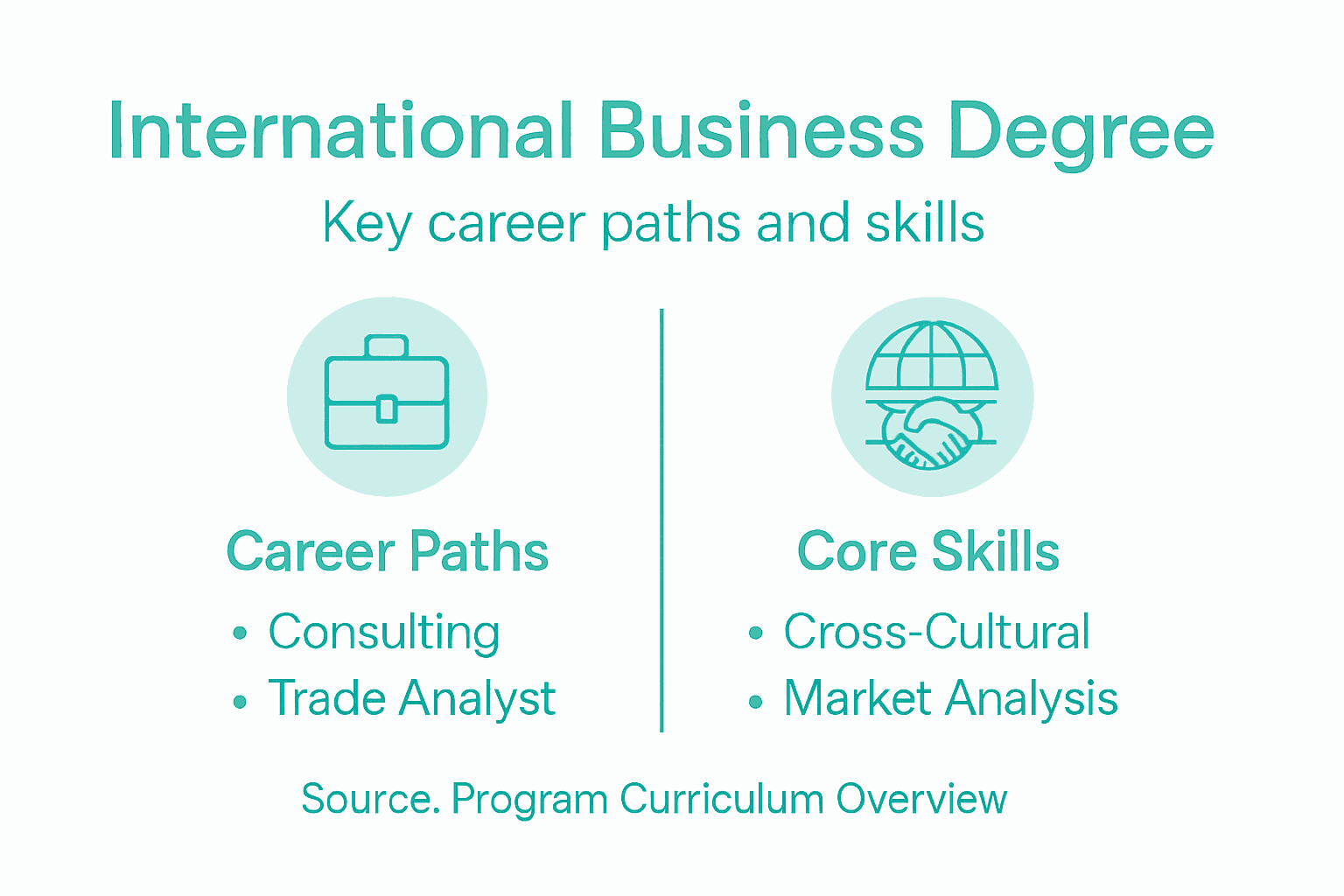
Career opportunities span management analysis, sales management, and financial analysis. These roles leverage the cross-cultural skills and analytical abilities you develop during your degree.
Common positions include:
- Management analyst evaluating international operations and recommending improvements
- Sales manager overseeing accounts across multiple countries and time zones
- Financial analyst assessing investment opportunities in emerging markets
- Business intelligence analyst tracking global market trends
- International trade specialist managing import/export compliance
- Global supply chain manager coordinating operations across continents
Each role requires the blend of business acumen and cultural intelligence your degree provides. You’re not just analyzing spreadsheets—you’re making decisions affecting operations worldwide.
Below is a summary of core career outcomes for international business graduates:
| Career Path | Primary Responsibilities | Typical Employers |
|---|---|---|
| Management Analyst | Streamline multinational operations | Consulting firms, global corporations |
| Sales Manager | Oversee cross-border sales teams | Consumer goods, tech companies |
| Financial Analyst | Assess investments in new markets | Banks, investment firms |
| Trade Specialist | Manage import/export compliance | Logistics, manufacturing |
| Supply Chain Manager | Coordinate international sourcing | Retail, production firms |
Skills That Drive Career Advancement
Employers value specific competencies international business graduates develop. Cross-cultural communication distinguishes you from candidates with only domestic experience. You understand negotiation styles differ across cultures and can adapt your approach accordingly.
Analytical skills matter equally. You can interpret complex international markets, assess political and economic risks, and identify growth opportunities competitors miss. These abilities directly translate to higher salaries and faster promotions.
Compensation and Growth Potential
International business roles typically offer competitive salaries. Management analysts earn median salaries around $93,000 annually in the United States, with senior roles reaching $140,000 or more. Sales managers in multinational companies often earn significantly higher when including bonuses tied to international expansion.
Growth trajectory accelerates with experience. A financial analyst working in international markets may advance to senior analyst, portfolio manager, or managing director within 7-10 years—each step bringing substantial salary increases.
International business credentials create pathways to leadership roles at companies operating across continents, opening compensation and opportunity trajectories unavailable to graduates with purely domestic training.
Entrepreneurship and Global Business Opportunities
Your degree supports entrepreneurial ambitions. Graduates launch import-export businesses, consulting firms serving multinational clients, and startups targeting international markets. Understanding global regulations, cultural preferences, and market entry strategies gives you competitive advantage.
Many startups fail because founders underestimate international complexity. Your formal training prevents costly mistakes and accelerates growth in new markets.
Flexibility Across Industries
International business credentials work across sectors:
- Technology companies expanding into Asian markets
- Financial institutions managing global investments
- Retail chains entering new countries
- Manufacturing companies optimizing supply chains
- Consulting firms advising multinational clients
- Government agencies handling international trade
This versatility means you’re never locked into one industry. Economic shifts in one sector won’t derail your career—you can pivot to growing opportunities elsewhere.
Employer Demand and Job Security
Globalization continues expanding. Companies increasingly need employees who understand international markets and can lead cross-border teams. Demand for these skills grows faster than supply, creating job security and bargaining power in salary negotiations.
Professionals with demonstrated international experience command premium compensation because they solve problems domestic-only candidates cannot.
Pro tip: Build your professional network intentionally during your degree through internships and study abroad. The relationships you establish with international professionals, peers from different countries, and multinational employers become your most valuable career asset, often leading to opportunities that never appear on job boards.
Accelerate Your Global Career with a Fast-Track International Business Degree
Navigating the complexities of international business demands more than just knowledge. It requires cultural intelligence, practical global experience, and a recognized degree that employers trust. Many aspiring professionals face challenges like balancing work, study, and the desire for authentic international exposure. If you want to overcome these hurdles and gain real-world skills through a program that blends UK and Asian business environments, fast-track your journey with SeekStudy.
Explore our Destinations archive to discover how studying in multiple countries enriches your learning and enhances your cultural adaptability. With SeekStudy’s accredited bachelor’s and master’s degrees, including a unique two-year business management program combining classroom and international study, you earn a UK-recognized degree without compromising quality or time. Take the step now to secure your place in a program tailored to global ambitions and designed for the fast-paced professional. Visit https://seekstudy.com today and transform your international business aspirations into reality.
Frequently Asked Questions
What is an international business degree?
An international business degree prepares students for careers in global business environments. It focuses on understanding how international trade, finance, and marketing operate across different cultures and economies.
What are the key focus areas of international business programs?
International business programs emphasize cross-cultural communication, global economics, international marketing strategies, and management of multinational projects. They also include real-world experiences such as internships and study abroad opportunities.
How long does it take to earn an international business degree?
Typically, a bachelor’s degree in international business takes 3 to 4 years to complete, while fast-track options can be finished in 2 years. A master’s degree usually requires 1 to 2 years of study.
What career opportunities are available with an international business degree?
Graduates can pursue various roles including management analyst, sales manager, financial analyst, and international trade specialist. These positions leverage cross-cultural communication skills and analytical abilities developed during the program.