

Balancing a demanding job with dreams of rapid career growth can feel like an impossible trade-off. For many international professionals, a one-year online MBA offers a unique path—delivering the same respected credential as longer programs without pausing your life or relocating. You gain a fast-paced, accredited business education designed for driven individuals, all while immersing yourself in real-time global learning experiences that build both expertise and worldwide connections.
Table of Contents
- Defining A One-Year MBA Program
- Comparing One-Year And Traditional MBAs
- Key Requirements And Accreditation Standards
- Global Formats And Online Study Options
- Costs, Benefits, And Career Implications
Key Takeaways
| Point | Details |
|---|---|
| One-Year MBA Structure | One-year MBA programs are intensive, completing the same curriculum as traditional MBAs in a shorter timeframe, demanding full-time commitment. |
| Accreditation Importance | Not all one-year MBAs are equivalent; ensure the program is accredited to ensure quality and recognition in the job market. |
| Flexibility with Online Formats | Many one-year MBAs offer online or hybrid options that allow working professionals to maintain employment while pursuing their degree. |
| Focused Candidate Profile | Ideal candidates typically have 3+ years of work experience and clear career objectives to maximize the intense learning experience. |
Defining a One-Year MBA Program
A one-year MBA is an intensive master’s degree program compressed into twelve months of full-time study. Unlike traditional two-year programs, it condenses the curriculum without sacrificing rigor or recognition.
These programs maintain the same academic standards as their longer counterparts. Accredited one-year MBAs deliver equivalent business education—covering strategy, finance, operations, and leadership—but require accelerated pacing and focused coursework.
What Makes a One-Year MBA Different
The compressed timeline reshapes how programs operate:
- Continuous study cycles with minimal breaks between modules
- Streamlined curriculum focusing on core business competencies
- Intensive cohorts where you progress together without breaks
- Reduced electives emphasizing essential skills over breadth
- Block scheduling with concentrated courses rather than traditional semesters
One-year programs eliminate redundancy without cutting substance. You won’t spend extra time on foundational concepts—the curriculum assumes working professionals already possess baseline business knowledge.
International Study Options
Many reputable one-year MBAs, like those offered through online MBA programs for professionals, incorporate international learning experiences. You might study across multiple countries—combining online coursework with intensive residential periods.
This global approach means:
- Studying in different time zones and business environments
- Building networks across continents
- Understanding diverse regulatory and market contexts
- Gaining perspective on international business operations
A one-year MBA compressed into twelve months delivers the same recognized credential as traditional programs, but requires commitment to an accelerated schedule.
Recognition and Accreditation Standards
Not all one-year MBAs carry equal weight. Accreditation matters significantly—especially from bodies like Ofqual in the United Kingdom, which ensures consistent quality standards.
Accredited programs guarantee:
- Curriculum meets established business education standards
- Faculty hold appropriate academic qualifications
- Resources and facilities support quality instruction
- Degree is recognized by employers internationally
- Credits transfer if you continue studying elsewhere
Before enrolling, verify the awarding institution’s regulatory status. An Ofqual-regulated degree carries credibility across employers in the UK, Australia, Singapore, and beyond.
Who Should Pursue a One-Year MBA
This format suits professionals with specific career goals and work experience. The intensity demands time commitment, but rewards those ready to accelerate their trajectory.
Ideal candidates typically have:
- 3+ years of professional work experience
- Clear career advancement objectives
- Ability to balance studies with employment
- Readiness for accelerated learning pace
Pro tip: Verify the program includes international study components or online flexibility if you need to maintain your current role while earning your degree—this balance proves critical for working professionals.
Comparing One-Year and Traditional MBAs
The choice between a one-year and traditional MBA shapes your entire educational experience. Both paths lead to the same credential, but the journey differs significantly in pace, cost, and lifestyle impact.
Traditional MBAs span two years, allowing students to explore diverse electives, complete internships, and develop skills gradually. One-year MBAs compress the curriculum into an intensive twelve-month sprint, maintaining academic rigor while eliminating downtime.
Key Differences at a Glance
Here’s how these programs compare across critical dimensions:
- Duration: One-year programs finish in 12 months; traditional programs take 24 months
- Pacing: One-year programs are fast-paced and intensive; traditional programs allow slower absorption
- Cost: One-year programs typically cost less due to shorter duration
- Cohort experience: One-year programs create tight-knit groups; traditional programs have more turnover
- Flexibility: Traditional programs offer more elective choices; one-year programs focus on core competencies
- Work balance: One-year programs demand full commitment; traditional programs allow part-time study options
Curriculum and Learning Approach
One-year MBA programs maintain the same academic rigor as traditional two-year programs while compressing content into half the time. You’ll cover identical core subjects—finance, strategy, operations, leadership—but with accelerated delivery.
Traditional MBAs allow you to slow down. You take fewer courses per semester, spread study over longer periods, and complete internships during breaks. One-year programs eliminate this breathing room.
The intensity creates deeper engagement. You work closely with the same cohort throughout, developing stronger professional relationships. Faculty know you better. Your peers become your network for life.
Cost and Time Investment
One-year programs cost less overall due to shorter duration. You’re not paying tuition for a second year, and you lose less income by returning to work faster.

Traditional programs carry higher total costs despite lower annual tuition—you’re paying for two years of living expenses, opportunity costs, and potential part-time study arrangements.
Time investment differs too. One-year programs demand full focus for twelve months. Traditional programs may fit around work, but extend your transition period significantly.
Which Format Suits Your Situation
Your career stage and goals determine the better choice:
- Choose one-year if: You have 3+ years of work experience, clear career objectives, ability to leave work temporarily, and readiness for intensive study
- Choose traditional if: You need flexibility, want to explore diverse interests, plan to intern during the program, or prefer gradual learning
One-year and traditional MBAs deliver equivalent credentials, but one-year programs demand full commitment in exchange for faster career acceleration.
Career Acceleration Timelines
One-year programs get you back to the workforce faster. You can pursue promotions or career changes twelve months sooner than traditional MBA graduates. This speed advantage compounds—an extra year of post-MBA career progression adds significant earnings and advancement potential.
Traditional programs offer different advantages. The longer timeline lets you build internship experience and explore career paths before graduating. You graduate with more varied professional experience.
Pro tip: If you’re employed and can’t afford to leave your job, verify whether the program offers online or part-time delivery—some universities now hybrid one-year formats that maintain intensity while preserving income stability.
Key Requirements and Accreditation Standards
Not all one-year MBAs are created equal. What separates a valuable degree from a questionable credential is accreditation—the official stamp proving your program meets rigorous educational standards.
Accreditation ensures your degree carries weight with employers globally. It verifies that faculty are qualified, curriculum is current, and the institution maintains ongoing quality improvement. Without it, your MBA becomes a certificate with limited value.
Entry Requirements for One-Year Programs
One-year MBAs demand more from applicants than traditional programs. You’ll need:
- Bachelor’s degree from an accredited institution
- 3+ years of professional work experience (non-negotiable for most programs)
- Strong academic record with minimum GPA requirements (typically 2.5 or higher)
- GMAT or GRE scores (some programs waive for experienced professionals)
- English language proficiency demonstrated through TOEFL or IELTS if studying in English-speaking countries
- Professional references attesting to your leadership potential
- Clear career goals articulated in application essays
The experience requirement filters for serious candidates. Programs assume you’ll bring workplace context to classroom discussions. This makes cohorts more academically robust.
What Accreditation Actually Means
Accreditation standards for MBA programs involve rigorous evaluation of leadership, strategic planning, curriculum quality, and faculty qualifications. Accrediting bodies validate that programs maintain high educational standards and demonstrate positive student outcomes.
Accredited institutions undergo regular audits. They document assessment processes, track graduate employment, measure student learning, and prove continuous improvement.
Ofqual-regulated programs in the United Kingdom meet specific quality benchmarks. Graduates receive degrees recognized across the UK, Australia, Singapore, and increasingly worldwide.
Key Accreditation Bodies to Know
Multiple organizations credential business schools. The most recognized include:
- AACSB International (Association to Advance Collegiate Schools of Business)
- ACBSP (Accreditation Council for Business Schools and Programs)
- Ofqual (Office of Qualifications and Examinations Regulation in the UK)
- EQUIS (European Quality Improvement System)
Seek programs accredited by at least one major body. Dual accreditation indicates higher standards. Check the institution’s accreditation status on official regulator websites—don’t rely on program claims alone.
Quality Assurance Indicators
Beyond formal accreditation, verify these markers:
- Faculty hold doctoral degrees from recognized universities
- Program reviews curriculum annually against industry needs
- Alumni demonstrate strong career outcomes and salary growth
- Student satisfaction scores reflect quality instruction
- Partnerships with corporations provide real-world relevance
Accreditation verifies your MBA degree carries recognition and value—without it, employers may question the credential’s legitimacy.
Choosing an Accredited One-Year Program
When evaluating programs, prioritize institutions with UK-recognized degrees if global mobility matters for your career. Cross-reference the institution’s regulatory status on official government websites.
Request employment data from recent graduates. Verify job placement rates, salary increases, and employer types hiring program alumni. This reveals whether accreditation translates to real career acceleration.
Pro tip: Before enrolling, download the program’s accreditation certificate and verify its current status directly with the accrediting body—some institutions claim accreditation they’ve lost or never received.
Global Formats and Online Study Options
One-year MBAs are no longer confined to physical classrooms. Online and hybrid formats now dominate the one-year MBA landscape, offering professionals worldwide the flexibility to earn recognized degrees without uprooting their careers.
The shift to digital delivery hasn’t compromised rigor. You’ll encounter the same challenging curriculum, peer collaboration, and faculty expertise—just delivered through screens and virtual platforms.
Fully Online One-Year MBA Programs
One-year MBA programs increasingly available in fully online formats provide accelerated options for working professionals worldwide. These programs maintain rigorous pacing while allowing you to study from anywhere with internet access.
Online delivery typically combines:
- Live virtual sessions with real-time instructor interaction and peer discussion
- Asynchronous coursework you complete on your own schedule
- Recorded lectures for reviewing complex topics multiple times
- Virtual group projects building collaboration across time zones
- Digital case studies reflecting real-world business scenarios
The mix of synchronous and asynchronous content balances structure with flexibility. You attend certain live classes but complete individual work whenever your schedule allows.
Hybrid and Blended Models
Many one-year programs combine online learning with intensive in-person residencies. You might study online for most modules, then spend two weeks in Singapore, the United Kingdom, or another hub for concentrated face-to-face instruction.
These hybrid approaches offer best of both worlds. You maintain employment continuity while gaining the relationship-building and networking that comes from physical cohort experiences.
Residential components let you:
- Build deeper relationships with faculty and peers in person
- Experience different business environments firsthand
- Participate in team-building and leadership workshops
- Network with international professionals and industry leaders
- Develop cultural competency through global immersion
Global Networking in Virtual Environments
Global online MBA programs deliver fully remote formats combining live sessions and recorded lectures while supporting international networking opportunities. Your cohort spans continents—classmates from Australia, Canada, India, Nigeria, and Brazil bring diverse perspectives to every discussion.
This diversity accelerates learning. You’re not just studying international business theory—you’re living it through daily interactions with global peers.
Online one-year MBAs eliminate geographic barriers while preserving the peer collaboration and networking that accelerate career growth.
Managing Time Zones and Work Commitments
Online formats require self-discipline, but enable continued employment. Most programs schedule live sessions during evening hours or weekends to accommodate working professionals across regions.
Your typical week might include:
- Two to three live online classes (evenings)
- Individual coursework (flexible timing)
- Group project collaboration (asynchronous communication)
- Case study analysis (self-paced)
This structure lets you maintain your current job, salary, and professional momentum while completing your MBA.
Below is a reference table summarizing the business impact of major one-year MBA features:
| Program Feature | Business Impact | Professional Benefit |
|---|---|---|
| Accelerated Timeline | Fast skill acquisition | Quickly advance career |
| Cohort Learning | Hands-on teamwork | Builds lasting network |
| International Exposure | Cross-cultural competency | Expands global mobility |
| Streamlined Curriculum | Focused management expertise | Enhanced leadership skills |
| Online Flexibility | Maintains job during study | Preserves income stability |
Each feature contributes to tangible advancement and competitive advantage.
Technology Requirements and Support
Successful online learning demands reliable infrastructure. You’ll need:
- Stable broadband internet connection
- Laptop or desktop computer
- Video conferencing software access
- Learning management system login
- Quiet study space for focused work
Reputable programs provide technical support, helping troubleshoot connectivity issues and platform problems.
Pro tip: Test your internet speed and video conferencing setup weeks before classes start, and create a dedicated study space away from household distractions—your learning environment directly impacts performance in online formats.
Costs, Benefits, and Career Implications
A one-year MBA requires significant financial and time investment. Understanding the true cost against career returns helps you make an informed decision about whether this path makes sense for your circumstances.
The calculation isn’t just tuition. You’re also considering opportunity costs—income foregone during your study year—plus living expenses if you relocate for residential components.
Financial Investment Breakdown
One-year MBA costs typically range from $20,000 to $80,000 depending on the institution, location, and program format. Here’s what you’ll encounter:
- Tuition fees ($15,000–$70,000 for the full program)
- Technology and platform costs ($500–$2,000 for software, laptops, stable internet)
- Residential components ($5,000–$15,000 if attending in-person modules internationally)
- Books and course materials ($1,000–$3,000)
- Living expenses (variable based on your location and whether you’re studying full-time)
- Lost income (your salary during the study year if you leave employment)
Online programs typically cost less than on-campus alternatives because you avoid relocation and commuting expenses. Accredited programs from reputable institutions represent better long-term value than cheaper, unaccredited options.
Here’s a quick comparison of the typical costs for one-year vs. traditional two-year MBA programs, including broader financial implications:
| Cost Category | One-Year MBA | Two-Year MBA |
|---|---|---|
| Tuition | $15,000–$70,000 | $30,000–$120,000 |
| Living Expenses | Lower, one year | Higher, two years |
| Technology & Materials | $1,500–$5,000 | $2,000–$6,000 |
| Lost Income | One year | Two years |
| Opportunity Cost | Shorter absence | Longer pause from work |
| ROI Timeline | 18–36 months | 24–48 months |
This table summarizes the financial factors impacting your MBA decision.
Quantifiable Career Benefits
The ROI on a one-year MBA shows up quickly. Most graduates see measurable returns within 18-36 months of completion.
Typical career gains include:
- Salary increases averaging 30–50% within two years
- Accelerated promotions to management roles one to three years faster
- Career pivots enabling transitions into new industries or functions
- Leadership positions unlocking C-suite and executive opportunities
- Global mobility opening opportunities across international markets
- Negotiating power with enhanced credentials supporting higher compensation
These aren’t guarantees—outcomes depend on your industry, prior experience, job market conditions, and how actively you leverage your MBA network.
Intangible Benefits Worth Considering
Beyond salary, a one-year MBA delivers harder-to-quantify advantages:
- Professional credibility that opens doors in competitive fields
- Global network providing lifelong peer connections and opportunities
- Confidence to tackle complex business challenges and lead teams
- Strategic thinking frameworks applicable across career moves
- Competitive advantage when competing for senior roles
A one-year MBA typically pays for itself within three years through salary increases alone—but the network and leadership capabilities compound value across your entire career.
Career Acceleration Compared to Alternatives
Fast-track degrees boost career advancement worldwide by compressing valuable credentials into shorter timeframes. A one-year MBA gets you back to the workforce faster than traditional programs while delivering the same credential.
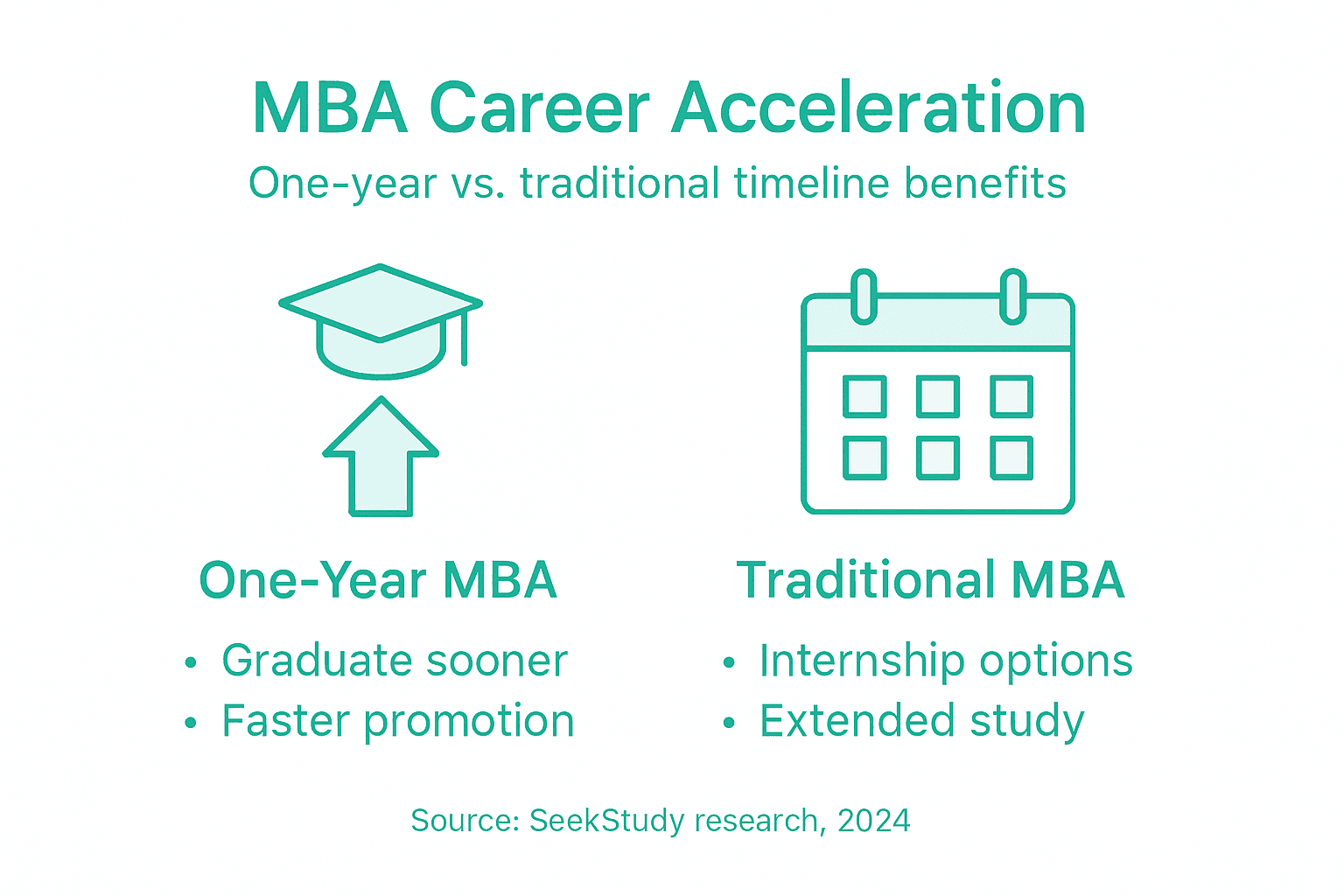
This timing advantage matters significantly. You enter the job market with a credential while peers are still studying. An extra year of post-MBA career progression—promotions, raises, network building—compounds your advantage substantially.
Consider your timeline. If you’re targeting a promotion or career change within three years, the one-year format accelerates your goals. If you’re exploring options without urgency, traditional programs offer flexibility.
Who Sees the Best ROI
Certain professionals capture greater value from one-year MBAs:
- Mid-level managers targeting senior leadership roles
- Career changers entering business or management fields
- Entrepreneurs seeking business acumen and credibility
- International professionals expanding global career options
- Technical experts transitioning to management functions
If you’re already earning a strong salary and need a credential to unlock the next level, the MBA ROI is compelling. If you’re early-career with limited salary baseline, the absolute gains may take longer to materialize.
Pro tip: Calculate your personal ROI by determining your target salary increase, timeline to achieve it, and how the MBA credential accelerates that goal—if the payoff occurs within three years, the investment typically justifies itself regardless of total cost.
Accelerate Your Career With a One-Year MBA From SeekStudy
If you are ready to fast-track your career with an accredited and internationally recognized MBA, the challenges of balancing an intensive program and your professional goals have a solution. As the article explains, a one-year MBA demands full commitment but offers a faster path to leadership, promotions, and global opportunities. SeekStudy understands these pain points and offers a flexible online one-year MBA program that combines rigorous study with international experiences in Singapore and the United Kingdom. This program is Ofqual-regulated, ensuring the highest accreditation standards that employers worldwide respect.
Discover how you can gain core business expertise, build a global network, and maintain your job with our innovative hybrid and fully online options. Visit SeekStudy Business School to explore our accelerated management degrees designed for working professionals like you. Learn more about our programs including the Uncategorized Archives for insights and opportunities. Act now to transform your career trajectory with a program tailored to your ambitions and lifestyle.
Frequently Asked Questions
What is a one-year MBA program?
A one-year MBA program is an intensive master’s degree course completed in twelve months. It condenses the traditional MBA curriculum while maintaining academic rigor and covers essential business topics like finance, strategy, and leadership.
How does a one-year MBA accelerate careers?
A one-year MBA accelerates careers by allowing graduates to re-enter the workforce more quickly, typically within a year, leading to faster promotions, higher salaries, and enhanced professional networks compared to those who complete a traditional two-year program.
Who should consider a one-year MBA program?
Professionals with 3 or more years of work experience, clear career objectives, and the ability to commit fully to an intensive study schedule are ideal candidates for a one-year MBA program.
What are the key differences between a one-year MBA and a traditional MBA?
The key differences include duration (one year vs. two years), pacing (intense vs. gradual), flexibility (fewer electives vs. broader course options), and overall cost, with one-year programs generally costing less due to their shorter duration.