

Balancing work, family, and professional growth can feel daunting when you are aiming for a credential that truly holds weight. Professionals worldwide choose UK-accredited degrees because British higher education is globally recognized for world-class teaching and research standards. This reputation for quality, supported by clear learning outcomes and credible regulation, means your Management or Accounting degree offers real value wherever your career takes you. Discover what makes UK qualifications a trusted ticket for global advancement.
Table of Contents
- What Defines UK Degree Value Worldwide
- Key Features of UK-Accredited Degrees
- Career Impact and Global Employability
- Costs, Duration, and ROI for Fast-Track Learners
- Alternatives to Traditional UK Study Options
Key Takeaways
| Point | Details |
|---|---|
| Global Recognition of UK Degrees | A UK degree enhances career prospects globally, signifying rigorous training and desirable competencies to employers. |
| Value of Fast-Track Programs | Fast-track degrees save time and money, allowing graduates to enter the job market sooner and potentially earn higher salaries. |
| Importance of Independent Thinking | UK education emphasizes analytical skills and independent thought, which are vital in competitive job markets. |
| Diverse Pathways to Qualification | Alternative study options, such as degree apprenticeships and online programs, provide flexibility and maintain the value of UK- accredited qualifications. |
What Defines UK Degree Value Worldwide
A UK degree opens doors because employers globally recognize the standards behind it. British higher education combines rigorous academic expectations with independent thinking that transcends borders. This reputation didn’t happen by accident—it’s built on decades of quality assurance and consistent excellence.
The core value comes from what world-class teaching and research standards deliver to students. You develop analytical skills that employers actively seek, not just subject knowledge. English language proficiency becomes a professional asset when you complete your degree in Britain’s academic environment.
Here’s what makes UK degrees specifically valuable to your career prospects:
- Regulatory credibility: The Office for Students oversees quality assurance, ensuring every degree meets consistent standards
- Independent thinking emphasis: Coursework demands critical analysis rather than rote memorization
- Employer recognition: International companies trust the rigor of UK assessment methods
- Professional language proficiency: Studying in English strengthens communication skills employers require
The global job market trusts UK qualifications because they signal specific competencies. A UK degree in Management or Accounting tells recruiters you’ve completed coursework with measurable standards. This matters when you’re competing for roles across different countries.
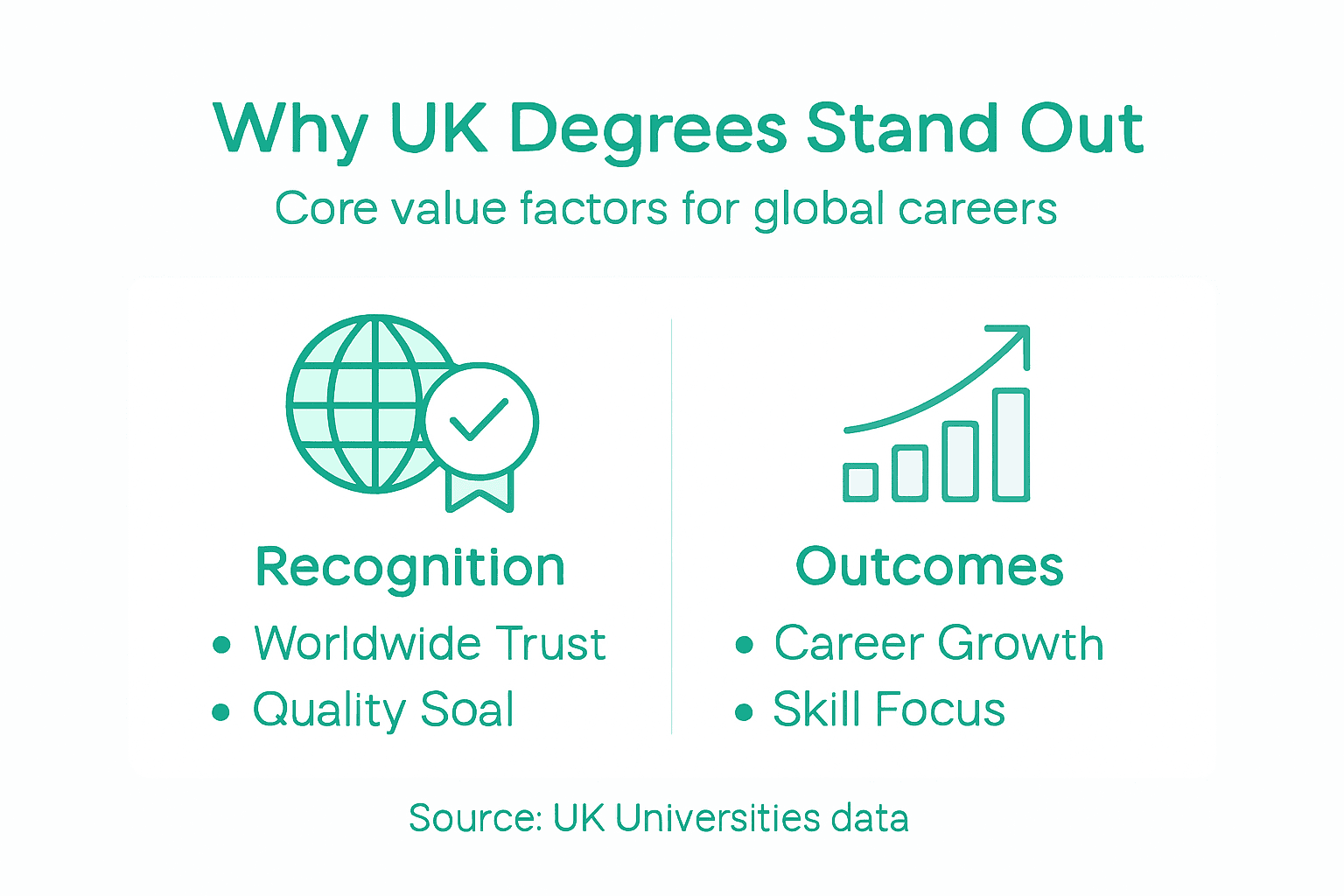
International graduates report strong global brand recognition and positive career impact from their UK credentials. Employers in Asia, the Middle East, Europe, and North America actively seek UK-educated professionals. Your degree becomes portable capital in the international job market.
The value extends beyond initial hiring. UK degrees demonstrate your ability to work independently and think analytically—skills that shape your entire career trajectory. When you balance a full-time job with fast-track studies, these capabilities become even more valuable to employers.
Recognition also comes from how UK degrees standardize learning outcomes. Whether you study online or on campus, whether you combine Singapore and UK study locations, your degree meets the same quality benchmarks. This consistency is what makes your qualification credible in any country.
Real competitive advantage: UK employers and international firms both recognize that a UK degree signals rigorous training, not just credential completion. This distinction matters when advancing your career.
Pro tip: When applying for roles after graduation, highlight specific analytical projects and independent research from your UK degree—these directly address what international employers value most in British qualifications.
Key Features of UK-Accredited Degrees
UK-accredited degrees follow a standardized system that guarantees quality across every institution. You’re not just getting a diploma—you’re earning a credential built on measurable academic standards. This structure is what makes your degree recognized globally, whether you study full-time or balance it alongside work commitments.

The foundation rests on clear qualification descriptors tied to academic levels. Every UK degree spells out exactly what you’ll learn and what you’ll be able to do. This outcomes-based approach means coursework connects directly to skills employers actually need.
Here’s what defines UK-accredited degrees in practice:
- Rigorous quality assurance: The Quality Assurance Agency and other bodies conduct regular reviews to maintain standards
- Standardized degree classifications: First-class, upper-second, lower-second, and third-class honors mean the same thing across universities
- Alignment with international frameworks: UK degrees fit the Bologna Process, making them transferable across European and global systems
- Professional body accreditations: Specialized programs gain additional recognition from industry organizations
Consistency across providers is built into the system. Whether you complete your Management or Accounting degree online, on campus, or through a combined Singapore and UK study model, the academic rigor remains identical. This standardization protects your investment and strengthens your credentials.
Another critical feature is transparency in learning outcomes. You know from day one what competencies you’ll develop. When employers review your degree, they understand precisely what coursework entailed and what analytical skills you’ve mastered.
UK degrees also emphasize professional relevance alongside academic depth. Many programs include specialized credentials and professional body accreditations that directly boost career prospects. This dual focus—theoretical knowledge plus practical credentials—distinguishes UK qualifications in competitive job markets.
The regulatory framework ensures comparability across providers. Fast-track degrees from accredited institutions meet the same standards as traditional three-year programs. Your compressed timeline doesn’t compromise the degree’s global standing or employer recognition.
Key advantage: UK-accredited degrees use outcomes-based frameworks, meaning you study what you’ll actually need to perform well in your career, not just theoretical material with limited application.
Pro tip: When evaluating any UK degree program, verify it’s regulated by Ofqual or listed on the UK Register of regulated qualifications—this confirmation takes 60 seconds and guarantees your credential will transfer internationally.
Career Impact and Global Employability
A UK degree fundamentally changes your competitive position in the global job market. Employers across continents recognize British qualifications as signals of rigorous training and marketable skills. For working professionals balancing careers with studies, this credential advantage pays dividends immediately upon graduation.
The evidence is clear: over 10,000 international graduates report UK degrees significantly enhance employability. These professionals work in Asia, the Middle East, Europe, and North America—each market values the UK qualification distinctly. Your degree becomes currency in multiple job markets simultaneously.
Here’s what UK degrees deliver on the career front:
- Immediate hiring advantage: Recruiters prioritize candidates with UK credentials when screening Management and Accounting roles
- Salary premium potential: UK-educated professionals often negotiate higher starting salaries than non-UK graduates in equivalent positions
- Career progression speed: Employers view UK degrees as preparation for senior roles, accelerating advancement timelines
- Global mobility: Your credential removes barriers when relocating for career opportunities across different countries
- Industry recognition: Professional bodies acknowledge UK degrees, sometimes waiving additional certifications
The quality-of-education component matters significantly. You’re not just earning a degree—you’re developing specific competencies employers actively seek. Independent thinking, analytical problem-solving, and English language proficiency become tangible assets on your resume.
Post-study work opportunities amplify the career impact further. Many countries offer visa pathways allowing UK graduates extended time to secure employment before returning home or relocating. This breathing room lets you build professional networks and gain experience that strengthens long-term career prospects.
For professionals in Management and Accounting, UK degrees unlock sector-specific advantages. Your coursework aligns with international accounting standards and global business practices. This alignment means your knowledge transfers immediately into multinational company environments.
However, one gap exists in current offerings. Graduates highlight that additional practical experience through internships and placements would strengthen career readiness even further. When evaluating programs, prioritize those incorporating real-world projects or professional placements alongside theory.
Career reality: UK degrees open doors, but internship experience during your studies accelerates your transition into senior roles—the combination is more powerful than the degree alone.
Pro tip: Seek programs incorporating case studies from major companies or client-based projects—these real-world components become portfolio pieces when interviewing for management-level positions after graduation.
Costs, Duration, and ROI for Fast-Track Learners
Fast-track degrees compress your education timeline while protecting your wallet. You complete your qualification in two years instead of three, which means real savings on tuition and living expenses. For working professionals, this acceleration also means faster salary increases—critical when balancing current job commitments with future career growth.
The financial math is straightforward. International undergraduate tuition ranges from £11,400 to £38,000 and postgraduate fees from £9,000 to £30,000, with living costs averaging £900 to £1,400 monthly. A fast-track degree eliminates one full year of both tuition and accommodation costs. That’s meaningful savings for professionals managing family commitments alongside studies.
Here’s what impacts your total investment:
- Tuition fees: Vary by program type (bachelor vs. master) and institution location
- Living expenses: Depend on whether you study full-time on campus or online while working
- Opportunity cost: Fast-track completion returns you to full earning capacity a year earlier
- Salary uplift timeline: Earlier graduation accelerates when higher-paying positions become available
- Study mode flexibility: Online options eliminate relocation costs entirely for international learners
Return on investment becomes compelling when you factor in accelerated career progression. Completing your Management or Accounting degree in two years means you enter the job market with a UK credential a full year ahead of traditional three-year students. That year translates into accumulated salary differential plus advancement opportunities.
Consider the real scenario: A working professional earning $60,000 annually gains a typical 15-20% salary increase after completing a UK Master’s degree. That salary uplift begins one year earlier with a fast-track program, creating compound financial advantage over your career lifespan. The calculation shifts dramatically when you account for 30-40 year earning trajectories.
Costs also vary significantly by study model. Online fast-track programs eliminate living expenses, while combined study locations like Singapore and UK options reduce accommodation costs compared to full-time UK residency. Your choice directly impacts total financial outlay.
Break-even analysis matters here. Calculate the difference between your current salary and projected salary post-degree. Divide total program costs by this annual difference. Most professionals recover their investment within 3-5 years of completion—and that’s before accounting for long-term career progression advantages.
Financial reality: Fast-track degrees reduce study duration costs by 25-33% while accelerating your entry into higher-paying positions—the combination creates significant lifetime earnings advantage.
Pro tip: Build a spreadsheet comparing total costs (tuition plus your lost income during study) against projected salary increases by your target industry—this reveals whether full-time or part-time study mode maximizes your ROI given your personal circumstances.
Typical cost, timeline, and ROI factors for UK fast-track degree options:
| Cost Factor | Fast-Track Degree | Traditional Degree | Impact on ROI |
|---|---|---|---|
| Tuition | Lower overall | Higher, more years | Faster break-even, less debt |
| Living Expenses | One year less | Full three years | Substantial annual savings |
| Opportunity Cost | Returns to work quicker | Longer study break | Earlier career advancement |
| Salary Differential | Earns uplift sooner | Delayed increase | More lifetime income gains |
Alternatives to Traditional UK Study Options
Traditional on-campus UK degrees aren’t your only path to recognized qualifications. Working professionals often benefit from flexible alternatives that combine earning, learning, and credential-building simultaneously. Understanding your options helps you choose what actually fits your lifestyle and career timeline.
The landscape has expanded significantly beyond conventional full-time study. Apprenticeships, traineeships, degree apprenticeships, and vocational courses now provide recognized qualifications while allowing participants to earn and gain work experience. These pathways deliver practical skills employers actively seek, often without accumulating substantial debt.
Here’s what alternative routes offer:
- Degree apprenticeships: Combine paid employment with university-level study, awarding bachelor’s or master’s degrees alongside work experience
- Higher technical qualifications: Focus on specialized skills aligned with specific industries and career progression
- Online fast-track degrees: Compress traditional three-year programs into two years while maintaining full-time work capacity
- Blended study models: Mix online learning with intensive on-campus modules, reducing time away from work
- Professional certifications: Add industry-recognized credentials alongside or instead of traditional degrees
For working professionals balancing family and career, the flexibility factor dominates decision-making. Gap years, overseas study options, and alternative entry routes expand choices beyond traditional full-time enrollment. You’re not locked into a single pathway—you can test multiple approaches before committing.
Apprenticeships deserve specific attention for your situation. You earn a salary while studying toward recognized qualifications. This income covers living expenses and family commitments without requiring student loans. Many apprenticeship programs lead directly to management or accounting roles—precisely aligned with your career goals.
Online fast-track degrees represent another compelling alternative. You maintain current employment, study during flexible windows, and complete your qualification in two years. This approach preserves your salary continuity while delivering UK-recognized credentials that employers globally respect.
The key distinction: alternatives don’t sacrifice credential value for flexibility. A UK degree earned through apprenticeship, online fast-track, or blended models carries identical global recognition as traditional on-campus study. Employers can’t distinguish between pathways—they only see the outcome: a UK-accredited qualification.
Pathway reality: The most valuable degree is the one you actually complete while maintaining family stability and career momentum—alternative routes often achieve this better than traditional study alone.
Pro tip: Compare total earnings across 2-3 years between staying in your current job versus pursuing an apprenticeship that pays salary—many apprenticeships earn you more cumulative income than traditional study while delivering the same degree credential.
Here’s how major UK degree study pathways compare for working professionals:
| Pathway Type | Flexibility for Working Adults | Typical Duration | Financial Commitment |
|---|---|---|---|
| Fast-track Online | High, fits around job | 2 years | Moderate, lower living cost |
| Degree Apprenticeship | Very high, salaried work | 3-4 years | Low, employer funded |
| On-campus Traditional | Low, full-time attendance | 3 years | High tuition and expenses |
| Blended Learning | Medium, some travel required | 2-3 years | Moderate, mixed expenses |
Unlock the True Value of Your UK Degree with SeekStudy
Navigating the complexities of earning a UK degree that truly stands out in today’s global job market can be challenging. The article highlights critical factors such as regulatory credibility, quality assurance, and fast-track options that shape degree value worldwide. If you want to transform your educational journey into a powerful career asset while balancing work and life commitments, SeekStudy offers accredited, flexible fast-track programs in Management and Accounting. Our courses are regulated by Ofqual and provide internationally recognized qualifications blending online learning and international study experiences, including unique Singapore and UK combinations.

Take the next step to elevate your global employability with SeekStudy. Explore how our accelerated two-year bachelor’s degrees or online MBAs deliver the critical competencies employers seek. Benefit from industry-relevant curricula, professional accreditations, and the convenience to study without relocating. Visit SeekStudy Business School and discover opportunities that align with your career ambitions today. Start your journey by learning more at our Uncategorized Archives – SeekStudy Business School and see firsthand how we help students worldwide earn UK-recognized degrees with tangible career impact.
Frequently Asked Questions
What defines the value of a UK degree?
A UK degree is valued for its rigorous academic standards, emphasis on independent thinking, and widespread employer recognition, which signal specific competencies sought by employers globally.
How does a UK degree affect my employability?
Graduates with a UK degree often experience enhanced employability as it is recognized by employers worldwide as a sign of quality education and professional skills.
What are the benefits of fast-track UK degree programs?
Fast-track UK degree programs allow students to complete their qualifications in a shorter time, leading to reduced costs and accelerated entry into higher-paying job positions, enhancing return on investment.
Are online or blended UK degree programs equally respected as traditional degrees?
Yes, UK degrees earned through online or blended programs carry the same recognition and credibility as traditional on-campus degrees, ensuring graduates have access to the same career opportunities.