

You’ve probably heard the skeptics: accelerated bachelor’s degrees cut corners, rush learning, and leave graduates unprepared. That’s simply not true. Research shows well-designed accelerated programs deliver the same quality education as traditional degrees while offering flexibility, speed, and career-focused learning that international adult learners and working professionals need. This guide breaks down what accelerated degrees really offer, who benefits most, and how to choose programs that advance your global career without sacrificing quality or years of your life.
Table of Contents
- Understanding Accelerated Bachelor’s Degrees: What They Are And Who They’re For
- Advantages Of Choosing An Accelerated Bachelor’s Degree
- Considerations And Common Misconceptions About Accelerated Degrees
- How Accelerated Degrees Support Global Careers And International Adult Learners
- Explore Accelerated Bachelor’s Degree Options With SeekStudy
- Frequently Asked Questions
Key takeaways
| Point | Details |
|---|---|
| Quality matches traditional programs | Meta-analysis confirms no significant difference in learning outcomes between well-designed online and traditional education formats. |
| Complete degrees 1-2 years faster | Accelerated programs condense timelines without removing content, allowing career advancement sooner. |
| Flexibility for working adults | Online and hybrid formats let you balance work, family, and study across time zones. |
| Career-focused curriculum | Programs emphasize practical skills and real-world applications valued by employers globally. |
| Growing international demand | Enrollment in accelerated programs has increased 60% among working adults in five years. |
Understanding accelerated bachelor’s degrees: what they are and who they’re for
Accelerated bachelor’s degrees compress traditional four-year programs into two to three years by eliminating extended breaks, offering year-round enrollment, and focusing curriculum on essential career competencies. Unlike traditional programs with lengthy summer breaks and lighter course loads, accelerated formats maintain academic rigor while maximizing your time investment.
These programs typically use online or hybrid delivery methods. You attend virtual lectures, complete assignments on your schedule, and engage with instructors and peers through digital platforms. Some programs blend online coursework with intensive on-campus modules, giving you hands-on experience without relocating permanently. This structure works perfectly for busy adults managing careers and personal commitments.
Who thrives in accelerated programs? International learners seeking recognized degrees without extended overseas stays benefit enormously. Working professionals aiming to advance careers or pivot industries find the condensed timeline invaluable. Adult learners returning to education appreciate flexible scheduling that accommodates existing responsibilities. Studies show a significant increase in enrollment in online programs among working adults, with a reported 60% increase in the last five years, confirming growing demand.
Key benefits include:
- Condensed schedules that reduce total study time by 12 to 24 months
- Online access allowing study from anywhere with internet connectivity
- Practical course design emphasizing skills employers value immediately
- Flexible pacing options to match your work and personal schedule
- Lower total costs due to shorter enrollment periods
If you’re preparing for fast track degrees online abroad, understanding these fundamentals helps you evaluate whether accelerated programs align with your career goals and lifestyle needs.
Advantages of choosing an accelerated bachelor’s degree
The primary advantage is speed without compromise. Completion times are often reduced by 1-2 years compared to traditional programs, meaning you enter the workforce or advance your career sooner. This time savings translates to earlier earnings, faster promotions, and quicker return on your education investment.

Quality concerns? A meta-analysis of online vs. traditional education found no significant difference in learning outcomes when comparing well-designed programs. Accredited accelerated degrees maintain the same academic standards as traditional formats. The difference lies in delivery method and pacing, not content depth or rigor.
Curriculum design focuses on career relevance. Instead of broad electives with limited workplace application, accelerated programs emphasize competencies employers demand: data analysis, strategic thinking, financial management, and leadership skills. You learn frameworks you’ll use immediately in business management and accounting roles.
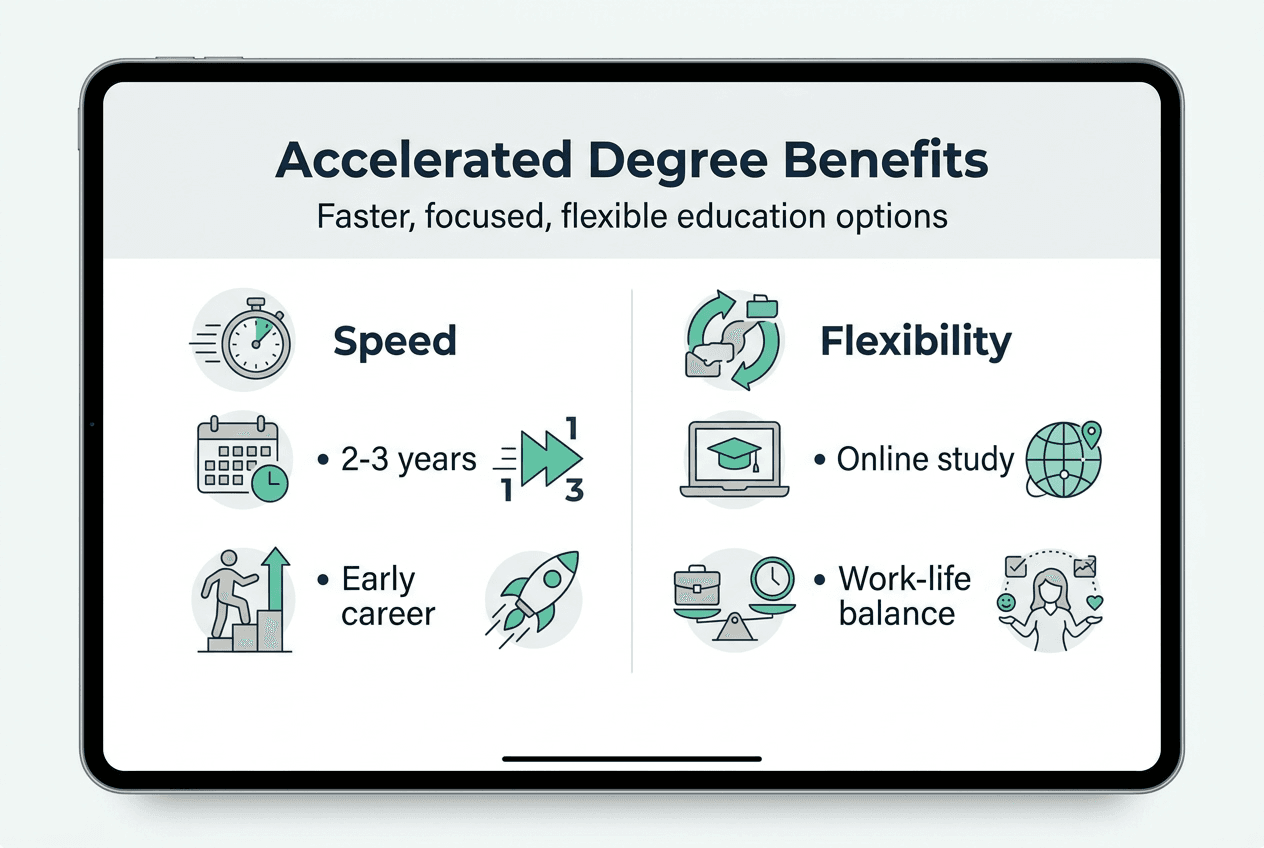
Flexibility transforms education accessibility. Online formats let you study during commutes, lunch breaks, or evenings after work. No need to quit your job or relocate. You balance income generation with skill development, maintaining financial stability while advancing your credentials.
Consider this comparison:
| Feature | Traditional Degree | Accelerated Degree |
|---|---|---|
| Typical Duration | 4 years | 2-3 years |
| Schedule Flexibility | Fixed class times | Asynchronous online access |
| Career Focus | Broad liberal arts emphasis | Targeted professional skills |
| Cost Efficiency | Higher total tuition and living costs | Lower due to shorter enrollment |
| Work Compatibility | Difficult to maintain full-time work | Designed for working professionals |
Pro Tip: When evaluating accelerated programs, verify accreditation through recognized bodies like the Higher Learning Commission or regional accreditors. Check if the institution has partnerships with established universities, as this often indicates quality standards and degree recognition. Review graduate employment rates and employer partnerships to gauge career outcomes.
For those exploring accelerated business degrees career boost potential, these advantages compound over your career lifetime. Earlier degree completion means more years earning at higher salary levels, faster leadership advancement, and greater lifetime earnings.
Considerations and common misconceptions about accelerated degrees
The faster pace demands commitment and discipline. You’ll cover the same material as traditional students but in compressed timeframes. Expect intensive study periods, frequent assessments, and limited breaks between modules. This intensity challenges time management and requires strong self-motivation.
Some argue that accelerated programs may lack the depth of traditional programs, but proponents emphasize practical skills and career focus. The reality? Depth isn’t sacrificed; breadth is strategically narrowed. You study fewer tangential topics and more directly applicable content. For business management and accounting careers, this trade-off usually benefits you.
Common misconceptions include:
- Accelerated degrees are easier: False. The rigor matches traditional programs; only the timeline differs.
- Employers view them as inferior: Not when properly accredited. Employers value skills and credentials, not study duration.
- They’re only for exceptional students: Wrong. They’re for motivated adults with clear career goals and decent time management.
- Online formats mean less interaction: Modern platforms facilitate robust peer and instructor engagement through forums, video calls, and collaborative projects.
Choosing reputable, accredited programs is critical. Diploma mills exploit the accelerated format label to sell worthless credentials. Verify accreditation, research institutional reputation, and confirm degree recognition in your target employment markets.
“The key distinction isn’t speed versus quality; it’s focused versus diffuse learning. Accelerated programs concentrate on competencies that drive career success, eliminating academic wandering that characterizes many traditional degrees.”
Be honest about your readiness. Accelerated formats suit self-directed learners comfortable with technology and capable of managing competing priorities. If you need extensive hand-holding or prefer leisurely exploration of subjects, traditional programs might fit better. For driven professionals seeking efficient paths to credentials, understanding fast-track degree programs explained helps set realistic expectations.
How accelerated degrees support global careers and international adult learners
International learners face unique challenges: visa limitations, time zone differences, family obligations in home countries, and costs of extended overseas stays. Accelerated online programs eliminate many barriers. You earn recognized degrees from UK, Australian, or Singaporean institutions without relocating permanently.
Enrollment in accelerated programs is growing, reflecting demand among international and working adults. This growth stems from programs addressing real accessibility needs. Asynchronous learning lets you attend lectures and complete assignments regardless of time zone. No need to wake at 3 AM for live classes or sacrifice sleep for education.
Leveraging accelerated degrees for global career growth:
- Choose programs with international accreditation recognized across multiple countries, ensuring credential portability.
- Select business management or accounting specializations with universal employer demand, maximizing job market flexibility.
- Build networks with international peers and faculty through program collaboration, creating global professional connections.
- Gain credentials quickly, allowing you to apply for international roles or transfers sooner.
- Combine online study with optional intensive modules in key business hubs, adding international study experience explained value to your resume.
Comparing accessibility:
| Factor | Traditional International Study | Accelerated Online Programs |
|---|---|---|
| Visa Requirements | Student visa, often complex | Usually not required |
| Relocation Costs | High (housing, living expenses) | Minimal (study from home) |
| Time Zone Flexibility | Fixed schedule conflicts | Asynchronous access |
| Family Separation | Often necessary | Remain with family |
| Career Continuity | Must quit or take leave | Maintain employment |
| Credential Timeline | 4+ years | 2-3 years |
Pro Tip: Verify that your chosen accelerated program offers degrees from institutions recognized by employers in your target countries. Check why accredited online programs matter for international career mobility. Research whether graduates successfully secure roles in your desired markets, and confirm the program provides career support services for international students.
For working professionals in emerging markets, accelerated degrees offer upward mobility without the financial burden of traditional international education. You gain UK or Australian credentials while earning income, supporting family, and building local professional experience simultaneously.
Explore accelerated bachelor’s degree options with SeekStudy
Ready to fast-track your career with a recognized bachelor’s degree? SeekStudy offers accelerated programs in business management and accounting designed specifically for international adult learners and working professionals. Complete your degree in two years through flexible online formats, with optional international study modules combining Singapore and UK experiences.
Our programs emphasize practical skills employers demand: financial analysis, strategic management, and leadership competencies. You’ll earn UK-recognized degrees through partnerships with established institutions, ensuring global credential acceptance. Whether you’re advancing in your current field or pivoting to new opportunities, our bachelor’s in business management guide shows how accelerated education transforms careers. Explore accelerated business degrees career placements to see graduate outcomes, and learn more about fast-track degree programs explained to find the right fit for your 2026 goals.
Frequently asked questions
What is an accelerated bachelor’s degree?
An accelerated bachelor’s degree compresses traditional four-year undergraduate programs into two to three years by eliminating extended breaks and offering year-round enrollment. These programs maintain the same credit requirements and academic rigor as traditional degrees but deliver content through condensed schedules and focused curriculum. They typically use online or hybrid formats, making them ideal for working professionals and international learners who need flexibility. Accelerated programs emphasize career-relevant skills in fields like business management and accounting, preparing graduates for immediate workplace application.
Are accelerated bachelor’s degrees recognized internationally?
Yes, when properly accredited through recognized bodies like regional accreditors or international quality assurance organizations. Employers worldwide evaluate credentials based on institutional reputation and accreditation status, not program duration. Degrees from established UK, Australian, or Singaporean institutions maintain recognition across global markets. Always verify that your chosen program holds accreditation recognized in your target employment countries. Check institutional partnerships and graduate employment outcomes to confirm international acceptance.
How do accelerated programs handle the faster pace without sacrificing quality?
Accelerated programs maintain quality through focused curriculum design that emphasizes essential competencies over broad electives. They use proven instructional methods, experienced faculty, and robust student support systems including tutoring, mentoring, and career services. The faster pace comes from eliminating breaks and optimizing content delivery, not reducing rigor or removing material. Research confirms no significant difference in learning outcomes between well-designed accelerated and traditional programs. Quality depends on institutional commitment to standards, not timeline length.
Can working professionals balance accelerated degrees with their jobs?
Absolutely. Accelerated programs are specifically designed for working adults. Online formats provide asynchronous access, letting you study during evenings, weekends, or whenever your schedule allows. Most programs require 15 to 20 hours weekly, manageable alongside full-time work with proper planning. Success requires strong time management, clear priorities, and realistic expectations. Choose programs offering flexible deadlines and support services. Communicate with employers about your education goals, as some offer tuition assistance or flexible scheduling for degree-seeking employees.