

Many believe bachelor’s degrees require four years of study, but accelerated two-year bachelor’s programs challenge this assumption. These fast-track options deliver the same accredited qualification in half the time, cutting costs and speeding career advancement. If you’re an international student or working professional seeking flexibility, a two-year bachelor’s in management or accounting offers online learning, study abroad opportunities, and employer-recognized credentials. This guide explains why choosing a two-year bachelor’s can transform your educational investment into rapid career success.
Table of Contents
- Key takeaways
- Understanding two-year bachelor’s degrees and who they’re for
- Financial and time advantages of accelerated two-year bachelor’s programs
- Accreditation, transfer policies, and employer recognition: what to verify
- Maximizing your two-year bachelor’s experience: study abroad and flexible learning options
- Explore accelerated business degrees for a career boost
- Frequently asked questions
Key Takeaways
| Point | Details |
|---|---|
| Cost savings | Accelerated programs cut tuition and living costs by compressing study into 24 months and eliminating extended housing expenditures. |
| Online flexibility | Online delivery lets working adults and international students study from home with live lectures and flexible schedules. |
| Higher earnings | Bachelor degree holders earn about 40 percent more than those with associate degrees, translating to substantial lifetime earnings. |
| Accredited programs | Accredited programs protect transfer credits and ensure employer recognition, improving return on investment. |
Understanding two-year bachelor’s degrees and who they’re for
A two-year bachelor’s degree is an accelerated undergraduate program that condenses traditional four-year curricula into intensive, focused study. These programs maintain the same academic rigor and credit requirements as conventional degrees but eliminate extended breaks and streamline course sequences. Students typically take more credits per semester or study year-round, completing 120 credit hours in 24 months instead of 48.
Accelerated programs shine in business disciplines like management and accounting, where practical skills and industry knowledge matter more than lengthy theoretical exploration. Accelerated shorter programs offer flexible online learning and are popular among working professionals who need education that fits around career commitments. You can attend live virtual lectures, access recorded content, and complete assignments on your schedule while maintaining full-time employment.
These programs suit specific student profiles particularly well:
- Motivated learners with associate degrees or diplomas who want to upgrade credentials quickly
- International students seeking globally recognized qualifications without extended overseas stays
- Working professionals balancing career advancement with educational goals
- Career changers needing fast reskilling in high-demand business fields
- Students with transfer credits from previous college coursework
The structure demands discipline and time management. You’ll handle heavier course loads and tighter deadlines than traditional programs require. However, this intensity creates an accelerated bachelor’s degree benefits environment where you stay engaged, apply learning immediately to work situations, and graduate before skills become outdated. Online delivery removes geographic barriers, letting you study from anywhere while maintaining local employment or exploring study abroad components that add international perspective to your business education.
Financial and time advantages of accelerated two-year bachelor’s programs
The financial case for two-year bachelor’s programs centers on dramatic cost reduction across multiple dimensions. Tuition represents the most obvious savings, as you pay for four semesters instead of eight. State university tuition averages $10,000 annually for in-state students and $28,000 for out-of-state, meaning traditional degrees cost $40,000 to $112,000 in tuition alone. Cutting this timeline in half immediately saves $20,000 to $56,000 before considering other expenses.
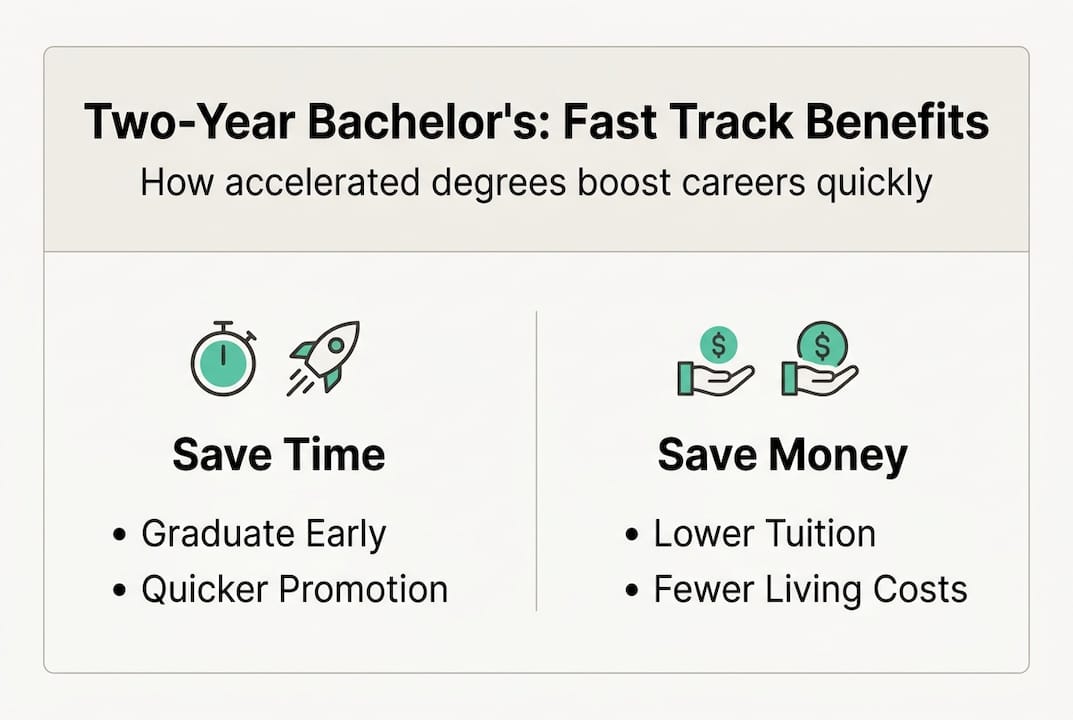
Living costs compound these savings significantly. Room, board, transportation, and books add $15,000 to $20,000 per year for on-campus students. Two fewer years of these expenses save another $30,000 to $40,000. Online accelerated programs eliminate most living costs entirely if you study from home, though you’ll still need reliable internet and a dedicated workspace. Possible $25,000+ savings by finishing early represents a conservative estimate that doesn’t account for opportunity costs.
The earnings premium justifies the investment even more compellingly:
| Credential | Median annual earnings | Lifetime earnings advantage |
|---|---|---|
| Associate degree | $48,000 | Baseline |
| Bachelor’s degree | $67,200 | $760,000 over career |
| Accelerated bachelor’s | $67,200 | $760,000 plus two extra earning years |
Bachelor’s holders earn about 40% more than those with associate degrees, translating to $19,200 additional annual income. Over a 40-year career, this compounds to $760,000 in extra earnings. Accelerated graduates gain two additional years of bachelor’s-level salary that traditional students spend in school, adding roughly $134,000 to lifetime earnings.
Pro Tip: Calculate your personal ROI by comparing total program costs against your expected salary increase and the value of two extra earning years. Choose fast-track degree programs from accredited institutions to ensure employers recognize your credential and you actually realize the earnings premium.
The time advantage extends beyond finances into career progression. You enter professional roles two years earlier, gaining experience while peers complete degrees. This head start compounds through promotions, skill development, and professional networks that accelerate long-term career trajectories in ways pure salary calculations can’t capture.

Accreditation, transfer policies, and employer recognition: what to verify
Accreditation serves as the quality assurance mechanism that separates legitimate degrees from worthless credentials. Accredited institutions meet rigorous standards set by independent educational authorities, ensuring your program delivers recognized learning outcomes. For international students, UK degrees regulated by Ofqual or programs validated by established universities carry global recognition that employers and graduate schools accept without question.
Verifying accreditation protects your investment in multiple ways. Accredited programs qualify for financial aid, credits transfer to other institutions if you pursue further education, and employers trust the credential represents genuine competency. Unaccredited programs may cost less initially but leave you with a degree employers dismiss and graduate schools reject, destroying your ROI completely.
Transfer credit policies determine how quickly you actually complete your two-year bachelor’s. Most accelerated programs accept credits from:
- Associate degrees or diplomas in related fields
- Prior bachelor’s coursework from accredited institutions
- Professional certifications and workplace training
- International qualifications assessed for equivalency
- Advanced Placement or International Baccalaureate credits
Strategic credit transfer can reduce your actual study time to 12-18 months if you enter with substantial prior learning. Review transfer policies carefully before enrolling, as institutions vary widely in how many credits they accept and which courses satisfy degree requirements. Some programs cap transfers at 60 credits while others accept up to 90, dramatically affecting your completion timeline.
Employer recognition hinges on accreditation but extends to program reputation and delivery format. Accredited programs ensure employer recognition through empirical studies showing high ROI long term, with graduates achieving comparable or superior career outcomes to traditional degree holders. Hiring managers increasingly accept online degrees as equivalent to on-campus credentials, especially from established institutions with strong business programs.
“Accelerated degree holders demonstrate strong time management, self-direction, and goal orientation that employers value. Empirical evidence shows no earnings penalty for online or accelerated formats from accredited institutions, with long-term ROI matching or exceeding traditional programs.”
Evaluate programs using this checklist:
- Verify institutional accreditation through official databases
- Confirm specific program accreditation for business or accounting degrees
- Review detailed transfer credit policies and maximum accepted credits
- Check employer partnerships and graduate employment rates
- Validate global recognition if you plan international career moves
- Examine whether the degree specifies “online” or appears identical to on-campus credentials
Understanding the importance of accreditation and choosing programs offering UK recognized degrees explained ensures your accelerated bachelor’s opens doors rather than raising questions about credential legitimacy.
Maximizing your two-year bachelor’s experience: study abroad and flexible learning options
Flexible learning transforms accelerated programs from grueling marathons into manageable journeys that enrich rather than overwhelm your life. Online delivery lets you structure study around work schedules, family commitments, and personal preferences. You might complete coursework early mornings before work, during lunch breaks, or late evenings when you focus best. Recorded lectures mean you never miss content due to schedule conflicts.
Study abroad components add global perspective that purely online programs lack. Two-year programs offer flexible online and global study options, supporting working professionals and international students who want cross-cultural business exposure without relocating permanently. Programs combining Singapore and UK study, for example, deliver Asian and European business perspectives while maintaining accelerated timelines through intensive short-term residencies.
Balancing coursework, employment, and optional study abroad requires deliberate planning:
- Map your entire program timeline before starting, identifying heavy course load periods and lighter semesters where study abroad fits naturally.
- Communicate with employers about your educational goals, negotiating flexible hours or remote work during intensive study periods.
- Choose study abroad opportunities lasting 2-4 weeks rather than full semesters, minimizing work disruption while maximizing cultural immersion.
- Build buffer time into your schedule for unexpected work demands or personal emergencies that could derail tight academic timelines.
- Leverage program advisors to customize your course sequence, front-loading general education requirements and saving specialized courses for when you have more bandwidth.
- Connect with classmates to form study groups that share workload and provide accountability during challenging periods.
- Use vacation time strategically for study abroad components or intensive course modules requiring full-time focus.
Pro Tip: Schedule a planning session with your program advisor within the first week of enrollment. Share your work schedule, career goals, and study abroad interests so they can map a personalized completion plan that maximizes flexibility while maintaining momentum toward graduation.
The combination of online flexibility and optional global components creates educational experiences impossible in traditional formats. You gain practical business skills while employed, apply classroom concepts immediately to real work situations, and add international exposure that differentiates your resume. This integrated approach to preparing for fast track degrees turns potential challenges into competitive advantages.
Successful accelerated students treat their program as a temporary sprint requiring focused effort and strategic sacrifice. You might reduce social commitments, delegate household tasks, or postpone major life decisions during intensive study periods. However, the compressed timeline means these sacrifices last months rather than years, and the career benefits begin accruing almost immediately upon graduation.
Explore accelerated business degrees for a career boost
Accelerated business degrees deliver rapid career advancement by combining academic credentials with practical skills employers value immediately. Whether you’re seeking management roles, accounting positions, or entrepreneurial ventures, a two-year bachelor’s provides the foundation while minimizing time away from earning.
Seekstudy’s programs exemplify this approach, offering UK-recognized degrees through flexible online learning combined with optional international study experiences. You can complete a bachelor’s in business management in two years while working full-time, gaining both the credential and the experience that make you promotable. The platform’s collaboration with institutions in the UK, Singapore, and Australia ensures global recognition without requiring permanent relocation.
Explore detailed guidance on accelerated business degrees career boost to understand specific program structures and career outcomes. The bachelor in business management guide breaks down curriculum, admission requirements, and post-graduation opportunities. Learn why study management online offers advantages beyond flexibility, including diverse peer networks and technology skills that enhance your professional capabilities.
Frequently asked questions
What is a two-year bachelor’s degree?
A two-year bachelor’s degree is an accelerated undergraduate program that delivers the same 120 credit hours as traditional four-year degrees through intensive year-round study and streamlined course sequences. These programs maintain full accreditation and academic rigor while eliminating extended breaks between semesters. Graduates earn identical credentials to traditional bachelor’s holders, with degrees that don’t specify accelerated or online format.
How do credits transfer into accelerated programs?
Most accelerated programs accept 60-90 transfer credits from associate degrees, prior bachelor’s coursework, professional certifications, and international qualifications assessed for equivalency. You’ll submit official transcripts during admission, and evaluators determine which credits satisfy degree requirements. Strategic transfer planning can reduce your actual study time to 12-18 months, though you must complete core major courses and residency requirements at the degree-granting institution.
Can working professionals realistically complete accelerated bachelor’s programs?
Working professionals succeed in accelerated programs by leveraging online flexibility, employer support, and disciplined time management. You’ll typically dedicate 20-25 hours weekly to coursework, scheduling study around work commitments through evening and weekend sessions. Many employers offer tuition assistance or flexible schedules for employees pursuing relevant degrees, and the compressed timeline means intensive study periods last months rather than years.
Does accreditation matter for two-year bachelor’s degrees?
Accreditation ensures your degree meets quality standards that employers and graduate schools recognize globally. Accredited programs qualify for financial aid, credits transfer to other institutions, and hiring managers trust the credential represents genuine competency. Unaccredited programs may cost less but leave you with worthless credentials that destroy your educational ROI, so verify institutional and program-specific accreditation before enrolling.
What career outcomes do accelerated bachelor’s graduates achieve?
Accelerated bachelor’s graduates achieve career outcomes matching or exceeding traditional degree holders, with median earnings 40% higher than associate degree holders. The two-year head start on career progression compounds through earlier promotions, skill development, and professional networks. Employers value the time management and self-direction required to complete accelerated programs, viewing graduates as motivated and goal-oriented candidates for advancement.