

TL;DR:
- English proficiency significantly influences GPA and academic performance in management and accounting programs.
- Placement tests and foundation courses help international students build essential language skills before degree coursework.
- Strong English skills early in studies boost confidence, networking, and career opportunities beyond graduation.
Most people entering a management or accounting degree spend months memorizing financial ratios, supply chain models, and balance sheet structures. Very few spend the same energy on the tool they will use to learn, discuss, and prove all of it: English. Research shows that proficiency scores predict GPA in business and management courses, which means your language ability is not just a checkbox at admission. It is an active force shaping how well you perform once you are inside the program.
Table of Contents
- Why English proficiency matters in management and accounting
- Screening and support: Placement tests and foundation English
- The evolving effect of English proficiency during your studies
- Inclusive English classes: New approaches for diverse learners
- The truth most students miss about English classes in higher education
- Advance your degree and English proficiency today
- Frequently asked questions
Key Takeaways
| Point | Details |
|---|---|
| English drives academic success | Strong English skills are closely linked to higher grades, especially in management and accounting degrees. |
| Placement tests support growth | Universities use English tests to place you and offer extra classes if needed. |
| Impact changes over time | English ability matters most early on, but other skills take over as you adapt. |
| Inclusive classes help everyone | Equitable teaching methods in English courses ensure all students can thrive. |
Why English proficiency matters in management and accounting
Management and accounting programs are not just about numbers and strategy. They are built on communication. Every case study, group presentation, written report, and oral examination demands that you understand ideas clearly, express arguments precisely, and engage with peers who may have very different academic backgrounds. If your English is shaky, every one of those tasks becomes harder than it needs to be.
“Language is the vehicle through which academic knowledge is acquired, demonstrated, and evaluated. In English-medium instruction programs, proficiency is not separate from learning — it is learning.”
The academic evidence backs this up. TOEIC, IELTS, and TOEFL scores show moderate positive correlations with GPA in business and management courses. That means students who score higher on English proficiency tests tend to perform better in their degree programs. This is not a small or trivial finding. It suggests that the gap between a strong student and a struggling one is sometimes not about intelligence or subject knowledge, but about language confidence.
Here is where many students run into trouble in real-world scenarios:
- Group projects: International students often struggle to assert ideas, challenge teammates diplomatically, or draft the final written submission without second-guessing every sentence.
- Business case discussions: You may understand the problem but lack the vocabulary to describe it with the precision the instructor expects.
- Examination essays: Speed matters. If you are mentally translating as you write, you lose both time and nuance.
- Professional email writing: A formal tone, correct register, and clear structure are expected from day one, and these are skills English classes explicitly teach.
- Networking conversations: In MBA and business management programs, your ability to engage confidently in English with peers, faculty, and guest speakers shapes your opportunities well beyond graduation.
The contrast is stark. Two students with identical subject knowledge can perform very differently based on how fluently they can articulate that knowledge in English. Fast-track business degree preparation programs recognize this and often integrate English skills directly into early coursework rather than treating them as a prerequisite the student is expected to handle alone.
Pro Tip: If you are starting a new term and feel your English needs work, do not wait for grades to suffer. Use the first two to three weeks to identify your specific weaknesses, whether it is academic writing, listening comprehension, or spoken fluency, and find targeted support early.
Screening and support: Placement tests and foundation English
Before any of the degree-level learning begins, many universities place incoming students through an English Placement Test, or EPT. This is a diagnostic tool designed not to reject students but to route them toward the right level of support. Think of it as a navigation system for your academic journey.
Research confirms that placement tests predict success in foundation English courses and accurately identify which students are at risk of falling behind without extra help. For international students in particular, this step can be the difference between struggling silently through year one and entering the degree with language skills already calibrated to the academic demands ahead.
Here is how the placement process typically works:
- Take the EPT: Usually administered online or on campus before your program starts. It assesses reading, writing, grammar, and sometimes speaking.
- Receive your placement level: Scores are mapped to English course levels or foundation programs. A lower score does not disqualify you; it routes you to additional support.
- Complete your assigned course or foundation program: Depending on your score, you may be enrolled in a pre-sessional English course, an academic writing module, or a full foundation year.
- Access support services: Writing centers, tutoring, and language labs are commonly offered alongside the formal course to reinforce progress.
- Reassess before main program entry: Many institutions use a follow-up test to confirm you are ready for degree-level study.
To illustrate how EPT performance relates to academic readiness, consider this example breakdown:
| EPT Score Range | Recommended Support | Typical Course Outcome |
|---|---|---|
| 85 to 100 | Direct degree entry | High pass rate in year one |
| 70 to 84 | Short pre-sessional course | Good performance with minor support |
| 55 to 69 | Foundation English program | Improved readiness after completion |
| Below 55 | Extended foundation year | Conditional entry pending reassessment |
The foundation course stage matters far more than most students realize. It is not a penalty for low English ability. It is a structured environment where you build the exact academic skills that management and accounting programs will test repeatedly: report writing, critical reading, academic argumentation, and professional presentation. The university entry preparation guide at Seekstudy outlines what these preparatory stages look like in practice, while the fast-track degree entry requirements page clarifies what scores and qualifications are expected for accelerated programs.
The evolving effect of English proficiency during your studies
Here is something that surprises most students: the advantage that strong English gives you in year one does not stay the same throughout your degree. Research shows that early GPA in EMI programs, where EMI stands for English-medium instruction, is meaningfully influenced by proficiency at entry, but this effect weakens significantly as students adapt over time.

This is actually good news if your English is still developing. It means the gap is not permanent. Students who enter with moderate English proficiency can and do close the performance gap by year two or three as they absorb vocabulary, grow familiar with academic writing conventions, and become more confident in spoken discussions.
Here is a simplified view of how the English advantage typically plays out across a degree program:
| Degree Stage | Impact of High English Proficiency | Notes |
|---|---|---|
| Year 1, Semester 1 | Strong positive GPA boost | Immediate advantage in assessments |
| Year 1, Semester 2 | Moderate positive effect | Students begin adapting |
| Year 2 | Slight to moderate effect | Subject knowledge grows in importance |
| Year 3 | Minimal independent effect | Adaptation largely complete |
The practical takeaway from this data is twofold. First, your first year is the most critical window. Students with strong English proficiency tend to score higher early on, which shapes their confidence, their relationships with faculty, and their standing within their cohort. Second, the effect fading over time does not mean English stops mattering. It means other factors, including subject expertise, effort, and peer learning, grow in relative importance.
Pro Tip: Do not assume your English improvement will happen automatically just because you are studying in an English-medium environment. Students who improve fastest are those who actively use English outside class: joining student clubs, writing reflective journals in English, watching lectures without subtitles, and forming study groups where English is the working language.
There are specific moments when seeking additional help makes the most sense: before major written assignments, before oral examinations, and at the start of any module that introduces new technical vocabulary. Preparing for university with that kind of intentionality makes a measurable difference in outcomes.
Inclusive English classes: New approaches for diverse learners
Not all English classes are built the same. For a long time, English for Academic Purposes, or EAP, courses followed a fairly rigid template: grammar rules, essay structure, academic vocabulary lists. That model works for some students, but it leaves many international and multilingual learners behind, particularly those whose educational backgrounds are very different from Western academic norms.
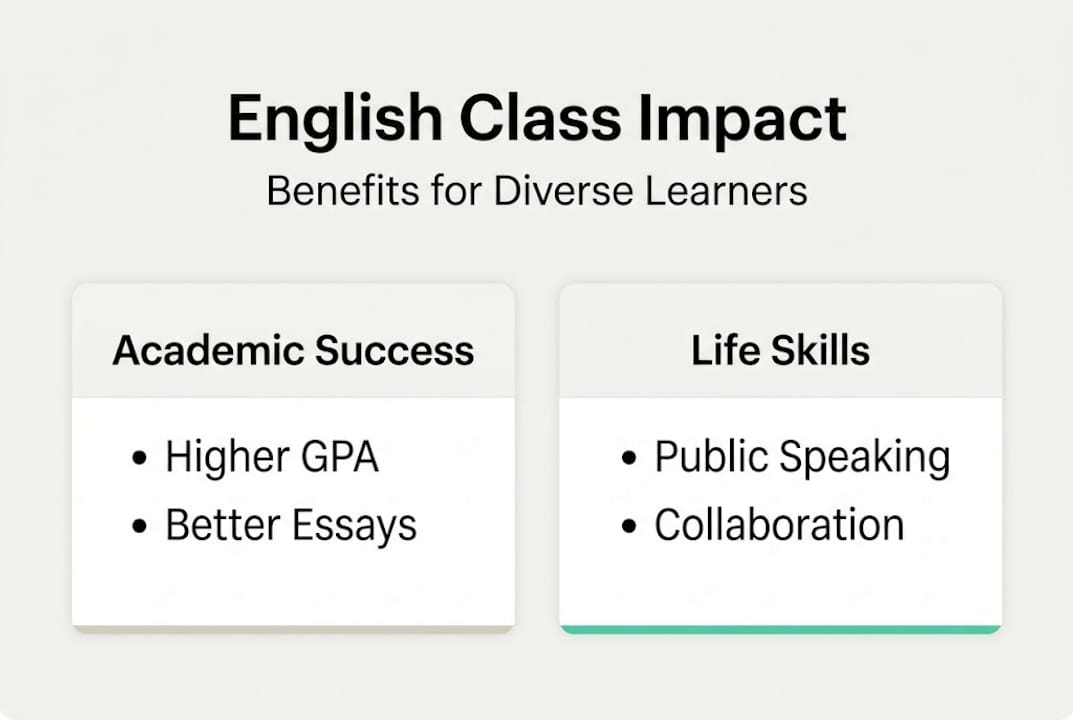
A growing body of evidence points to more effective approaches built around inclusion and equity. Inclusive EAP methodologies that incorporate culturally responsive pedagogy, equitable assessment design, and decolonial practices produce better outcomes for diverse learners, including those from refugee backgrounds, non-Western educational systems, and communities where academic English was never formally taught.
Here are five research-backed strategies that distinguish inclusive EAP instruction from traditional approaches:
- Culturally responsive curriculum: Uses examples, texts, and case studies from a range of global contexts rather than defaulting exclusively to Western business or academic sources.
- Bias-aware assessment design: Creates evaluation criteria that reward intellectual depth and clear communication rather than penalizing unfamiliar writing styles or accented English.
- Social justice pedagogy: Encourages students to explore power, identity, and equity as part of their academic development, which builds critical thinking alongside language skills.
- Trauma-informed teaching: Acknowledges that some international students, particularly those who have experienced displacement or disrupted schooling, may need flexible deadlines, alternative formats, and extra time without stigma.
- Choice-based assignments: Allows students to demonstrate language competence through multiple formats, such as video presentations, podcasts, or written reports, rather than a single standardized essay.
The challenge is real and worth naming directly. Universities are often required to use standardized English benchmarks for accreditation, international student visa compliance, and quality assurance purposes. These benchmarks can clash with inclusive approaches if institutions are not thoughtful about implementation. The most effective programs find ways to meet both goals: satisfying regulatory requirements while genuinely supporting diverse learners.
“Equity in English education does not mean lowering standards. It means redesigning pathways so that diverse learners can meet rigorous standards without being penalized for who they are or where they come from.”
Programs that offer inclusive English course options and incorporate international study benefits into their model give students the kind of language development that prepares them for global careers, not just degree completion.
The truth most students miss about English classes in higher education
Most students treat English classes like a tax. You pay it upfront, you move on, and you never think about it again. That is exactly the wrong way to approach it.
The students who get the most out of English instruction are the ones who treat it as professional training. Every academic writing workshop is a chance to practice structuring arguments the way a senior manager would in a boardroom memo. Every group discussion is a chance to practice diplomatic disagreement, which is one of the most valuable skills you can bring to a leadership role. Every presentation is a rehearsal for client-facing communication.
We have seen time and again that students who arrive at Seekstudy with strong English engagement, not just strong scores, are the ones who build the best professional networks during their studies. Language confidence opens doors that technical knowledge alone cannot. Employers notice when a candidate can write clearly, speak with authority, and adapt their tone to different audiences. These are skills built in English class, not just in finance lectures.
The students who focus only on passing the language test miss the bigger picture. Fluency is not just an academic asset. It is a career-defining advantage that follows you far beyond graduation. Engage deeply with every opportunity your English program offers. The students who do this do not just graduate. They lead.
Advance your degree and English proficiency today
If this article has shown you anything, it is that English proficiency and academic success are not separate journeys. They move together, especially in management and accounting programs where communication is everything.
At Seekstudy, our programs are built with exactly this in mind. Whether you are pursuing an Executive MBA, exploring our business management degrees, or looking to study accounting online with the flexibility your schedule demands, we integrate English support directly into the learning journey. Our foundation courses, online English classes, and international study pathways in Singapore and the UK are designed to help you build both the language skills and the academic credentials that global employers respect.
Frequently asked questions
How do English test scores impact admission to management and accounting programs?
Most universities require English proficiency scores for admission and use them to predict your likelihood of academic success, especially in the first year. Research confirms that scores from IELTS, TOEFL, or TOEIC show a moderate positive correlation with GPA in business and management programs.
What if my English test score is lower than required?
You may be offered foundation or support courses to strengthen your English before starting your main program. Placement tests identify students who need additional support and route them toward the right preparatory courses rather than outright rejection.
Does English proficiency still matter after my first year?
English skills are most important early on, but their impact lessens as you adapt and build confidence. Studies show that early GPA benefits from proficiency are real but diminish over time as students adjust to their academic environment.
What are the most effective English teaching methods for international students?
Inclusive teaching, diverse curriculum, and support for student backgrounds make the greatest difference. Inclusive EAP methodologies, including culturally responsive pedagogy and equitable assessment, consistently outperform traditional standardized approaches for diverse learners.