

TL;DR:
- Applying for a UK degree as an international student involves choosing between on-campus and online pathways, each with distinct application processes and visa requirements. Proper planning, document preparation, and understanding deadlines are essential to ensure a successful application; online programs eliminate visa complexity, but still demand accreditation verification. Strategic early preparation and personalized application materials significantly improve your chances of acceptance into your desired UK-accredited program.
Applying for a UK-accredited degree as an international student can feel like juggling a dozen moving parts at once. You’re tracking visa deadlines, gathering academic transcripts, choosing between on-campus study and a fully online program, and trying to figure out which requirements actually apply to your situation. The good news? The process is completely manageable once you understand the two main pathways and what each one demands. This guide breaks it all down step by step, so you can submit a strong, complete application without the last-minute panic.
Table of Contents
- Understanding UK study pathways: On-campus vs. online
- Essential requirements and documents for UK applications
- Step-by-step application process: From preparation to submission
- Avoiding common mistakes and troubleshooting your application
- What most guides miss: The expert’s view on strategic application planning
- Next steps: Fast-track your UK-accredited application
- Frequently asked questions
Key Takeaways
| Point | Details |
|---|---|
| Pathways matter | On-campus and online UK study routes require very different approaches and paperwork. |
| UCAS essentials | Personal statements, references, and transcripts drive successful UCAS applications. |
| No visa for online | You don’t need a UK student visa for fully online degrees taken from your home country. |
| Start early | Begin gathering documents as soon as possible to avoid missed deadlines or errors. |
| Expert shortcuts | Strategically prioritizing document prep and looking into online routes reduces hassle and risk. |
Understanding UK study pathways: On-campus vs. online
Before you fill out a single form, you need to know which route you’re taking. The application process for a UK degree looks very different depending on whether you plan to study on-campus in the United Kingdom or complete your degree entirely online from your home country. These are not minor differences. They affect your timeline, your paperwork, and whether you need a visa at all.
On-campus study means physically relocating to the UK to attend university. For this route, most undergraduate applicants go through the UCAS Hub, the centralized UK university application system. You’ll submit a personal statement, an academic reference, and official transcripts, and you’ll need to meet a hard deadline. The standard equal-consideration deadline for most courses falls on January 14. Missing it doesn’t automatically disqualify you, but it does mean your application receives less priority in the process.
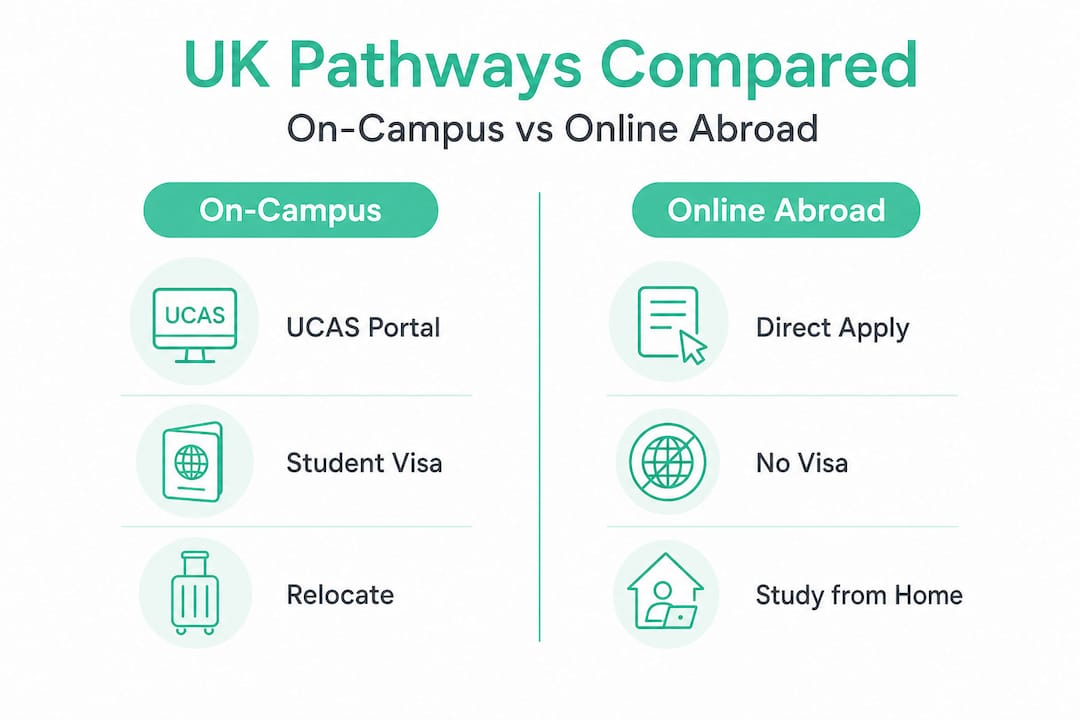
Online study works differently. You apply directly to the institution or program provider rather than going through UCAS. Enrollment windows are typically more flexible, and there’s no fixed national deadline. This pathway suits working professionals and adult learners who want a UK online degree application process that fits around their existing commitments.
One of the biggest differences? Visas. If you study a fully online UK-accredited degree from abroad, a Student visa is not required, since you’re not physically entering the country to study. On-campus applicants, however, must obtain a CAS (Confirmation of Acceptance for Studies) number from their university and demonstrate sufficient funds and English language proficiency as part of their visa application. That’s a significant extra layer of complexity.
Here’s a quick comparison to make this clear:
| Feature | On-campus | Online from abroad |
|---|---|---|
| Application system | UCAS Hub | Direct to institution |
| Student visa required | Yes | No |
| Fixed national deadline | Yes (e.g., January 14) | Usually flexible |
| Personal statement | Required | Varies by program |
| CAS number needed | Yes | No |
| English proof needed for visa | Yes | No (may still be needed for entry) |
You can also explore a range of international study options to understand how different countries structure their pathways before committing to one direction. Understanding the full picture early saves a lot of time later.
Essential requirements and documents for UK applications
Having mapped out your pathway, it’s time to gather what you’ll need to apply successfully. Missing even one document can stall your application or get it rejected outright, so treat this section as your master checklist.
For on-campus UCAS applications, you’ll need:
- A completed personal statement (maximum 4,000 characters)
- One academic or professional reference
- Official academic transcripts from all previous institutions
- Proof of English language proficiency (IELTS, TOEFL, or equivalent)
- A valid passport
- CAS number (issued after you receive a conditional or unconditional offer)
- Financial evidence showing you can cover tuition and living costs (for visa purposes)
The required documents for UK applications can vary slightly between institutions, but this list covers what virtually every UK university expects from international applicants. According to the UCAS guide for international students, the January 14 deadline is considered the equal-consideration cutoff, meaning submitting before this date gives your application the strongest possible position.
For online degree applications, the list is leaner:
- Academic transcripts
- Proof of prior qualifications
- English language proof (may be waived for some programs)
- Valid ID or passport copy
- Application form completed through the provider’s portal
No visa-related documents are needed for fully online programs. This makes the process noticeably lighter for international students who want a recognized UK qualification without the complexity of relocation.
Here’s a document-readiness table to help you plan:
| Document | On-campus | Online |
|---|---|---|
| Academic transcripts | Required | Required |
| Personal statement | Required | Sometimes |
| Reference letter | Required | Sometimes |
| English language test | Required | Varies |
| Financial evidence | Required (for visa) | Not required |
| Passport copy | Required | Required |
| CAS number | Required | Not applicable |

Check out this university entry checklist for a more detailed breakdown and some useful application advice tailored for international learners navigating these processes.
Pro Tip: Start gathering your documents at least three months before your target submission date. Transcripts from overseas institutions often need to be officially translated and notarized, and this process can take several weeks. Don’t assume it will be quick.
Step-by-step application process: From preparation to submission
With all your paperwork in place, follow these steps to complete your application efficiently.
For on-campus UCAS applications:
- Create your UCAS Hub account at ucas.com and complete your personal profile with accurate contact and background details.
- Research and shortlist up to five courses. UK universities allow you to apply to a maximum of five choices through UCAS in a single application cycle.
- Write and refine your personal statement. This is the most time-intensive part. Your statement needs to demonstrate motivation, relevant experience, and fit for your chosen subject. The personal statement is crucial for UCAS, and unlike a resume, it’s your only chance to speak directly to admissions staff.
- Request your reference early. Academic or professional referees often need two to four weeks to write a strong letter. Give them as much notice as possible.
- Upload transcripts and supporting documents to your UCAS Hub profile.
- Submit before the January 14 deadline for equal consideration.
- Respond to offers through UCAS Track, selecting a firm and insurance choice.
- Apply for your Student visa once you receive your CAS number from your chosen university.
For online degree applications:
- Identify your program and confirm accreditation details. Make sure the degree is recognized in your country.
- Complete the provider’s online application form. This usually takes 30 to 60 minutes.
- Upload required documents directly to the provider’s student portal.
- Await confirmation and enrollment details. Online programs typically respond within days rather than weeks.
- Begin your course on the scheduled start date.
“The difference between UCAS and direct online registration isn’t just a process change. It’s a fundamentally different experience of higher education access. Online routes eliminate the gatekeeping elements that prevent many qualified adults from progressing.”
These fast-track application steps are designed for learners who value efficiency. If you’re drawn to the idea of studying while maintaining work and family commitments, exploring fast-track degree flexibility could be the clearest path forward.
Pro Tip: For UCAS applications, write your personal statement in a separate document and review it over several days before pasting it into the system. Fresh eyes catch errors that you miss during continuous editing sessions.
Avoiding common mistakes and troubleshooting your application
Even with a careful process, mistakes happen. Here’s what you need to watch for and how to fix them fast.
The most common errors that derail international applications include:
- Missing the UCAS equal-consideration deadline. Applications submitted after January 14 are still processed, but universities are no longer obligated to treat them equally. In competitive courses, this matters enormously.
- Incomplete or incorrectly formatted documents. Transcripts that aren’t officially certified, or references that don’t match the required format, are among the top reasons applications stall.
- Underestimating the personal statement. Many applicants write a generic statement that could apply to any subject. Admissions staff read thousands of these. A statement that shows genuine subject passion and real-world relevance stands out immediately. The UCAS guide consistently flags personal statement quality as a critical success factor.
- Visa proof errors for on-campus applicants. Financial statements that are too old (most universities require bank statements dated within the last 28 days at visa application stage), wrong currency, or from an ineligible account type are common pitfalls.
- Applying to programs without checking recognition status. Not all “UK-accredited” labels mean the same thing. Confirm the degree is regulated and recognized in your country before you invest time and money.
- Not creating a backup plan. Only applying to competitive programs without lower-risk insurance choices leaves you with nothing if offers don’t materialize.
For online programs, the most frequent mistake is not confirming accreditation details before enrolling. Explore your UK-accreditation study options to make sure the qualification you earn carries real weight.
Pro Tip: Before you hit submit on any application, print or download the full application form and cross-reference it against your document checklist line by line. It sounds basic, but this five-minute step catches errors that cost weeks to fix after submission.
What most guides miss: The expert’s view on strategic application planning
Most articles about applying to UK universities focus on the mechanics. Fill in this form. Meet that deadline. Upload these documents. That’s all useful, but it misses the bigger picture of what actually separates successful applicants from those who repeat the cycle year after year.
Here’s the honest truth: most applicants dramatically underestimate how long document preparation takes. They start the application feeling confident, hit the transcript request stage, and suddenly realize that their previous institution charges a fee, requires a written request by post, and operates on a three-week turnaround. By then, the deadline is two weeks away. This is the single most avoidable failure point in the entire process.
Strategic applicants start document gathering before they even finalize their course list. They treat paperwork as the long lead-time item and application writing as the flexible one. That mindset shift alone dramatically reduces application stress.
On the question of online versus on-campus study, there’s a persistent assumption that online degrees are a compromise. They’re not. For working adults and international learners who want a UK degree from abroad, the online route isn’t the fallback option. It’s often the smarter one. You eliminate visa complexity, housing costs, and relocation logistics. You retain your income and your professional network while earning a globally respected qualification.
The global degree value of a UK-accredited program is real, and it doesn’t diminish because you earned it without moving countries. What matters is the accrediting body, the quality of the curriculum, and the recognition of the institution. Those factors are identical whether you studied in London or Lagos.
Finally, on personal statements: most guides tell you to “be yourself” and “show passion.” That’s true but not enough. Your statement needs to answer one unspoken question from the admissions reader: Why should we choose you over someone with similar grades? The answer always involves specific experiences, concrete examples, and a clear sense of direction. Generic enthusiasm doesn’t differentiate. Detailed, specific storytelling does.
Next steps: Fast-track your UK-accredited application
You now have a clear map of the entire application process, from choosing your pathway to submitting documents and avoiding the errors that trip up most applicants. The next step is putting it into action with the right support behind you.
At Seekstudy, we’ve built our programs specifically for international learners who want recognized UK qualifications without the complexity of full relocation. Whether you’re exploring a business management bachelor’s guide to understand what a fast-track degree involves, or ready to start the online MBA process as a working professional, our team is here to guide your application from first inquiry to enrollment. Regulated by Ofqual and partnered with institutions across the UK, Hong Kong, Singapore, and Australia, we take the guesswork out of international study. Browse our full range of international study pathways and take the next step toward your accredited UK degree today.
Frequently asked questions
Do I need a student visa for UK-accredited online degrees?
No. If you study a fully online UK-accredited degree from your home country, a Student visa is not required because you are not entering the UK to study.
What are the most important documents for an on-campus UK application?
The essential documents are your personal statement, academic reference, and official transcripts, all of which must be submitted via UCAS Hub by the applicable deadline.
How are deadlines different for online versus on-campus UK applications?
On-campus applications are governed by fixed UCAS deadlines such as January 14 for equal consideration, while most online programs accept direct rolling applications throughout the year.
Is the personal statement really that important for UCAS applications?
Yes. The personal statement is crucial for UCAS applicants and is often the deciding factor when academic profiles between candidates look similar.