

TL;DR:
- Different management degrees serve distinct career stages and goals, from recent graduates to senior executives.
- Modern programs emphasize systems thinking, AI literacy, and global perspectives to stay relevant.
- Flexible online, hybrid, and accelerated formats make management education accessible without disrupting careers.
Not all management degrees are created equal, and assuming otherwise could cost you years of progress. The MBA gets most of the attention, but programs like the Master in Management (MiM), Master of Science in Management (MSM), and Executive MBA (EMBA) exist for very different reasons, and they serve very different people. A recent graduate with a non-business background has almost nothing in common with a senior director looking to move into a C-suite role. Yet both might search for the same thing: a management degree. This guide will break down each degree type, show you how to match one to your specific career stage and goals, and explain how modern formats make it easier than ever to earn one.
Table of Contents
- Types of management degrees explained
- How to choose the right management degree for you
- Modern management education: curriculum trends and skills
- Flexible pathways: online, international, and accelerated formats
- What most guides miss about management degrees
- Fast-track your management career with the right program
- Frequently asked questions
Key Takeaways
| Point | Details |
|---|---|
| Degree options vary widely | MBA, MiM, MSM, and EMBA serve different career stages and goals. |
| Accreditation is crucial | Only accredited management programs guarantee employer recognition and global mobility. |
| Flexible study is mainstream | Online, international, and accelerated management degrees now offer recognized pathways for career advancement. |
| Skills focus is shifting | Modern degrees emphasize systems thinking, digital leadership, and adaptation for the AI era. |
Types of management degrees explained
The management degree landscape has expanded significantly over the past decade. Where once the MBA dominated every conversation, today’s learners have a range of specialized options that can be more precise, more affordable, and sometimes faster to complete.
Here is a quick comparison to orient you:
| Degree | Typical target | Duration | Format options |
|---|---|---|---|
| MBA | Mid-career professionals | 1 to 2 years | Full-time, online, accelerated |
| MiM | Recent graduates | 1 to 2 years | Full-time, blended |
| MSM | Early-career or career changers | 1 to 2 years | Online, hybrid |
| EMBA | Senior executives | 18 to 24 months | Part-time, weekend, blended |
The MBA (Master of Business Administration) is the most widely recognized management credential in the world. It focuses on practical leadership, strategy, finance, and operations. It is designed for professionals who already have work experience, typically three to seven years, and want to accelerate into leadership or pivot industries.
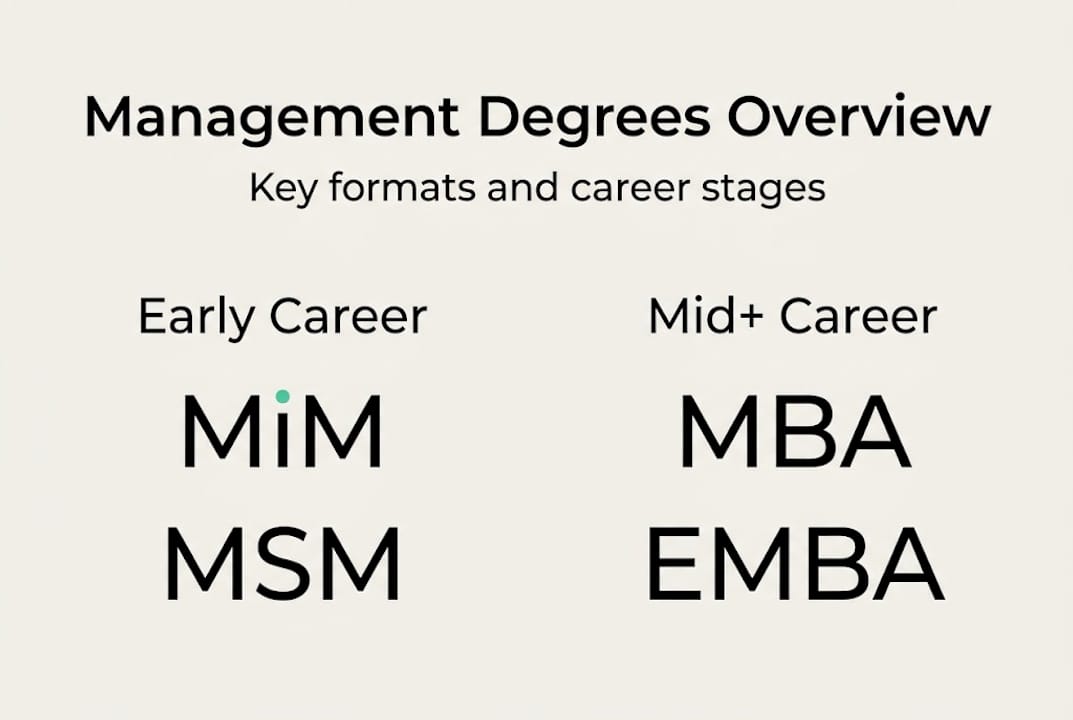
The MiM (Master in Management) is aimed at those who are early in their careers or just completing an undergraduate degree. It is more theory-focused than the MBA, building foundational business knowledge. Contrary to popular belief, MBA vs MiM differences show the MiM is not limited to business undergraduates. Students from engineering, arts, or sciences can qualify and thrive.
The MSM (Master of Science in Management) bridges the gap between the MiM and MBA. It is often more quantitative and research-driven, appealing to those who want analytical depth alongside leadership training. Like the MiM, it suits early-career professionals and those exploring studying management online for maximum flexibility.
The EMBA (Executive MBA) is built for senior professionals who cannot step away from their careers. It runs part-time, usually over weekends or in intensive blocks, and students bring their leadership experience into the classroom as much as they take learning out of it. For a clear picture of how this works, explore what is an Executive MBA and how it differs from a standard MBA.
Modern programs across all four formats are also beginning to integrate systems thinking, artificial intelligence, and global market perspectives into core curricula, reflecting just how fast the business world is changing.
- MBA: Best for experienced professionals targeting leadership roles
- MiM: Best for recent grads building foundational business acumen
- MSM: Best for analytical thinkers early in their careers
- EMBA: Best for senior executives seeking structured development without leaving work
How to choose the right management degree for you
Knowing what exists is only half the battle. Choosing the right degree requires honest self-assessment. Here is a practical framework you can use right now.
-
Assess your academic background. If you have a non-business undergraduate degree, a MiM or MSM might help you build the foundations before pursuing an MBA later. If you already have business training, an MBA or EMBA might be your immediate next step.
-
Evaluate your career stage. Early-career professionals typically benefit most from MiM or MSM programs. Mid-career professionals gain more from MBA programs. Senior leaders should look at EMBA formats. Matching your stage to the right program means you will be in a cohort with peers at similar levels, which dramatically improves classroom quality and networking value.
-
Examine your lifestyle constraints. Are you working full-time? Do you have family commitments? Fast-track management degrees allow you to complete programs in compressed timeframes without sacrificing rigor. Online and hybrid formats let you study around a schedule that actually fits your life.
-
Map your future goals. Not all degrees carry equal weight in every industry. Research how employers in your target sector perceive each credential. The benefits of online MBA programs have grown substantially as accredited institutions raise their standards to match traditional formats.
-
Check accreditation carefully. Accreditation ensures global recognition and is crucial for employer acceptance and career mobility across borders. Look for programs recognized by bodies like Ofqual in the UK or AACSB internationally. Understanding degree accreditation for careers is a step many students skip and later regret.
Pro Tip: When evaluating programs, ask admissions teams for employer outcome reports. A transparent school will share where graduates work within 12 months of completing the degree. If they cannot provide this data, treat it as a red flag.
Also think ahead. Roles in management are being reshaped by AI, automation, and global competition. A degree that includes exposure to these forces will age better than one that ignores them entirely.
Modern management education: curriculum trends and skills
Management curricula are not static. The best programs today look very different from what was taught even five years ago, and that evolution is accelerating.
One of the biggest shifts is the rise of systems thinking. Rather than training managers to optimize isolated functions, programs now teach students to see organizations as interconnected systems. According to Durham Business School Dean Kieran Fernandes, managers must think like engineers in the age of AI, meaning they need to understand how systems behave, break, and adapt, not just how to manage people.
“The manager of the future will not just lead people. They will orchestrate systems, technologies, and global networks simultaneously.”
Here is how modern curriculum priorities are shifting:
| Old focus | New focus |
|---|---|
| Functional silos (finance, HR, marketing) | Cross-functional systems thinking |
| Local market strategy | Global and cross-cultural leadership |
| Manual data analysis | AI-assisted decision making |
| Classroom theory | Real-world project-based learning |
The integration of AI advancements in education is reshaping how management programs deliver content, assess students, and simulate real business scenarios. Some schools now use AI-driven case simulations where students must respond to live market data rather than historical cases.
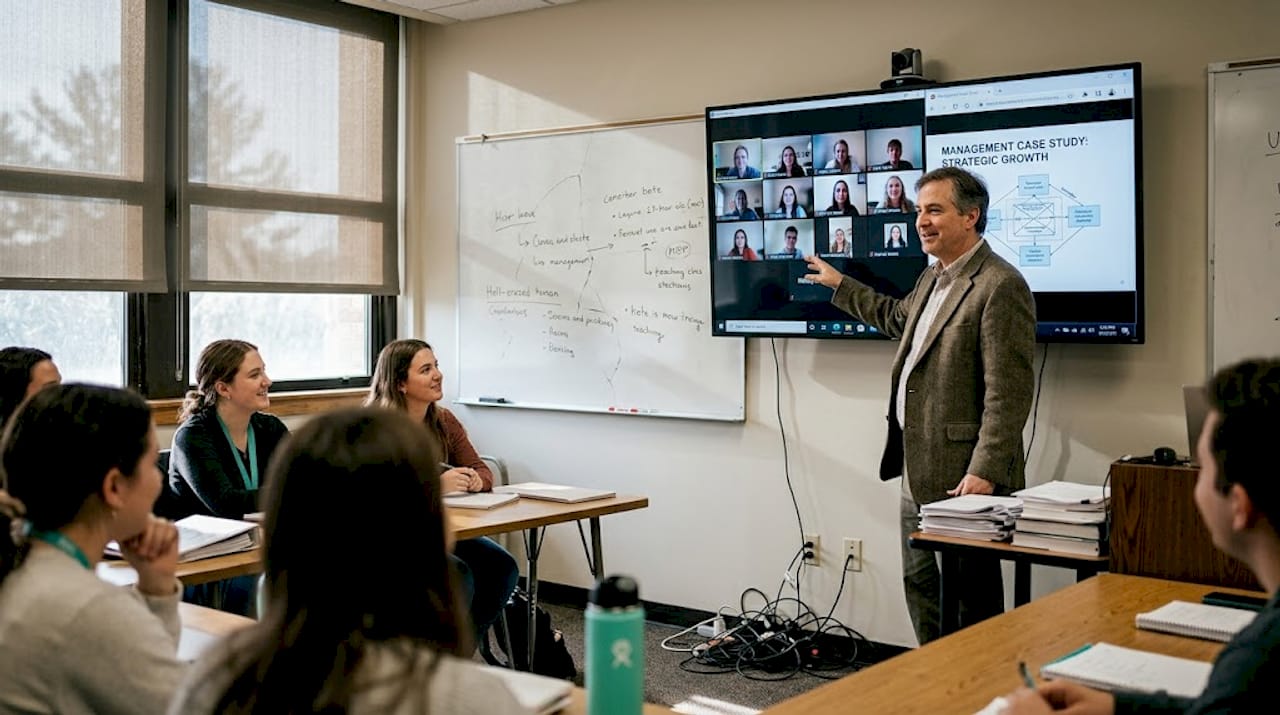
Employers are noticing. Graduates from programs that prioritize digital literacy, cross-border communication, and adaptive leadership are being hired faster and into higher roles than those from programs that stick to traditional frameworks. Explore top management courses to see how this shift is already being built into program design.
Practical skills that employers now rank highest include stakeholder communication under uncertainty, data interpretation for non-technical audiences, and the ability to lead diverse remote teams across time zones. These are learnable, and the best modern programs build them directly into assessments.
Flexible pathways: online, international, and accelerated formats
One of the biggest misconceptions about management degrees is that the best ones require you to quit your job and sit in a classroom for two years. That was true once. It is simply not true anymore.
Today, the main formats available to you include:
- 100% online programs: Fully asynchronous, meaning you study on your schedule. No physical attendance required. These programs work especially well for working professionals and international students who cannot relocate.
- Hybrid or blended programs: Mix online study with periodic in-person intensives. You get the flexibility of online learning with the networking benefits of face-to-face interaction.
- International programs: Allow you to study management in Singapore or UK settings, earning credentials recognized across multiple jurisdictions. These programs often include cultural immersion that pure online study cannot replicate.
- Accelerated degrees: Compressed timelines, often 12 to 18 months for a full master’s degree. Accelerated formats benefit working professionals by reducing time away from career progression while still delivering recognized credentials.
The idea that online degrees are somehow inferior to campus-based ones is outdated. What matters is accreditation, curriculum rigor, and graduate outcomes, not the delivery method. Many of the world’s most respected institutions now offer fully online management degrees that rank alongside their on-campus equivalents.
Pro Tip: Consider stacking credentials strategically. Start with an online foundation or bachelor’s program, then progress to an accelerated MBA. This approach builds your resume incrementally while keeping costs manageable. Explore accelerated business degrees to see how this stacking model can fast-track your career progression.
International formats also give you something that purely domestic programs rarely can: a global network. Studying alongside peers from different countries, industries, and regulatory environments forces you to think in ways that prepare you for real cross-border management roles.
What most guides miss about management degrees
Here is the part most admission brochures will never tell you. There is no single best management degree. The right one is the one that fits your actual life, not the one with the most impressive brand name on the cover.
We have seen students choose elite MBA programs and struggle because they were not ready for the pace or the cost. We have seen others choose flexible, accredited online programs and land senior roles faster because they kept building real-world experience while studying. The degree name opened the door. The combination of degree plus experience walked them through it.
The market is also shifting fast enough that adaptability often matters more than the credential itself. Employers are increasingly asking what you can do today, not what school’s name is on your diploma. Programs that prioritize hands-on projects, international exposure, and interdisciplinary thinking are delivering graduates who perform better in real environments.
Our honest advice: talk to recent graduates before you commit. Ask them what employers actually said about their degree. Ask about the curriculum’s real-world relevance. Explore global benefits of online management study to see how flexible programs are closing the gap with traditional formats. Insist on curriculum transparency. A strong program will welcome those questions.
Fast-track your management career with the right program
You now know the landscape. The next step is finding a program that is built around your specific goals, not a generic template.
At Seekstudy, we offer accredited management programs designed for people who cannot afford to pause their careers. From a one-year online MBA to international study combining Singapore and UK campuses, every program is built for flexibility and real outcomes. Explore fast-track degree programs and see which format matches your timeline and ambitions. Whether you want a fully online route or an international experience, we have structured programs that fit working professionals. Find out how accelerated business degrees can move your career forward without putting your life on hold.
Frequently asked questions
What is the difference between an MBA, MiM, MSM, and EMBA?
The MBA suits mid-career professionals, the MiM and MSM target recent graduates or early-career professionals, and the EMBA is designed for senior executives who study part-time while remaining in their roles.
Do employers value online and accelerated management degrees?
Yes. Accredited online programs are broadly accepted by employers, particularly when program rigor and graduate outcomes match those of traditional campus-based degrees.
How important is accreditation when choosing a management degree?
Accreditation drives employer recognition and ensures your degree is respected globally, which is critical if you plan to work across different countries or industries.
Can I study management online while working full-time?
Absolutely. Many programs are specifically designed for working professionals, offering flexible online or hybrid formats that allow you to study without stepping away from your current role.
What new skills are emphasized in modern management degrees?
Modern programs increasingly focus on systems thinking and AI readiness, alongside digital leadership, cross-cultural communication, and project-based learning that reflects real workplace demands.