

TL;DR:
- Professional qualifications focus on practical, job-specific skills, unlike broad academic degrees.
- Earning recognized credentials can significantly boost earnings and global career mobility.
- Choosing the right qualification depends on career goals, timing, and personal circumstances.
Most professionals assume there are two clean lanes in business education: get a degree or get certified. The reality is far messier, and far more interesting. Many people spend years chasing the wrong credential because they never stopped to question what each path actually delivers. Understanding the difference between academic and professional qualifications is not just a technicality. It is the decision that shapes how fast you advance, how globally recognized your expertise becomes, and how much you earn. This guide cuts through the confusion and gives you a clear, actionable framework to choose the credential that actually fits your goals.
Table of Contents
- Defining professional business qualifications
- Entry criteria and how professional qualifications work
- Top business professional qualifications and their career impact
- Professional vs academic qualifications: Which is right for you?
- Essential skills and real-world value from business certifications
- Why choosing the right business qualification goes beyond prestige
- Accelerate your career with a recognized business qualification
- Frequently asked questions
Key Takeaways
| Point | Details |
|---|---|
| Practical focus | Professional business qualifications emphasize real-world, job-ready skills for quick career impact. |
| Rigorous requirements | Most require a degree, relevant experience, tough exams, and ongoing education for certification. |
| Career acceleration | Earning a business credential can significantly boost your earning potential and global mobility. |
| Choosing your path | Decide between professional or academic routes based on your goals, career stage, and lifestyle. |
Defining professional business qualifications
Let’s first set the record straight about what professional business qualifications actually are.
A professional business qualification is a credential that proves you have job-specific skills and practical competence in a defined area of business. These are not theory-heavy academic awards. They are designed by industry bodies to certify that you can perform a specific function at a professional level, right now.
Academic degrees, by contrast, are built around broad, theoretical learning. A bachelor’s degree in business gives you a wide foundation. An MBA expands that foundation strategically. Neither is designed to immediately signal readiness for a single, specialized role the way a professional credential does.
“Professional qualifications focus on practical, job-specific competence, while academic qualifications emphasize theoretical and broad-based learning. The two serve different purposes, and understanding which one fits your goals is essential.”
That said, the line is not always sharp. The MBA is the best example of a credential that straddles both categories. It is awarded by universities (academic) but built around real business problems and leadership application (professional). So when someone tells you the MBA is “just another degree,” they are missing half the picture.
Here are the most recognized professional business qualifications you will encounter:
- CMA (Certified Management Accountant): Financial planning and decision-making
- ACCA (Association of Chartered Certified Accountants): Global accounting and finance
- CFA (Chartered Financial Analyst): Investment analysis and portfolio management
- CPA (Certified Public Accountant): Public accounting and audit
- CIMA/CGMA (Chartered Global Management Accountant): Management accounting
- PMP (Project Management Professional): Project leadership and delivery
Employers value these credentials for one practical reason: they reduce hiring risk. When you walk in with a CFA or ACCA, the employer does not have to guess whether you can handle the technical demands of the role. The certification has already answered that question.
Entry criteria and how professional qualifications work
With this foundation in mind, let’s look at what it takes to actually begin and pursue a professional qualification.

Most professional business qualifications are not open-door programs. They have structured entry requirements, and those requirements exist for a reason: employers trust these credentials precisely because the bar is high. Typically, you will need a bachelor’s degree or equivalent, plus relevant work experience ranging from two to four years.
Exams are the core of every professional qualification. Take the CMA certification as an example. It consists of two parts: financial planning and strategic financial management. The pass rate sits between 45% and 50%, which means roughly half of all candidates do not pass on their first attempt. That is not discouraging news. It is a signal that passing carries genuine weight with employers.
Beyond the initial exam, most certifications require ongoing continuing professional education, commonly called CPE. For the CMA, that means 30 hours of CPE per year. This is not just a formality. It ensures your knowledge stays current as regulations, standards, and tools evolve.
Here is a step-by-step path from application to completion:
- Confirm your eligibility: Check degree and experience requirements for your target credential
- Register with the certifying body: Submit your application, transcripts, and work history
- Build your study plan: Use official study materials and set a realistic exam timeline
- Sit and pass all required exams: Some credentials have 2 parts, others have 13 papers
- Complete required work experience: Often verified by an employer or supervisor
- Receive your certification: Submit all documentation and receive your formal credential
- Maintain certification annually: Complete CPE hours and pay renewal fees each year
Pro Tip: When budgeting for a professional qualification, do not forget ongoing CPE costs. Study materials, exam fees, and annual renewal can add up quickly. Build these into your long-term plan from day one.
Top business professional qualifications and their career impact
Now that you know the process, let’s explore which qualifications can most rapidly advance your career and what results to expect.
The credential you choose has a direct impact on your earning potential and career mobility. According to certification salary data, CMA holders earn an average of USD 136,000 per year in the United States. ACCA requires 13 exam papers and three years of relevant experience and is recognized in over 180 countries. The CFA demands passing three levels of exams and four years of investment experience, and it is widely considered the gold standard in finance.
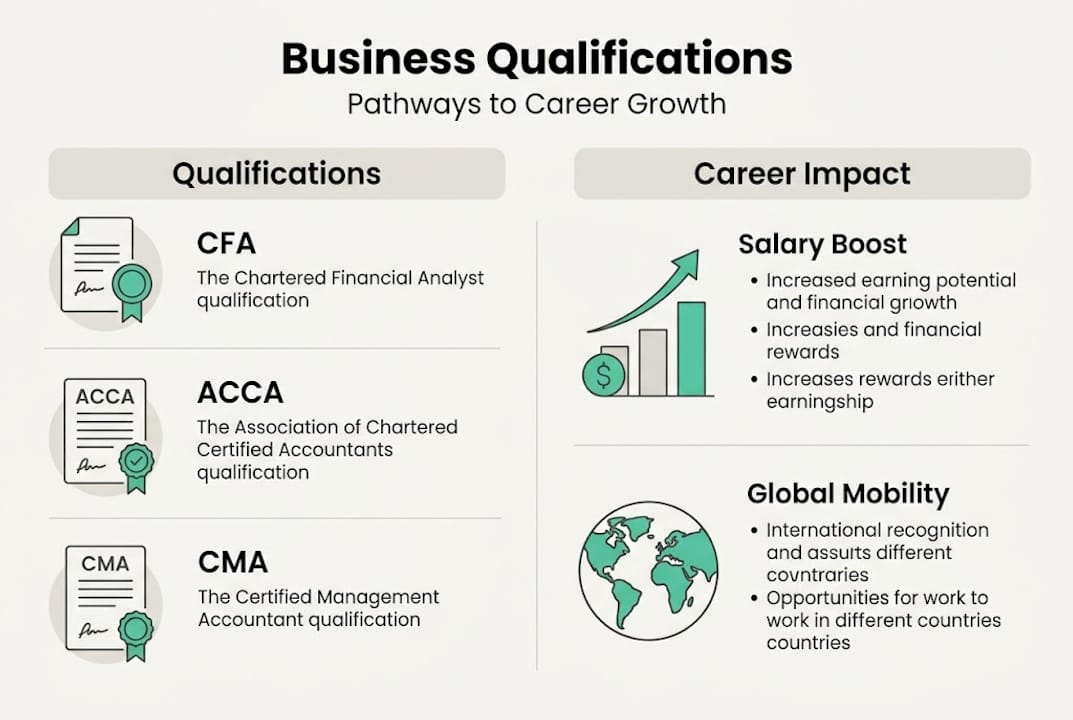
Key professional qualifications at a glance:
| Qualification | Exam structure | Experience required | Avg. salary (USD) | Global recognition |
|---|---|---|---|---|
| CMA | 2 parts | 2 years | ~$136,000 | High |
| ACCA | 13 papers | 3 years | ~$65,000 | Very High (180+ countries) |
| CFA | 3 levels | 4 years | ~$100,000+ | Very High |
| CPA | 4 sections | 1-2 years | ~$80,000 | High (US-focused) |
| CIMA/CGMA | Multiple exams | 3 years | ~$75,000 | High |
| PMP | 1 exam | 3-5 years | ~$120,000 | High |
Stat callout: Professionals holding recognized business certifications consistently earn significantly more than their non-certified peers, with some credentials delivering a salary premium of 20% or higher.
One factor that makes these credentials powerful is their portability. An ACCA or CFA designation follows you across borders, which is critical if you plan to study abroad or work in multiple countries. Understanding business school accreditation helps you see how academic programs complement these credentials by adding institutional recognition to your profile.
For working professionals already juggling job responsibilities, the benefits of fast-track MBA programs make them an appealing parallel path. Combining an MBA with a professional certification is increasingly common among high-performers who want both breadth and depth.
Professional vs academic qualifications: Which is right for you?
But how do you decide whether to pursue a professional qualification or an academic degree? Here’s a clear comparison to help you choose.
This is where most career guides give you a vague “it depends.” Let’s be more precise. The right choice depends on your career stage, your timeline, and what specific doors you need to open.
Side-by-side comparison:
| Feature | Professional qualification | Academic degree (MBA) |
|---|---|---|
| Duration | 1 to 4 years | 1 to 2 years (fast-track) |
| Cost | Moderate (exam + CPE fees) | Moderate to high (tuition) |
| Focus | Job-specific skills | Broad leadership and strategy |
| Entry requirement | Degree + work experience | Degree or equivalent |
| Outcome | Specialized role readiness | Management and leadership roles |
| Global recognition | High in specific fields | High across industries |
According to comparative research on qualifications, high skill levels drive roughly one-third of firm productivity gaps, according to the OECD. That finding cuts both ways. Employers need people with specialized skills, and they need people who can lead and think across functions. Neither credential wins outright.
Here are the decision factors that matter most:
- Choose a professional qualification if you want a faster path to a specialized, high-demand role in finance, accounting, or project management
- Choose an academic degree if you are targeting senior leadership, career pivots, or broader general management roles
- Combine both if you want maximum flexibility and global career mobility
- Consider your career stage: Early professionals often benefit from specialized credentials first; mid-career professionals often gain more from an MBA
For those weighing the online vs on-campus MBA question, flexibility and cost are usually the deciding factors. And if you are still exploring fast-track degrees, it is worth mapping credentials against your five-year career plan before committing.
Essential skills and real-world value from business certifications
Finally, let’s look beyond credentials and see the tangible skills these programs deliver.
A certificate on your wall means little if you cannot apply what it represents. The most respected business certifications build a specific set of skills that employers actively prioritize when making promotion and hiring decisions.
Professional qualifications focus on practical, job-specific competence rather than academic theory, which means the skills you gain are immediately applicable. A CMA holder is trained to analyze cost structures and make financial decisions under pressure. A PMP holder can manage complex, multi-team projects with competing deadlines. An ACCA professional understands international financial reporting standards well enough to advise global clients.
Here are the core skills developed across top business certifications:
- Financial analysis and reporting: Reading, interpreting, and acting on financial data
- Risk management: Identifying and mitigating business and financial risk
- Strategic planning: Contributing to long-term business decisions, not just day-to-day tasks
- Ethical judgment: Applying regulatory standards and professional codes in real situations
- Project management: Planning, executing, and closing complex initiatives on time
- Leadership and communication: Driving teams and reporting up to senior stakeholders
Consider a practical example. A mid-level finance manager earns a CMA while working full time. Within six months of certification, she is assigned to lead a cost-reduction initiative that was previously handled by a VP. The credential gave her both the skills and the organizational visibility to take on higher-stakes work.
To develop your broader business management skills, pairing a professional certification with a recognized degree program creates a profile that is genuinely hard to overlook.
Pro Tip: Once you earn a professional certification, do not wait for opportunities to use it. Volunteer for cross-functional projects, ask for international assignments, and update your profile to reflect your new credential. Active positioning accelerates the return on your certification investment.
Why choosing the right business qualification goes beyond prestige
As you weigh your options, here’s a perspective most guides miss about what really drives success.
Everyone talks about prestige when choosing a business qualification. Which credential has the most global name recognition? Which university has the best ranking? These questions matter, but they are rarely the deciding factor in whether someone actually succeeds after earning their credential.
What we have seen, working with students across multiple countries and career stages, is that the professionals who thrive are the ones who matched their qualification to their current life situation. Someone with a full-time job and a family cannot realistically pursue a three-year program with intensive in-person requirements. Choosing a flexible guide to online MBA or a structured certification path that fits their schedule delivers far more career value than the most prestigious program that they never finish.
Modern employers also care more about your ability to apply knowledge quickly and adapt to new challenges than the exact letters after your name. The professionals who combine a fast-track degree with a targeted certification consistently demonstrate both breadth and depth, and that combination is hard to overlook.
Accelerate your career with a recognized business qualification
Ready to take your business career to the next level?
At Seekstudy, we have built our programs specifically for people who cannot afford to slow down. Our fast-track business degrees are designed to deliver a UK-recognized qualification in a fraction of the traditional timeline, without sacrificing academic rigor or global credibility.
Whether you are working toward your first degree or ready to add an MBA to your profile, our programs combine online flexibility with real international study experiences across Singapore and the UK. Explore our guide to online MBA programs and see exactly how our curriculum maps to the career goals you are building toward. Your next qualification does not have to take five years. Start planning the smarter path today.
Frequently asked questions
What is considered a professional qualification in business?
A professional qualification in business is an industry-recognized credential like CMA or ACCA that certifies job-specific skills and practical experience in a defined business function.
Do I need a degree before earning a business professional qualification?
Most professional business qualifications require at least a bachelor’s degree plus relevant work experience, as most certification bodies mandate two to four years of practical background before awarding credentials.
How long does it take to complete a professional qualification?
Most business professional qualifications take two to four years to complete, depending on your chosen credential. For example, CMA requires two exam parts plus two years of experience, while ACCA involves 13 papers and three years of experience.
Are professional qualifications or business degrees better for career growth?
Professional qualifications offer faster, practical job skills, while academic degrees like MBAs provide broader business foundations. Skills differences drive roughly one-third of firm productivity gaps, so your choice should align with your specific career goals and timeline.
Do professional business qualifications expire?
Most professional qualifications require ongoing continuing education to stay active. The CMA, for example, requires 30 hours of CPE annually to maintain certification status.