

TL;DR:
- Professional qualifications emphasize applied skills and industry recognition, unlike traditional degrees focused on theory. They involve structured levels, exams, and practical experience, offering flexible study options for working professionals worldwide. These credentials significantly enhance career prospects, especially in management and accounting, by signaling continuous competence and industry-specific expertise.
Most people assume a professional qualification is just another way of saying “degree.” That assumption costs careers. A professional qualification is its own category entirely, one built around applied skills, industry recognition, and measurable career outcomes. Whether you are a recent graduate trying to stand out or a mid-career professional aiming for a leadership role in accounting or management, understanding this distinction can reshape how you invest in your education. This article clarifies exactly what a professional qualification is, how the process works, who benefits most, and how the return compares to a traditional degree.
Table of Contents
- Defining professional qualifications: More than a credential
- How the process works: Levels, exams, and requirements
- Who should pursue one? Entry points and practical advantages
- Comparing professional qualifications vs academic degrees
- Our take: Why real-world expertise beats academic theory for career moves
- Get started: Accelerate your career with the right qualification
- Frequently asked questions
Key Takeaways
| Point | Details |
|---|---|
| Practical value | Professional qualifications are designed for real-world business success, not just theory. |
| Flexible pathways | Entry routes include non-degree options and accommodate part-time or online study. |
| Career impact | Employers and recruiters value these certifications for rapid career advancement and ROI. |
| Ongoing development | Maintaining your credential requires continuous professional development each year. |
| Global recognition | Professional qualifications like CIMA, CMA, and ACCA are respected by employers worldwide. |
Defining professional qualifications: More than a credential
A professional qualification is not a degree, and treating it like one is a mistake that holds many learners back. At its core, a professional qualification is a certification earned through exams, practical experience, and sometimes prior education. It is awarded by professional bodies like CIMA (Chartered Institute of Management Accountants), IMA (Institute of Management Accountants), or ACCA (Association of Chartered Certified Accountants). The focus is on practical, job-specific skills in fields like management accounting, rather than the theoretical frameworks that define academic degrees.
Think of it this way. A degree teaches you how economies work. A professional qualification teaches you how to manage a company’s financial risk next quarter. Both have value. But they serve different purposes.
Key professional bodies and what they award:
- CIMA awards the CGMA (Chartered Global Management Accountant) designation
- IMA awards the CMA (Certified Management Accountant) credential
- ACCA awards the ACCA qualification, recognized in over 180 countries
- CPA bodies (various national organizations) award Certified Public Accountant status
These organizations are the gatekeepers of professional standards. Their certifications carry real weight with hiring managers because the bodies themselves maintain strict exam standards, enforce ethical codes, and require ongoing learning. This is fundamentally different from a university diploma that you earn once and carry forever.
| Feature | Professional qualification | Academic degree |
|---|---|---|
| Awarded by | Professional bodies (CIMA, IMA, ACCA) | Universities and colleges |
| Primary focus | Applied, job-specific skills | Theoretical frameworks |
| Time to complete | 2 to 5 years (flexible) | 3 to 4 years (full-time) |
| Ongoing requirement | CPD hours required annually | None after graduation |
| Recognition | Industry and employer-specific | Broadly recognized |
“Professional qualifications prioritize practical competence. Academic degrees prioritize academic knowledge. Neither replaces the other, but for employers in accounting and management, the practical edge often tips the balance.” — Industry consensus, supported by professional body guidance
Fields like management accounting, financial analysis, and business operations are especially built around these credentials. If your career goals involve professional qualifications vs degrees in a practical sense, this distinction matters enormously from day one.
How the process works: Levels, exams, and requirements
Now that the foundation is clear, let’s walk through exactly how the path to earning a professional qualification unfolds.
Most major qualifications follow a structured three-level progression. The CGMA pathway, for example, is organized into Operational, Management, and Strategic levels. Each level contains multiple papers, a mix of objective tests (multiple choice and short answer) and case study exams that simulate real business scenarios. The CGMA certification structure requires passing these staged exams, gaining 2 to 5 years of relevant work experience, and maintaining ongoing CPD, such as 30 hours per year for the CMA.
Step-by-step overview of the qualification journey:
- Check your entry route. Most bodies accept candidates with or without a degree. Some require a foundation certificate first.
- Register with the professional body. Pay the registration fee and confirm your exam pathway.
- Study for and pass each level’s exams. Objective tests can often be taken on demand. Case studies are scheduled.
- Accumulate relevant work experience. This can be full-time or part-time. Two part-time years typically count as one full-time year.
- Apply for membership. Once exams and experience requirements are met, submit your application.
- Maintain CPD. Most bodies require annual hours of professional development to stay certified.
One of the most misunderstood parts of this process is the flexibility built into it. The required steps for management accounting programs are often designed with working professionals in mind. You do not have to quit your job. You do not have to study full-time. Many candidates pass exams while working, letting their day job count toward the experience requirement simultaneously.
Pro Tip: If you already hold a CPA designation, you may be able to skip early levels of the CGMA pathway. The online MBA process follows a similar philosophy of recognizing existing credentials and experience to shorten your journey.
A critical detail that many candidates overlook: according to the CMA certification guide, non-degree entry is possible through certificates like the CIMA Business Accounting Certificate. Part-time experience counts, with two part-time years equaling one full-time year. There is also a seven-year window after passing exams to fulfill the experience and degree requirements. The IMA accepts a bachelor’s degree in any field, not just business or accounting. These nuances matter if you are planning your entry route strategically.
| Qualification | Levels | Exam types | Experience required | CPD requirement |
|---|---|---|---|---|
| CGMA (CIMA) | 3 | Objective tests + case studies | 3 years minimum | Ongoing annual hours |
| CMA (IMA) | 2 parts | Multiple choice + essay | 2 years | 30 hours/year |
| ACCA | 3 stages | Various paper types | 3 years | 40 hours/year |
Who should pursue one? Entry points and practical advantages
With the process understood, the next logical question is: who are these qualifications really for, and why do so many invest in earning one?
The honest answer is that they are for anyone serious about a career in management or accounting, regardless of where they are starting from. Recent graduates use them to differentiate themselves when competing for entry-level roles. Mid-career professionals use them to pivot into higher-paying specialties or move into leadership. Career changers use them to gain credibility in a new field without returning for a full undergraduate degree.
Who benefits most from professional qualifications:
- Recent graduates with business or finance degrees who want a competitive edge
- Career changers transitioning into accounting or management from another field
- Experienced professionals seeking formal recognition of their expertise
- International professionals who want globally recognized credentials that travel with them
- Working adults who cannot commit to full-time study but want structured skill-building
The salary data is compelling. Pass rates for qualifications like the CGMA and CMA sit at roughly 40 to 50 percent, which signals genuine rigor. This selectivity is exactly why employers pay attention. When you hold a CMA or CGMA, it communicates that you passed exams that most people do not.
For mid-career professionals especially, the ROI is strong. A management accountant with a CMA designation typically earns 20 to 30 percent more than a counterpart without one, across many markets. This is not just about the credential itself. It is about what the qualification trains you to do: business partnering, strategic analysis, and financial decision-making rather than routine compliance work.

Pro Tip: If you are already in a finance or business role and want to understand your career growth pathways more clearly, mapping your current experience against a qualification’s requirements can reveal how close you already are to eligibility.
Research from professional development educators consistently shows that professional development benefits go beyond salary. Professionals who earn certifications report greater job satisfaction, broader internal mobility, and stronger professional networks. This strategic role for career advancement is often underestimated by candidates who focus only on the credential itself rather than the community and reputation that comes with it.
Comparing professional qualifications vs academic degrees
Understanding these benefits invites another critical comparison: how do professional qualifications actually measure up against a traditional university degree?
The comparison is not about which is better in absolute terms. It is about fit. A degree offers breadth and theoretical depth. A professional qualification offers applied precision and industry signaling. Both have genuine value, and they serve different moments in a career.
According to the differences between qualifications and degrees, academic degrees emphasize theory, research methodology, and broad intellectual development. Professional qualifications focus on what you can do on the job by Monday morning. For an employer hiring a management accountant or a financial controller, that applied competence often ranks higher than the ability to critique economic theory.
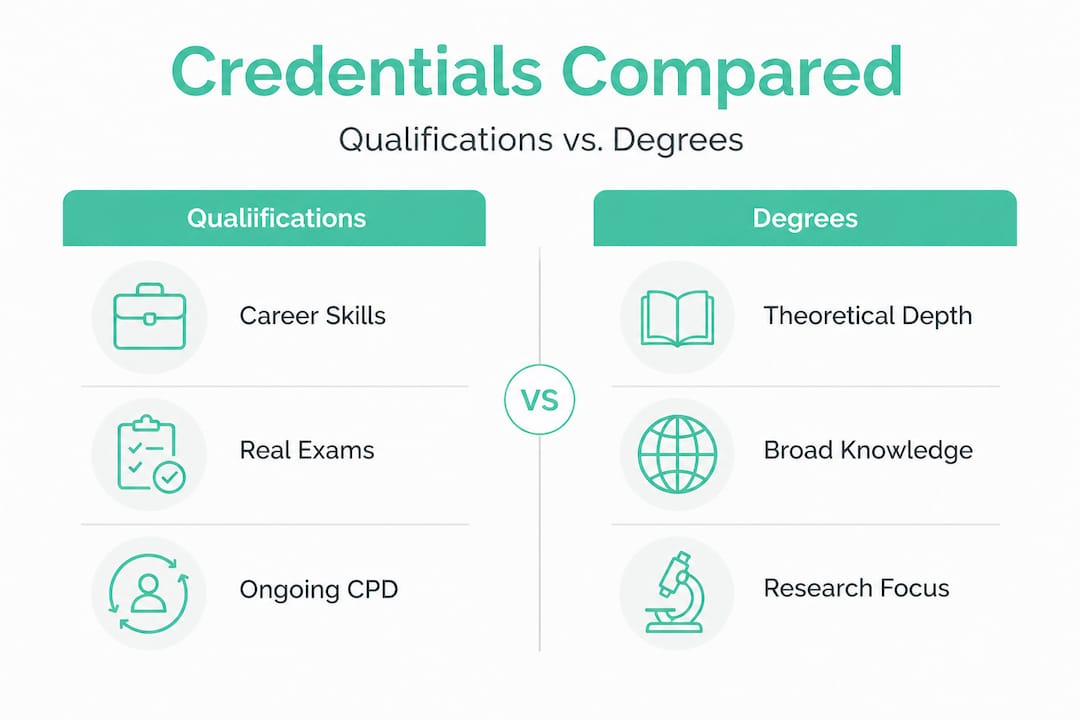
| Dimension | Professional qualification | Academic degree |
|---|---|---|
| Learning style | Case-based, applied, scenario-driven | Lecture-based, research-oriented |
| Career signal | High in specific industries | Broad, foundational signal |
| Cost | Generally lower per level | High tuition, full program cost |
| Flexibility | High, study while working | Often requires full-time commitment |
| Global portability | Strong within the body’s network | Varies by institution ranking |
What employers actually look for:
- Evidence that you can apply knowledge to real business problems
- Membership in a recognized professional body (signals ongoing accountability)
- Willingness to keep learning, shown by CPD records
- Relevant experience that aligns with the role’s scope
One area where academic degrees still hold a clear advantage is in roles that explicitly require them, such as certain academic, legal, or regulated positions. Global degree recognition from accredited UK institutions, for example, carries significant weight for roles in international markets. Similarly, why accreditation matters is a question worth exploring for anyone considering study abroad or cross-border employment.
The smartest strategy for most professionals is not to choose one over the other. It is to layer them intentionally. Accredited courses comparison data from Australian educators confirms that professionals who combine accredited academic study with professional certification see the strongest overall career outcomes.
Our take: Why real-world expertise beats academic theory for career moves
Here is the uncomfortable truth that most education marketers will not say directly: credential stacking without strategic intent is waste. We see it constantly. Professionals who collect qualifications like loyalty points, adding certificate after certificate to their resume, without ever developing deep applied expertise. The result is a resume that looks busy but says very little.
The employers we hear from most consistently, whether in the UK, Singapore, or Australia, are not looking for someone who has done everything. They are looking for someone who can do the specific thing they need done, and do it well. A finance director with 10 years of experience and a CMA will almost always beat a candidate with two degrees and no professional certification, because the CMA signals exactly what they can do right now.
This is not anti-academic. Degrees matter. A good foundation program or accredited bachelor’s degree builds the conceptual literacy that makes professional qualifications more meaningful when you earn them. But that combination only works when the degree informs the qualification, rather than just preceding it.
What most applicants get wrong is timing. They pursue professional qualifications too late, after feeling “stuck,” rather than building toward them as part of a deliberate plan. The professionals who benefit most from real-world outcomes are those who align their certification pursuit with actual career goals, not just ambition.
Globalization has also shifted the calculus. Practitioners in Hong Kong, Singapore, Nigeria, or the UAE who hold ACCA or CGMA designations can walk into roles across multiple markets. A degree from one national university system rarely achieves that portability without additional credentialing. This is the fast lane that practical qualifications have opened up, and most traditional academic advisors still underweight it.
Get started: Accelerate your career with the right qualification
Armed with new clarity, here is how you can act on this information and accelerate your own career.
At Seekstudy, our programs are specifically designed for professionals and prospective students who want to move faster, without cutting corners on recognition or quality. Whether you are exploring business qualification pathways that lead to accredited UK credentials, or researching online MBA resources that fit around your work schedule, we have built options that align with the practical realities of building a career in 2026.
Our fast-track programs span management, accounting, and business, with international study options linking Singapore and the UK. If you want to study accounting online while keeping your job and your life intact, our platform gives you accredited pathways that employers in global markets actually recognize. This is not just education. It is a career investment designed for people who are serious about where they are going.
Frequently asked questions
Is a professional qualification better than a degree for career growth?
Professional qualifications focus on practical, job-specific skills and are often preferred for career advancement in management and accounting, particularly when paired with real work experience. A degree provides broader theoretical grounding, but in many hiring decisions, the qualification speaks more directly to on-the-job capability.
How long does it take to complete a professional qualification?
Most professional qualifications take between 2 to 5 years to complete, requiring you to pass structured exams at multiple levels, accumulate relevant work experience, and meet ongoing CPD requirements. Flexible study options mean many candidates finish while working full-time.
Can I get a professional qualification without a bachelor’s degree?
Yes, many professional bodies allow non-degree entry via certs such as the CIMA Business Accounting Certificate, or through sufficient relevant work experience. Requirements vary by organization, so checking the specific body’s entry criteria is essential before you begin.
What is CPD and why is it required?
CPD stands for Continuing Professional Development. It is required because 30 hours/year for CMA and similar annual targets ensure that certified professionals stay current with evolving industry standards, regulations, and best practices rather than relying on knowledge that may have become outdated.
Recommended
- Unlock Career Growth: The Strategic Role of Professional Qualifications
- Professional business qualifications: pathways to career growth
- International Study Experience Explained: 30% Career Boost
- Why pursue accredited qualifications? Unlock global career mobility
- Why pursue professional development: skills and career gains