
TL;DR:
- Management education should focus on cultivating ethically grounded leadership and practical judgment, not just passing exams or adhering to symbolic compliance.
- Structured assessment and continuous curriculum improvement ensure programs deliver genuine skills aligned with global business needs, benefiting long-term career growth.
Most professionals assume management studies means learning a handful of frameworks, sitting through case studies, and walking away with a degree that signals competence to employers. That assumption leaves a lot of value on the table. True management education goes much deeper, and according to AACSB research, the real purpose is to translate management science into ethically grounded, mission-driven governance and leadership, not just to tick boxes. For international students and working professionals who want genuine career acceleration, understanding this distinction changes everything about how you choose and use your degree.
Table of Contents
- Understanding the true role of management studies
- Assurance of learning: The foundation for continuous improvement
- Curriculum innovation and global relevance
- Flexible delivery models for career acceleration
- Articulating skills: From learning to measurable outcomes
- Why integration matters more than placement statistics
- Accelerate your global career with study options at SeekStudy
- Frequently asked questions
Key Takeaways
| Point | Details |
|---|---|
| Management studies drive ethical leadership | They equip students to deliver lasting impact through strategic, mission-driven governance. |
| Continuous improvement ensures quality | Programs continually measure and enhance learning outcomes for global relevance. |
| Flexible learning accelerates careers | Online and hybrid formats make management studies accessible and efficient for professionals. |
| Skill articulation bridges the gap | Structured frameworks and reflection transform learning into evidence for employers. |
| Curriculum innovation sustains competitiveness | Ongoing updates integrate the latest business theories, digital advances, and ethical practices. |
Understanding the true role of management studies
Here is the surprising part: many business schools teach sophisticated management science while running their own institutions on autopilot, relying on symbolic compliance rather than real governance. This gap is exactly what separates a transformative management education from a credential factory. If you want to understand what business management means at its deepest level, you have to look past the surface curriculum.
Management studies are designed to translate management science into ethically grounded, mission-driven governance and leadership practices. That is a fundamentally different goal than teaching you to memorize Porter’s Five Forces or build a financial model. It is about building the judgment to apply those tools responsibly, across industries, cultures, and organizational contexts.
The distinction between management science and ethical governance matters especially if you are planning a career that crosses borders. A manager operating in Singapore faces different regulatory environments, stakeholder expectations, and cultural norms than one in the UK or Australia. Management studies, done properly, train you to navigate all of that without losing your moral compass or your strategic clarity.
| Symbolic compliance | Mission-driven management studies |
|---|---|
| Follows rules to avoid penalties | Applies principles to create real value |
| Treats ethics as a checklist item | Embeds ethical thinking into every decision |
| Focuses on short-term metrics | Balances profit, people, and long-term impact |
| Teaches tools in isolation | Integrates tools within strategic frameworks |
| Passive learning from case studies | Active reflection tied to real organizational problems |
“The best management education does not produce compliant managers. It produces leaders who understand why rules exist, when to challenge them, and how to build organizations that perform with integrity.”
This ethical and strategic foundation is what gives a management best practices framework its staying power across different roles and industries. You can change your job title five times over a decade, but a well-built management education continues paying dividends at every stage.
Key elements of a strong management studies foundation:
- Ethical reasoning applied to real business decisions
- Strategic thinking that accounts for multiple stakeholders
- Cross-cultural communication and negotiation skills
- Financial literacy linked to organizational mission
- Systems thinking that connects decisions to long-term outcomes
Pro Tip: When evaluating any management program, ask specifically how ethics is embedded throughout the curriculum, not just whether there is a single standalone ethics course. The answer tells you a great deal about the quality of the entire program.
As you explore your options in the business management bachelor’s guide, look for programs that make this ethical and strategic integration explicit rather than leaving it implicit.
Assurance of learning: The foundation for continuous improvement
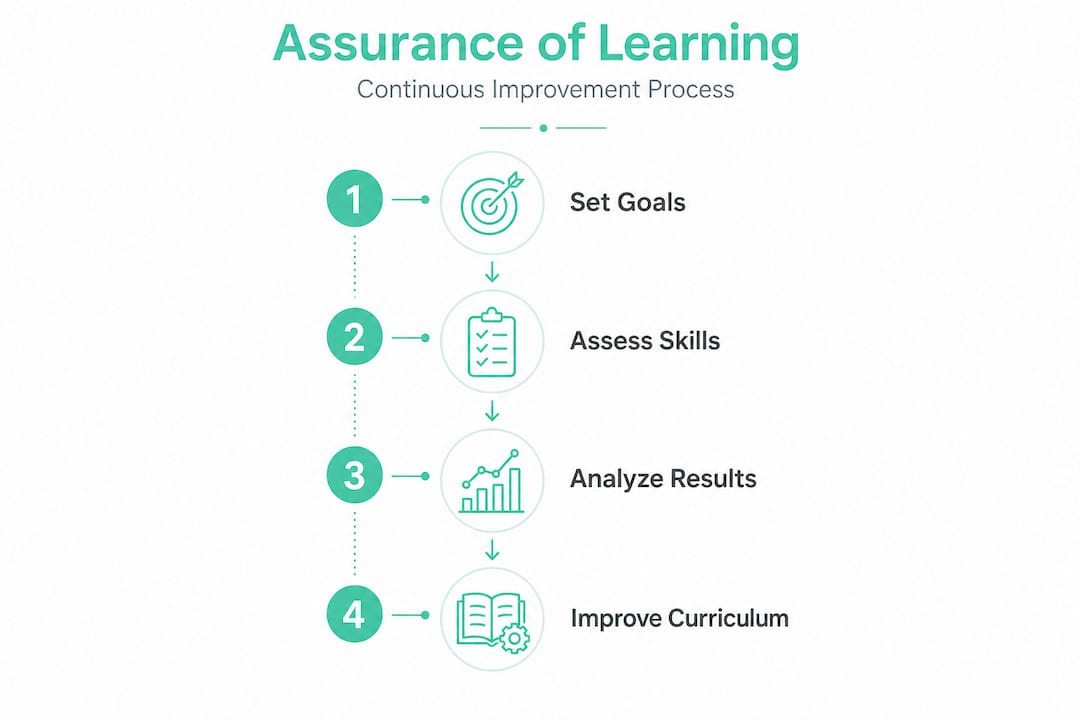
Once you understand the purpose of management studies, the next logical question is: how do you know if a program actually delivers what it promises? This is where assurance of learning becomes critical. It is a structured system that measures whether students actually achieve the stated learning goals, and then uses those results to improve the program over time.
According to AACSB global standards, curricula and learning are assessed against program competency goals through a “close the loop” improvement cycle. This means that a well-run management program is constantly testing itself: are graduates leaving with the skills they were supposed to develop? Where are the gaps? What needs to change next semester?
This matters to you as a student because it affects what you actually learn. A program with a rigorous assurance of learning system is one that has proven evidence of its outcomes rather than relying on reputation alone.
AACSB also makes an important distinction: Standard 5 covers outcomes-focused assurance of learning, while Standard 7 covers teaching effectiveness and the sustained impact of that teaching over time. These are separate concerns. A course might achieve its short-term learning objectives while still failing to produce skills that last beyond graduation. Strong programs pay attention to both.
How a “close the loop” improvement cycle works:
- Define specific, measurable competency goals for graduates (e.g., demonstrate ethical decision-making in complex scenarios)
- Collect direct evidence of learning through assignments, projects, and exams
- Collect indirect evidence through graduate surveys, employer feedback, and career outcome tracking
- Analyze where students fall short of the stated competency goals
- Redesign curriculum, teaching methods, or assessment strategies to address the gaps
- Reassess in the next cohort and compare results
This cycle repeats continuously. A program that has been running this system for several years has a much richer understanding of what works than one that simply updates its syllabus when a professor feels like it.
Pro Tip: Ask your prospective program about their most recent assurance of learning review. A school confident in its processes will share this information openly. Vague or defensive answers should raise questions.
Understanding this process also helps you develop skills for management success because the best programs use these improvement cycles to stay ahead of what employers actually need right now, not what they needed five years ago. Researching top management courses that explicitly mention accreditation standards can give you a useful shortcut when comparing options.
Curriculum innovation and global relevance
A management curriculum that was cutting-edge in 2015 may feel seriously outdated by 2026. The business world moves fast, and the programs that produce globally competitive graduates are the ones that keep their course content current through deliberate, evidence-based innovation.

AACSB global standards explicitly state that global relevance in management studies depends on integrating contemporary business theories and practices, research, and societal trends, and on delivering those through evidence-informed methods over time. This is not a vague aspiration. It is a measurable standard that accredited programs have to meet.
Research from Frontiers in Education points to a clear direction: management education for a globalized world is shifting toward interdisciplinary approaches, technology integration, and ethics and industry collaboration that build soft skills and adaptability. The curriculum is not just about finance and marketing anymore. It incorporates behavioral economics, data analytics, sustainability reporting, and cross-cultural team dynamics.
What genuinely innovative management curricula include:
- Digital literacy and data-driven decision making embedded across modules
- Sustainability and ESG (environmental, social, and governance) frameworks integrated into strategy courses
- Cross-functional team projects that mirror real organizational complexity
- Guest input from industry practitioners alongside academic faculty
- Assessed reflection and critical analysis, not just knowledge recall
- Global case studies that represent diverse markets beyond North America and Europe
The practical implication for you is significant. If you are studying management to build a career across multiple countries, a curriculum that only uses Western business case studies is going to leave gaps in your preparation. Programs that draw on business contexts from Asia, Africa, and Latin America build a genuinely transferable skill set.
Statistic callout: According to AACSB research, the shift toward interdisciplinary, ethics-integrated management education is now a defining feature of globally ranked business schools, not a differentiator but a baseline expectation.
Exploring career growth management courses that explicitly mention digital skills integration and global case studies is a smart filter when shortlisting programs. If you are considering postgraduate study, looking at an online executive MBA is worth your time because these programs are typically faster to update their curriculum than traditional full-time formats.
Pro Tip: Check whether the program you are considering has updated its curriculum in the last two years. Request a current module outline, not just a marketing brochure. The real content tells the real story.
Flexible delivery models for career acceleration
One of the most significant shifts in management education over the past five years is not about content. It is about format. Working professionals and international students can no longer be expected to put careers and families on hold for two years of full-time, on-campus study. The programs that understand this are growing fast.
Imperial College’s Global Online MBA combines live online and asynchronous learning with a reflective leadership journey, cohort support structures, and dedicated career services. This is the model that serious working professionals actually need: flexibility without sacrificing depth or rigor.
The enrollment data backs this up. Fully online MBA enrollment grew from 30% of total MBA enrollment in 2020 to 2021, to 38% in 2024 to 2025. That is a significant and sustained shift, driven by demand from working professionals who want quality education without geographic constraints.
Delivery formats worth knowing:
- Live online synchronous: Real-time classes with faculty and peers, scheduled sessions, interactive discussions
- Asynchronous online: Pre-recorded lectures, flexible submission deadlines, self-paced progress
- Hybrid: Combination of online learning with intensive on-campus or international residencies
- Cohort-based: Fixed group progresses through the program together, building professional relationships alongside academic skills
- Accelerated formats: Compressed timelines (one or two years instead of three or four) without reducing credit requirements
Each format serves different needs. If you value networking and real-time debate, live online or hybrid formats will serve you better. If you have unpredictable work schedules, asynchronous learning gives you the control you need. The key is matching the format to your actual life, not the idealized version of your life that you imagine when you first apply.
Thinking about studying management online versus on campus involves trade-offs that go beyond convenience. The difference between online and on-campus MBA study increasingly comes down to how you learn best rather than which option is more credible. Credential value has converged significantly. Understanding the types of executive MBA programs available helps you narrow down the format before you start comparing specific schools. And if you want to understand how online learning connects to management and accounting careers, the practical outcomes data is genuinely encouraging.
Pro Tip: When comparing programs, look at the career services specifically for online students. Some programs treat this as an afterthought for remote learners. The best programs offer dedicated career coaching, employer networking events, and alumni mentoring regardless of where you are in the world.
Articulating skills: From learning to measurable outcomes
Earning a management degree is one thing. Being able to explain what you learned in terms that resonate with employers is a completely different skill. This gap, often called the articulation problem, is where many graduates struggle after completing their studies.
“It is not enough to have developed a skill during your program. You need to be able to show evidence of that skill in a language that hiring managers and promotion committees understand.”
Management studies address this through structured frameworks tied to graduate attributes and student reflection and critical analysis. Research from AACSB confirms that being job-ready is no longer sufficient. Future-ready graduates can articulate how they developed specific competencies and demonstrate measurable evidence of applying them.
Practical tools for building your articulation portfolio:
- Maintain a running log of assignments and projects with explicit notes on which competency each one demonstrates
- Write structured reflections after significant team projects or case study analyses
- Collect artifacts: reports, presentations, models, and proposals that prove capability rather than just claiming it
- Map your work to the graduate attributes your program defines, because those attributes are what your degree communicates to employers
- Practice explaining your development in behavioral terms: “I identified, I led, I resolved, I measured”
The management career skills framework helps you understand which competencies matter most in your target roles. Building your articulation habit early, from your first semester, means that by graduation you have a rich evidence base rather than scrambling to remember what you did two years ago.
Why integration matters more than placement statistics
Here is an uncomfortable truth about management education that most schools will not tell you directly: placement statistics are one of the weakest measures of program quality. A school can optimize aggressively for short-term placement rates by funneling students toward roles that look good in the data, regardless of whether those roles represent genuine career advancement or personal fit.
Research on management education highlights this tension directly: when curriculum is optimized for short-term placement, it tends to produce framework fluency without deep meaning. Students know the vocabulary of management but lack the integrated judgment to apply it well under pressure. Stronger programs prioritize the integration of intellectual foundations, practical relevance, and holistic skill development, even when that makes the short-term numbers look less impressive.
We have seen this pattern consistently. Students who choose programs based on aggressive placement marketing often find themselves well-positioned at graduation but stuck two or three years later because they lack the conceptual depth to move into senior leadership. Conversely, students who invest in programs that build genuine analytical and ethical reasoning often have slower initial ramp-up periods but significantly stronger long-term trajectories.
The practical question to ask is not “what percentage of graduates get jobs within six months?” It is: “What kinds of roles do graduates hold five years after completing the program?” That second data point is much harder for schools to fake and much more informative about what the education actually builds.
Career-focused management courses that balance rigor and real-world application represent the sweet spot. Look for programs that are transparent about both their short-term and long-term outcome data, and be appropriately skeptical of those that only ever mention the first number.
Accelerate your global career with study options at SeekStudy
If this article has shifted how you think about management education, the next step is finding a program that actually delivers on these principles. At SeekStudy, we have built our offerings around exactly the kind of integrated, ethics-grounded, globally relevant management education described throughout this guide.
Our accelerated online executive MBA is designed for working professionals who need flexibility without sacrificing academic credibility. Regulated by Ofqual and delivered in partnership with recognized UK institutions, it combines rigorous curriculum with practical application across real business contexts. Whether you are exploring management degree pathways for the first time or looking for accelerated business degree options that fit around your current career, SeekStudy offers programs structured to move you forward faster, without cutting corners on the quality that makes a difference long-term.
Frequently asked questions
What is the main purpose of management studies?
Management studies foster ethical leadership and mission-driven governance, enabling students to apply management science in real organizational contexts rather than treating it as symbolic compliance.
How does management studies assure learning and improvement?
Programs use structured assessment systems to measure learner achievement against competency goals, then continuously update curricula using that feedback in a close-the-loop improvement cycle.
What delivery formats are available for management studies?
Most top business schools now offer fully online, hybrid, and cohort-based management programs. Fully online MBA enrollment grew from 30% to 38% of total enrollment between 2020 and 2025, reflecting strong demand from working professionals.
How do management studies help students communicate their skills?
Structured frameworks and artifact collection enable learners to turn competencies into measurable evidence through reflection and critical analysis, bridging the gap between having a skill and proving it to employers.
Why is curriculum innovation vital in management education?
Continuous curriculum innovation ensures programs stay relevant because management studies’ global relevance depends on integrating new theories, digital tools, and societal trends to keep graduates competitive across international markets.