

Juggling leadership responsibilities while eyeing the next level in your career can feel like a test of endurance. For experienced professionals in the UK, Hong Kong, Singapore, or Australia, the search for flexible yet rigorous management education is real. Choosing an online Executive MBA that recognizes your background allows you to access advanced management techniques and a diverse global network, empowering you to lead with confidence—even when your work schedule is demanding.
Table of Contents
- Defining The Executive MBA Experience
- How Executive MBA Programs Differ Globally
- Course Structure And Flexible Learning Options
- Admissions Requirements For Mid-Career Professionals
- Cost, ROI, And Career Advancement Outcomes
Key Takeaways
| Point | Details |
|---|---|
| Executive MBA Programs Target Professionals | Designed for experienced executives, these programs offer management education tailored to enhance leadership potential without interrupting careers. |
| Global Variations in Curriculum | Executive MBA programs vary internationally, focusing on aspects like entrepreneurial innovation in North America and collaborative management in Europe. |
| Flexible Learning Options | Courses typically incorporate hybrid models, enabling working professionals to balance coursework with their professional commitments. |
| Significant Return on Investment | Graduates often experience substantial salary increases and enhanced career opportunities, making this a valuable investment for career advancement. |
Defining the Executive MBA Experience
An Executive MBA represents a specialized graduate-level degree designed specifically for experienced professionals seeking advanced management education without interrupting their career trajectory. Unlike traditional MBA programs, these tailored curricula recognize the sophisticated background and professional expertise of mid-career executives across global industries.
Executive MBA programs are strategically crafted to address the unique challenges and opportunities faced by seasoned professionals who want to accelerate their leadership potential. These programs typically feature several distinctive characteristics:
- Flexible scheduling with weekend or modular formats
- Curriculum focused on strategic leadership and innovation
- Cohort-based learning with peer-to-peer knowledge exchange
- Advanced management techniques integrated with real-world applications
- Global networking opportunities with experienced professionals
Participants in executive MBA programs for professionals can expect an immersive learning environment that goes beyond traditional academic instruction. The programs are meticulously designed to blend theoretical frameworks with practical leadership strategies, enabling participants to immediately apply complex management concepts within their current professional roles.
The global landscape of business demands executives who can navigate complex organizational challenges with strategic insight and cross-cultural competence. An Executive MBA equips professionals with the advanced skills needed to drive organizational transformation, lead multicultural teams, and develop innovative business strategies in an increasingly interconnected world.
Pro tip: Before enrolling in an Executive MBA program, conduct thorough research on the curriculum’s alignment with your specific career objectives and professional development goals.
How Executive MBA Programs Differ Globally
Executive MBA programs around the world showcase remarkable diversity, reflecting the unique business environments and cultural contexts of different regions. While the core objective remains consistent – developing high-level management expertise – the approach and implementation vary significantly across international landscapes. Studying management online has become a global phenomenon that highlights these fascinating regional differences.
The variations in Executive MBA programs can be observed across several key dimensions:
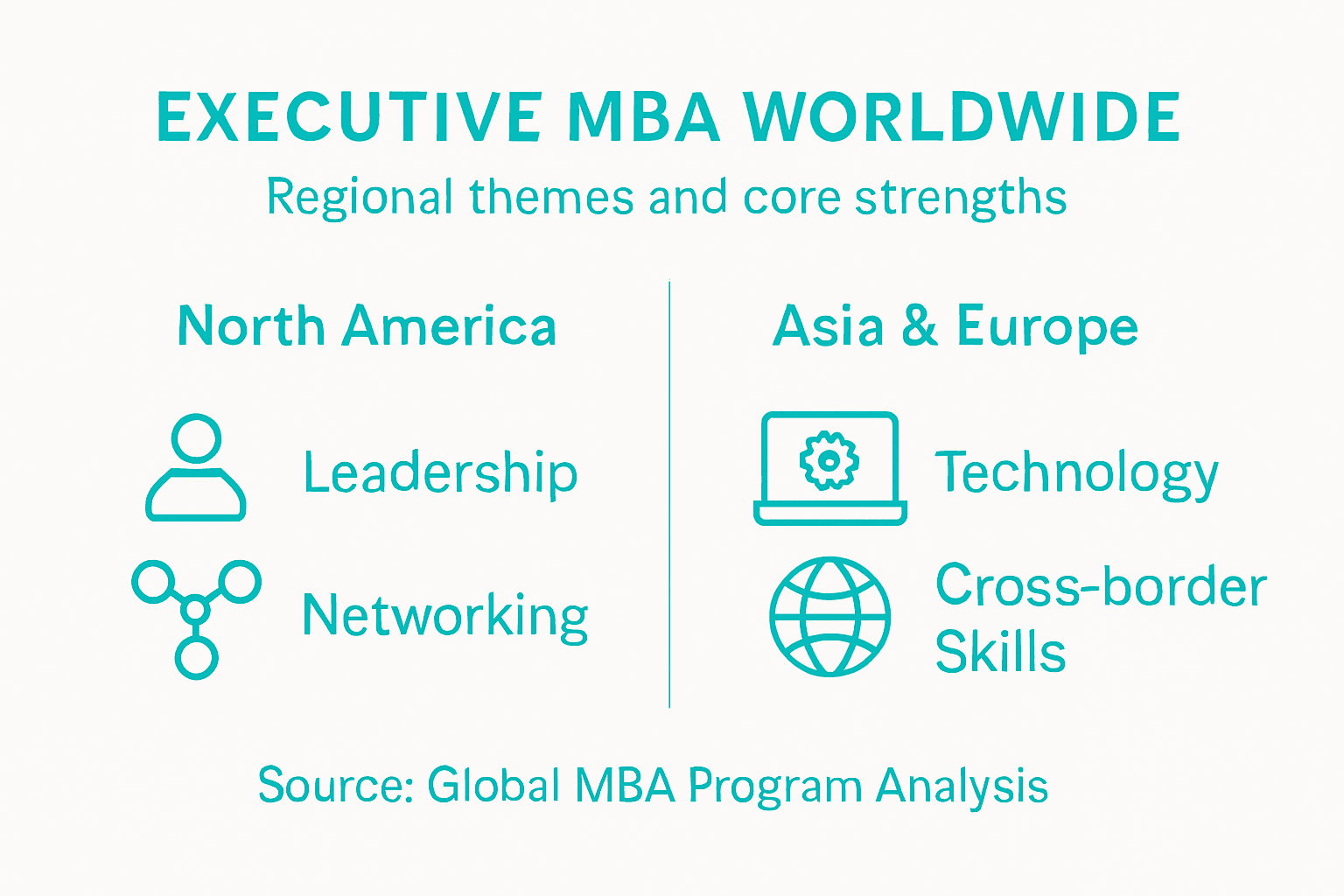
- North American programs emphasize entrepreneurial innovation and individual leadership development
- European curricula focus more on collaborative management and cross-cultural strategic thinking
- Asian programs often integrate technology and digital transformation strategies
- Latin American programs prioritize emerging market dynamics and sustainable business practices
- Middle Eastern programs concentrate on regional economic development and international business relationships
Global business education demands nuanced understanding of regional complexities. North American Executive MBA programs typically feature more individualistic learning models, encouraging personal leadership styles and competitive strategy development. In contrast, European programs tend to adopt a more collaborative approach, emphasizing collective problem-solving and integrated team dynamics.
Asian Executive MBA curricula distinguish themselves through intense technological integration and forward-looking digital transformation strategies. These programs often incorporate cutting-edge technologies and emerging market insights, reflecting the region’s rapid economic evolution. The curriculum design prioritizes adaptability, innovation, and global connectivity, preparing executives to navigate complex international business landscapes.
Here is a comparison of regional Executive MBA program emphases:
| Region | Core Focus | Distinctive Approach |
|---|---|---|
| North America | Entrepreneurial innovation and leadership | Encourages personal leadership style |
| Europe | Collaborative management and strategy | Fosters collective problem-solving |
| Asia | Technology integration and transformation | Emphasizes digital strategies |
| Latin America | Emerging markets and sustainability | Addresses rapid economic shifts |
| Middle East | Economic development and international ties | Builds global business relationships |
Pro tip: Research the specific regional focus of Executive MBA programs to ensure alignment with your career aspirations and professional development goals.
Course Structure and Flexible Learning Options
Executive MBA programs have revolutionized professional education by offering unprecedented flexibility to accommodate the demanding schedules of working professionals. Alternatives for global learners demonstrate the innovative approaches modern business education now embraces, allowing participants to balance career advancement with academic pursuits.
Typical Executive MBA course structures incorporate several key design elements that prioritize professional convenience and learning effectiveness:
- Hybrid learning models combining online and in-person sessions
- Weekend intensive workshops and modular formats
- Asynchronous online course materials accessible 24/7
- Small cohort groups for personalized learning experiences
- Flexible credit accumulation timelines
- Global residency programs for international exposure
Modular learning approaches have become increasingly sophisticated, enabling professionals to customize their educational journey. Most programs now offer multiple engagement formats, including synchronous virtual classrooms, recorded lecture series, interactive online workshops, and periodic intensive campus residencies. This multi-dimensional approach ensures that working executives can access high-quality education without disrupting their professional commitments.
The technological infrastructure supporting modern Executive MBA programs has transformed traditional learning paradigms. Advanced learning management systems, collaborative digital platforms, and real-time interactive technologies enable seamless knowledge transfer across global networks. These platforms facilitate dynamic interactions between participants, allowing professionals from diverse geographic locations and industrial backgrounds to engage in meaningful academic and professional exchanges.

Pro tip: Carefully evaluate the technological and scheduling flexibility of potential Executive MBA programs to ensure they align with your specific work and personal commitments.
Admissions Requirements for Mid-Career Professionals
Executive MBA admissions represent a sophisticated evaluation process designed specifically for accomplished professionals seeking advanced management education. Executive education admissions recognize that mid-career candidates bring substantial professional expertise that distinguishes them from traditional graduate students.
Typical admissions requirements for Executive MBA programs encompass several critical components:
- Minimum of 7-10 years professional work experience
- Demonstrated leadership roles in organizational settings
- Strong academic or professional recommendations
- Comprehensive professional biography highlighting career achievements
- Proof of managerial responsibilities and strategic decision-making experience
- Competitive professional track record with measurable impact
Professional credentials play a crucial role in Executive MBA admissions. Unlike traditional MBA programs, these specialized tracks prioritize practical leadership experience over standardized test scores. Many programs now offer alternative assessment methods, including the Executive Assessment exam, which provides a more nuanced evaluation of professional potential compared to traditional graduate school entrance examinations.
The selection process for Executive MBA candidates is highly competitive and holistic. Admissions committees carefully assess not just professional achievements, but also potential contributions to the learning community. Successful applicants typically demonstrate a combination of strategic thinking, leadership capability, and a clear vision for their professional growth. International programs often place additional emphasis on global perspective, cross-cultural experience, and the ability to navigate complex multinational business environments.
Pro tip: Prepare a compelling professional narrative that showcases your leadership journey, strategic achievements, and future aspirations when applying to Executive MBA programs.
Cost, ROI, and Career Advancement Outcomes
Executive MBA investments represent a strategic financial decision with substantial long-term professional returns. While the initial program costs can range from $50,000 to $200,000, the potential career acceleration and earning potential make these programs a compelling investment for ambitious professionals seeking transformative career growth.
Key financial and career advancement metrics typically associated with Executive MBA programs include:
- Average salary increase of 20-35% post-program completion
- Enhanced leadership opportunities in current and prospective organizations
- Expanded professional network with high-caliber global executives
- Access to advanced strategic management skill sets
- Accelerated career progression timelines
- Increased marketability across multinational corporations
Career advancement outcomes demonstrate the tangible value of Executive MBA investments. Professionals who complete these programs often experience significant career transformations, including lateral moves into strategic leadership roles, executive promotions, and opportunities to manage larger, more complex organizational units. The comprehensive curriculum equips participants with advanced strategic thinking capabilities that directly translate into enhanced professional performance and increased organizational impact.
Financial return on investment extends beyond immediate salary increments. Executive MBA graduates typically report long-term benefits such as improved decision-making skills, broader professional perspectives, and enhanced credibility within competitive corporate environments. Many employers recognize these programs as critical pathways for developing internal leadership talent, making participants more valuable to their current organizations while simultaneously expanding their external career opportunities.
Explore the balance between cost and career returns for Executive MBA programs:
| Investment Range | Average Salary Boost | Key Career Outcome |
|---|---|---|
| $50,000 – $120,000 | 20% | Leadership role opportunities |
| $120,001 – $200,000 | 35% | Accelerated executive promotions |
| Any level | Enhanced network | Global professional connections |
Pro tip: Calculate potential program return on investment by comparing program costs against projected salary increases and long-term career advancement opportunities.
Fast-Track Your Executive Career with Seekstudy’s Flexible MBA Solutions
The article highlights the challenges faced by mid-career professionals seeking an Executive MBA that fits their demanding schedules while delivering advanced management skills and global insights. Key pain points such as balancing work and study, accessing flexible course formats, and gaining strategic leadership expertise are critical for accelerating your career growth in today’s competitive global market. If you are looking for a streamlined path to achieve an accredited, internationally recognized qualification without pausing your professional journey, Seekstudy offers tailored programs to meet these exact needs.
Discover flexible learning options including our online one-year MBA and executive-level professional qualifications designed for busy professionals like you. Benefit from programs that combine online convenience with international exposure in locations such as Singapore and the United Kingdom. Our degrees are validated by recognized education authorities and built to help you gain the leadership skills, global network, and career advancement potential described in the Executive MBA discussion.
Ready to transform your career with a program that fits your life and ambitions? Explore how Seekstudy empowers professionals worldwide to earn credible degrees with agility and impact.

Visit Seekstudy now to learn more about fast-track executive MBA options and international business degrees. Take the next step toward leadership excellence and open doors to global opportunities today with Study Management Online and Executive MBA programs for professionals.
Frequently Asked Questions
What is an Executive MBA?
An Executive MBA is a specialized graduate-level degree designed for experienced professionals who seek advanced management education while continuing their careers. It focuses on strategic leadership, innovation, and real-world applications.
How do Executive MBA programs differ from traditional MBA programs?
Executive MBA programs are tailored for mid-career professionals and offer flexible scheduling, cohort-based learning, and a focus on advanced management techniques, unlike traditional MBA programs that may cater to students with less work experience.
What are the typical admissions requirements for an Executive MBA program?
Admissions for Executive MBA programs usually require a minimum of 7-10 years of professional experience, demonstrated leadership roles, strong recommendations, and a comprehensive professional biography.
What are the potential career benefits of obtaining an Executive MBA?
Graduates of Executive MBA programs typically experience a salary increase of 20-35%, enhanced leadership opportunities, and access to a global network of professionals, which can significantly accelerate their career advancement.