

Balancing career growth with family and location is a daily reality for professionals across Singapore, Hong Kong, Melbourne, and beyond. The value of a degree only holds true when it is formally recognized. That is why understanding accredited online programs and credentials is crucial for anyone seeking advancement in Management or Accounting. This guide helps you identify which qualifications are truly respected by global employers so you can confidently invest in your future without leaving Asia or Australia.
Table of Contents
- Defining Accredited Online Programs And Credentials
- How Accreditation Impacts Degree Recognition
- Flexibility, Career Value, And Global Access
- Common Pitfalls Of Unaccredited Programs
- Comparing Fast-Track And Traditional Degrees
Key Takeaways
| Point | Details |
|---|---|
| Accreditation is Essential | Earning a degree from an accredited program ensures global recognition and enhances career prospects. |
| Types of Credentials Matter | Understand the distinctions between certificates, diplomas, and degrees to choose the right qualification for your goals. |
| Avoid Unaccredited Programs | Unaccredited degrees may not be recognized by employers or licensing bodies, limiting your career opportunities. |
| Fast-Track vs. Traditional Degrees | Both accredited fast-track and traditional degrees are valuable; choose based on your career timeline needs. |
Defining Accredited Online Programs and Credentials
Accreditation means formal recognition that an online program meets rigorous quality standards. When you earn a degree from an accredited school, employers and other institutions recognize it as legitimate and valuable.
Online accreditation works differently than traditional in-person accreditation. Digital accreditation focuses on virtual peer evaluations and competency-based learning rather than in-person campus visits. This approach ensures your online degree carries the same weight as traditional ones.
For working professionals in Asia and Australia, accreditation matters because it directly affects your career trajectory. A degree from an accredited program opens doors with multinational employers, while unaccredited credentials often hit dead ends.
Understanding Different Credential Types
Credentials come in three main categories. Understanding the differences helps you choose the right qualification for your goals.
- Certificates: Focus on specific skills, completed in weeks to months. These validate competency in narrow areas like project management basics.
- Diplomas: Broader qualifications, typically 1-2 years. They demonstrate solid professional knowledge without a full degree commitment.
- Degrees: Bachelor’s and master’s programs, requiring 2-4 years. These represent complete academic qualifications recognized globally.
The distinction matters for your resume. Credentials in online learning serve as verifiable proof of competency after program completion. Employers see degrees as deeper commitment and expertise compared to certificates.
To better understand your options, here’s a comparison of the main online credential types:
| Credential Type | Time Commitment | Depth of Learning |
|---|---|---|
| Certificate | Weeks to months | Focused, skill-specific |
| Diploma | 1-2 years | Broader professional scope |
| Degree | 2-4 years | Comprehensive, in-depth |
What Makes a Program Truly Accredited
Real accreditation involves multiple quality checks. Accrediting bodies evaluate curriculum standards, instructor qualifications, learning outcomes, and student support systems.
Regulatory bodies verify that programs meet national and international standards. In the UK context, Ofqual-regulated programs guarantee consistent quality across online delivery. This matters when your degree travels with you globally.
Look for these accreditation indicators:
- Registration with official regulatory bodies like Ofqual
- Published quality assurance processes and learning outcomes
- Faculty with relevant industry experience and advanced degrees
- Student support systems specifically designed for online learners
- External reviews and accreditation audits conducted regularly
Accreditation protects you from diploma mills and substandard programs. It ensures your investment in time and money delivers real credentials employers actually value.
Real accreditation means regulatory recognition, quality assurance, and employer acceptance—not just a certificate mailed to your address.
Pro tip: When evaluating online programs, check the accrediting body’s website directly rather than trusting marketing claims. Verify the program appears on official regulatory registries before enrolling.
How Accreditation Impacts Degree Recognition
Accreditation is the bridge between your online degree and global acceptance. Without it, your qualification sits in a gray zone where employers question its legitimacy and universities won’t recognize it for further study.

Degree recognition relies on accreditation as a key indicator of legitimacy and quality. When your program meets authorized quality assurance benchmarks, educational institutions and employers worldwide treat your degree as legitimate. This matters when you’re competing for promotions or applying to international roles.
For professionals in Asia and Australia, accreditation opens specific doors. Multinational companies in Singapore, Hong Kong, and Australian cities trust accredited credentials because they signal consistent standards. Unaccredited degrees often trigger skepticism or outright rejection during hiring processes.
Why Employers Care About Accreditation
Employers use accreditation as a quality filter. They assume accredited degrees meet rigorous standards for curriculum, instruction, and student outcomes.
When screening resumes, recruiters often skip unaccredited qualifications. They worry about hiring someone with a degree they cannot verify. Accreditation removes that doubt immediately.
Accreditation also affects your eligibility for certain professional roles:
- Positions requiring licensed credentials (accounting, engineering, psychology)
- Roles with government or regulated sector employers
- Senior management positions at multinational corporations
- Sponsored visa or work permit applications
Accredited programs ensure your degree travels with you professionally. You gain access to opportunities that simply close off for unaccredited graduates.
International Recognition and Mobility
Global mobility depends on degree recognition. International agreements and mutual recognition frameworks support credential acceptance across countries, enabling professionals to move between markets without barriers.
UK-accredited degrees benefit from established recognition networks across Commonwealth nations, Europe, and Asia-Pacific regions. This network effect matters when you’re considering relocation or working remotely for international firms.
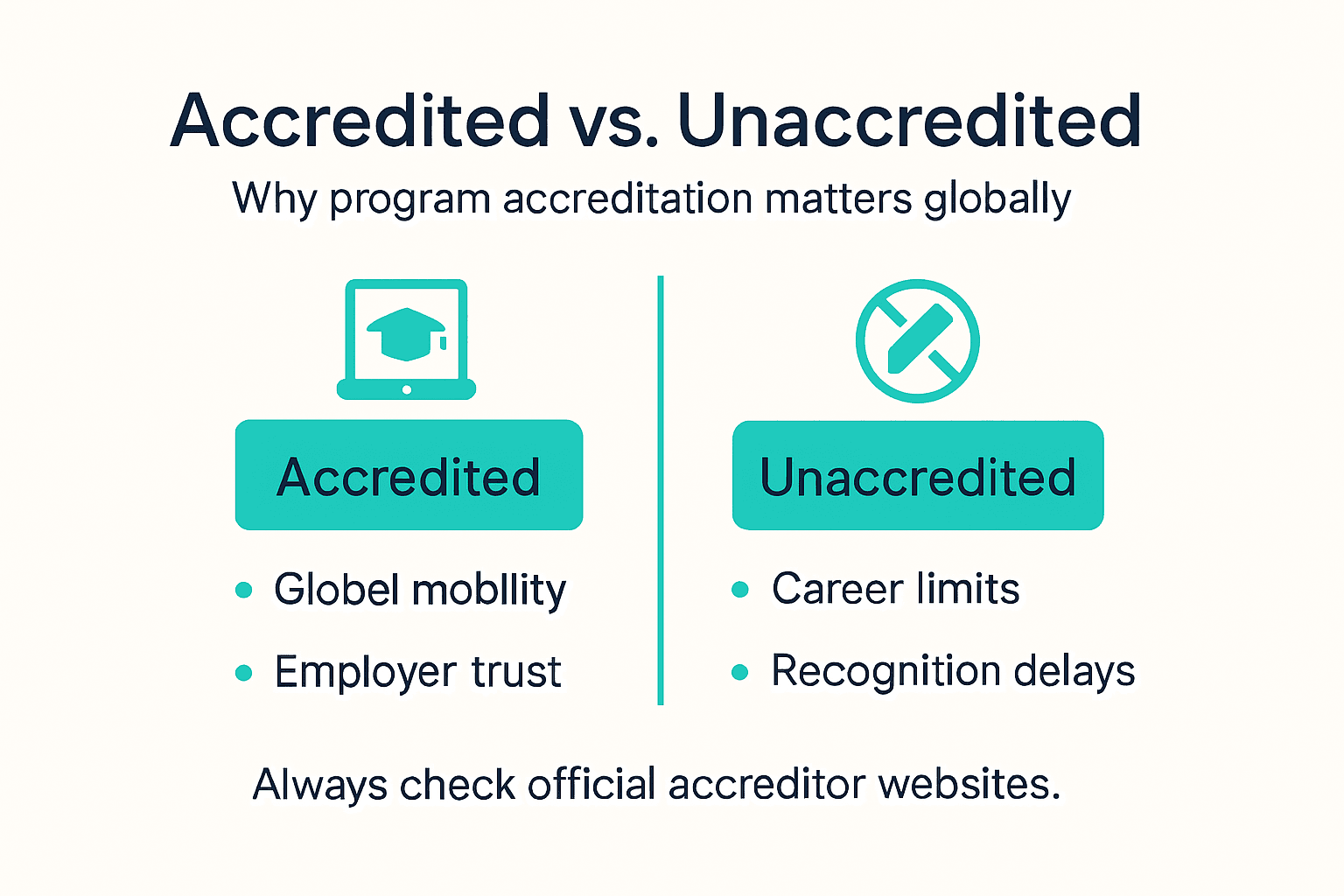
Without accreditation, you face credential evaluation delays and skepticism. Some countries may require costly credential assessment processes or refuse recognition entirely. Accredited degrees bypass these complications.
Professional Licensing and Certification
Certain careers require accredited degrees as a foundation. Accounting qualifications, for example, often require graduation from accredited programs before you can pursue professional certifications.
Check your target profession’s requirements early:
- Research whether your field requires accredited credentials
- Verify the accrediting body matches your profession’s standards
- Confirm the program holds both institutional and program-level accreditation
- Contact professional bodies in your target country to verify acceptance
This prevents investing time in a degree that doesn’t qualify you for your chosen career path.
Accreditation isn’t just nice to have—for many professional paths, it’s the requirement that separates qualified candidates from disqualified ones.
Pro tip: Before enrolling, contact three employers in your target role and ask directly whether they recognize the program’s accreditation. Real-world verification beats assumptions every time.
Flexibility, Career Value, and Global Access
Accredited online programs solve a problem most working professionals face: how to advance without pausing your career. You study when your schedule allows, not when a university dictates class times.
Flexibility isn’t just convenience—it’s a practical necessity. You’re balancing current employment, family responsibilities, and time zone differences across Asia and Australia. Traditional degrees demand you show up on campus at set times. Accredited online programs let you work through coursework during lunch breaks, early mornings, or weekends.
Accredited online programs offer flexibility that supports diverse learners while maintaining academic rigor. This balance matters. You’re not sacrificing quality for convenience—you’re getting both.
Career Value That Employers Recognize
The degree itself opens doors only if employers respect it. Accreditation makes that happen. Employers know accredited programs maintain consistent standards, so they trust graduates have solid knowledge.
Your credential directly affects salary negotiations and promotion eligibility. Accredited bachelor’s and master’s degrees position you for senior roles that unaccredited graduates simply cannot access.
Accredited programs deliver measurable career advantages:
- Qualification for senior management and leadership roles
- Eligibility for professional certifications in your field
- Recognition by multinational corporations across regions
- Stronger positioning during salary negotiations
- Access to visa sponsorship and work permit applications
You’re not just earning a degree—you’re building a credential that travels internationally and compounds your earning potential throughout your career.
Global Access Without Relocation
Geography no longer limits your education. You can earn a fast-track degree from the UK while living in Bangkok, Singapore, or Melbourne.
Accreditation frameworks enable this. Recognized programs operate under standards accepted globally, so your degree carries weight regardless of where you study. You avoid the massive costs of relocating—airfare, accommodation, visa fees add up quickly.
Remote learning infrastructure lets you:
- Stay employed full-time in your current role
- Avoid relocating your family
- Maintain your professional network locally
- Save money on living costs while studying
- Graduate with work experience in your field
This combination—accreditation, online delivery, and international recognition—creates opportunity previously unavailable to working professionals.
The Timeline Advantage
Accredited fast-track programs compress timelines without cutting corners. You complete a two-year bachelor’s degree or one-year master’s while maintaining your job.
This speed matters when you’re competing in dynamic markets. Delayed advancement costs real money. Every year matters in your career trajectory. Accredited programs let you upskill faster while earning, creating a competitive edge.
Flexibility without accreditation is just a certificate. Accreditation without flexibility wastes years you could be advancing. Accredited online programs deliver both.
Pro tip: Calculate your total investment: tuition plus lost income from traditional study versus staying employed while studying online. The financial difference often pays for itself within 18 months of graduation through salary increases.
Common Pitfalls of Unaccredited Programs
Unaccredited degrees look legitimate on paper. They come in fancy folders with official-looking seals. But when you try to use them, the real problems emerge.
The core issue: unaccredited programs operate without external quality oversight. No independent body verifies that teaching meets standards, that instructors are qualified, or that you’re actually learning anything valuable.
The Employment Reality
Employers quickly spot unaccredited credentials. When you submit your resume listing an unaccredited degree, hiring managers move your application to the rejection pile.
Unaccredited programs often lead to degrees not recognized by employers or licensing bodies. Your four years of study become irrelevant in job markets. Multinational companies across Asia and Australia simply won’t accept them.
Specific employment pitfalls include:
- Senior roles explicitly require accredited degrees
- Visa sponsorship applications get rejected
- Professional certifications become unavailable
- Salary negotiations weaken significantly
- Background checks flag unrecognized credentials
You’re not just losing job opportunities—you’re losing earning potential for your entire career.
Here’s a summary of key risks and rewards for accredited versus unaccredited online programs:
| Aspect | Accredited Program Benefit | Unaccredited Program Risk |
|---|---|---|
| Employer Recognition | Respected, globally accepted | Often rejected by hiring managers |
| Professional Licensing | Meets certification standards | Ineligible for most licenses |
| Educational Quality | Rigorously evaluated curriculum | May lack thorough teaching |
| Career Advancement | Enables promotions, higher pay | Stalls progress, limits mobility |
Professional Licensing and Certifications
Certain careers demand accredited degrees as a foundation. Accounting, engineering, psychology, and law all have licensing bodies that refuse to recognize unaccredited credentials.
You could complete a four-year degree in accounting from an unaccredited program, then discover you cannot sit for professional exams. That’s a devastating realization after investing years and money.
This isn’t theoretical. Professional bodies publish approved programs. If your degree doesn’t appear on their list, you cannot pursue licensure in that field. The barrier is absolute.
Poor Educational Quality
Unaccredited programs may have inadequate faculty qualifications and lack curriculum rigor, resulting in diminished educational outcomes. You might graduate without the knowledge your resume claims.
Accreditation ensures instructors have proper credentials and experience. Unaccredited programs sometimes hire anyone with basic subject knowledge, regardless of teaching ability or advanced degrees.
Red flags in unaccredited programs:
- Faculty without advanced degrees in their field
- No published learning outcomes or curriculum standards
- Minimal student support services
- No credit transfer agreements with other institutions
- Pressure to complete degrees quickly without rigor
The Diploma Mill Risk
Some unaccredited “universities” are outright scams. They send you a degree without requiring actual coursework. These diploma mills operate in legal gray zones, offering fake credentials.
Once you use a fake degree on a job application, you’ve committed fraud. Background checks discover the deception. Employers can fire you immediately. You face legal liability for misrepresentation.
This sounds extreme until you realize how many fake programs operate internationally. Without accreditation oversight, anything goes.
An unaccredited degree is either worthless or fraudulent. There’s rarely middle ground.
Pro tip: Before enrolling anywhere, verify accreditation directly through official regulatory websites like Ofqual. Don’t trust the program’s claims—check independent registries where accredited programs are listed publicly.
Comparing Fast-Track and Traditional Degrees
The choice between fast-track and traditional degrees hinges on your current situation. Both formats can be accredited and employer-recognized—the difference lies in timeline, intensity, and learning experience.
Traditional degrees follow established pathways over 3-4 years for bachelor’s degrees and 2 years for master’s programs. Fast-track degrees compress the same content into 2 years for bachelor’s and 1 year for master’s degrees. Neither sacrifices quality when properly accredited.
Timeline and Intensity
Fast-track degrees accelerate learning by condensing courses and credit requirements, appealing to professionals seeking rapid workforce entry. You move through material faster, with more intensive study blocks. This works if you can commit serious time.
Traditional programs spread learning across longer periods. You take fewer courses simultaneously, allowing deeper engagement with material. The extended timeline means slower career progression but potentially more thorough understanding.
Consider your current work situation:
- Fast-track: Best if you have 15-20 hours weekly for study
- Traditional: Better if you prefer spreading effort over longer periods
- Fast-track: Faster return on investment and career advancement
- Traditional: Allows more time for professional growth alongside studies
Learning Experience and Depth
Traditional degrees emphasize comprehensive study with extended engagement on topics. You return to concepts multiple times across different courses, building deeper connections.
Fast-track programs focus on efficiency through condensed curricula and flexible delivery, often online. You still cover all content but in concentrated blocks. Some students learn better this way; others feel rushed.
The intensity difference is real. Fast-track requires disciplined time management. You balance full-time work with intensive coursework. Traditional programs let you take breaks and reflect.
Accreditation Matters for Both
Accreditation levels the playing field between formats. An accredited fast-track degree carries equal weight to an accredited traditional degree. Employers care about the credential and accreditation status, not how long you took.
Both formats can lack accreditation. An unaccredited fast-track degree is worthless. An unaccredited traditional degree wastes even more time. Always verify accreditation first, then choose your timeline.
Fast-track programs requiring accreditation:
- Maintain rigorous curriculum standards despite condensed timeline
- Employ qualified faculty with advanced degrees
- Provide adequate student support and resources
- Undergo external quality reviews regularly
- Meet employer and licensing body recognition standards
The Career Advancement Reality
Fast-track degrees get you into the workforce faster. If you’re competing for promotions in 2026, completing your degree by 2025 matters. That extra year in your role compounds your experience and salary growth.
Traditional degrees offer more flexibility if you’re already established. Taking an extra year matters less when you’re already in your target role.
For international professionals in Asia and Australia seeking promotions now, fast-track timing is often the deciding factor.
Accreditation determines value. Timeline determines speed. Choose based on your career urgency, not convenience.
Pro tip: Calculate your timeline backwards from your target promotion date. If you need the degree by 2025, fast-track is non-negotiable. If you have until 2027, traditional offers less stress.
Advance Your Career with Accredited Fast-Track Degrees from SeekStudy
The challenge of finding truly accredited online programs that combine flexibility with global recognition is real for many international professionals. If you want a qualification that employers respect and licensing bodies accept, it is critical to avoid unaccredited credentials that can block your career path and reduce your earning potential. SeekStudy understands these concerns and offers fast-track, Ofqual-regulated degrees especially in Management and Accounting that deliver the accreditation you need to succeed across Asia, Australia, and beyond.
Explore our Uncategorized Archives to learn more about the power of accredited online education. Ready to fast-track your career with a UK-recognized degree without relocating? Visit SeekStudy today to discover our bachelor’s and master’s programs designed for busy professionals like you. Start your journey now and unlock global opportunities with confidence.
Frequently Asked Questions
What is the importance of accreditation for online programs?
Accreditation signifies that an online program meets rigorous quality standards, making the degree recognized and valued by employers and educational institutions alike.
How do accredited online programs benefit my career?
Earning a degree from an accredited program enhances your employability, opens opportunities with multinational employers, and qualifies you for promotions, as these credentials are trusted and recognized in the industry.
What types of credentials can be earned through accredited online programs?
Accredited online programs typically offer certificates, diplomas, and degrees, each serving different educational and professional purposes, from focused skills to comprehensive academic qualifications.
How can I verify if an online program is accredited?
To confirm accreditation, check the accrediting body’s website and ensure the program is listed on official regulatory registries, which provide transparency and accountability regarding the institution’s quality standards.