

TL;DR:
- Accreditation verifies a program meets quality standards through independent peer review.
- Recognized accreditation is crucial for professional licensing, employment, and international mobility.
- Verify accreditation by checking official directories and requesting official documentation before enrolling.
Most people assume a degree is a degree. Get the credential, frame it, move on. But employers, licensing boards, and immigration authorities around the world don’t see it that way. Where your degree comes from matters far less than whether it’s properly accredited. For international students and working professionals targeting Management or Accounting roles across borders, the difference between an accredited and an unaccredited qualification can mean the gap between a promotion and a rejection letter. This article walks you through what accreditation really involves, what the research actually says about outcomes, and how to protect yourself from costly mistakes before you enroll.
Table of Contents
- What degree accreditation really means
- Real-world impact: Employment and earnings outcomes
- Risks of unaccredited degrees and regional nuance
- How to verify accreditation: Practical steps and shortcuts
- The uncomfortable truth: Why shortcuts in accreditation never pay off
- Advance your career with accredited programs
- Frequently asked questions
Key Takeaways
| Point | Details |
|---|---|
| Sets trusted standards | Accreditation verifies that a degree meets recognized educational quality benchmarks. |
| Drives better outcomes | Graduates with accredited degrees enjoy better long-term wage and mobility prospects globally. |
| Prevents costly mistakes | Unaccredited degrees risk non-recognition, wasting time and money for students and professionals. |
| Easy verification steps | Checking a program’s official accreditation requires only a few practical actions. |
What degree accreditation really means
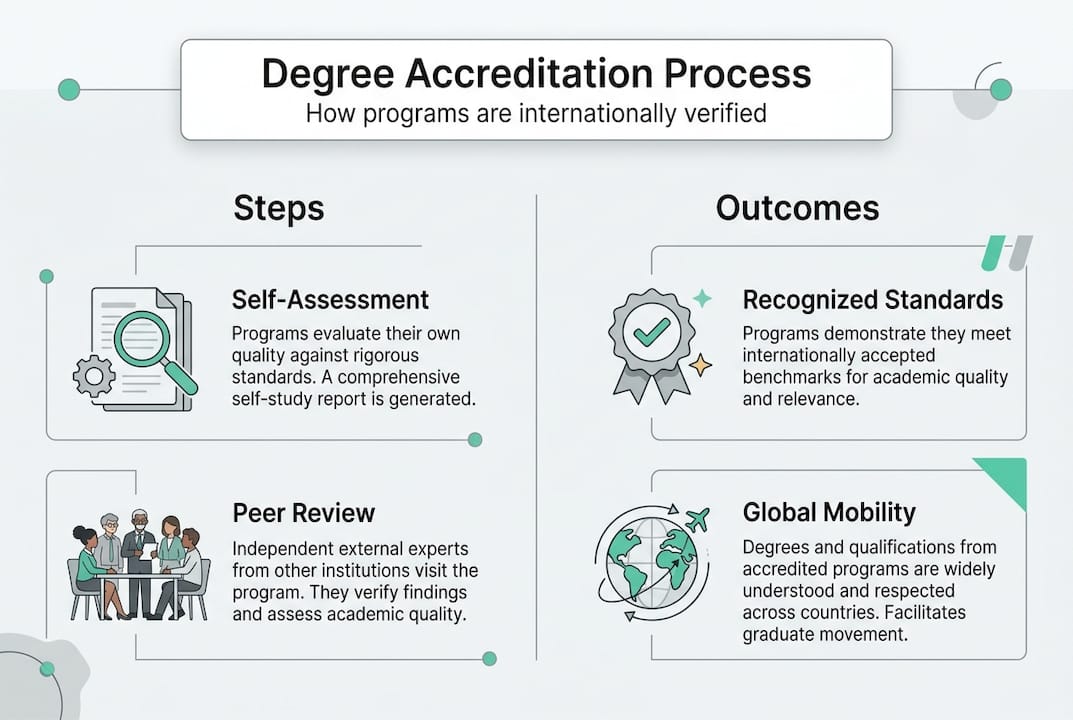
Accreditation is not a rubber stamp. It’s a structured, cyclical process in which independent experts evaluate whether a program meets nationally or internationally accepted quality standards. Think of it as the difference between a restaurant passing routine health inspections versus simply claiming to be clean. One is verified, one is not.
The mechanics work roughly like this: institutions submit detailed self-assessments, then external peer review panels conduct site visits, interview faculty and students, and examine curriculum, outcomes data, and governance structures. Programs are re-evaluated on a regular schedule, typically every five to seven years. Accreditation ensures quality through rigorous independent peer review processes, which means your degree continues to hold its value as standards evolve over time.
Global frameworks like the European Standards and Guidelines (ESG) and the International Standards and Guidelines (ISG) set the benchmarks that accreditation bodies reference. For programs operating across borders, including those combining study in Singapore, the UK, and Australia, alignment with these frameworks is what makes a degree portable. A well-designed evaluation guide breaks down how these evaluations are structured across different national systems.
Fast-track programs face an extra layer of scrutiny. Because they compress a traditional three-year bachelor’s into two years, or a two-year MBA into twelve months, skeptics question whether rigor is sacrificed for speed. This is exactly why business school accreditation matters so much in this space. Accredited fast-track programs must demonstrate the same learning outcomes as longer programs through tighter scheduling and higher-intensity instruction, not by cutting corners.
Pro Tip: When evaluating any fast-track program, ask specifically which accreditation body reviewed the program (not just the institution) and when the last review took place. Program-level accreditation is a stronger signal than institutional accreditation alone.
| Accreditation type | What it covers | International portability |
|---|---|---|
| Institutional | The whole university | Moderate |
| Program-level | Specific degree or course | High |
| Professional body | Industry-specific standards | Very high |
| Regional only | Limited national scope | Low |
For anyone pursuing UK recognized degrees from outside the UK, understanding which type applies to your program is foundational before committing financially or professionally.
Real-world impact: Employment and earnings outcomes
Here’s where the data gets interesting and a little more complicated than most prospective students expect. Accreditation does improve long-term career outcomes, but it doesn’t function like a magic key that unlocks a job offer the day after graduation.
Empirical research shows mixed labor outcomes: long-run wage gains are documented, but there is limited or no immediate employment boost tied directly to accreditation status. In other words, accreditation signals competence and credibility to employers over time, but it won’t shortcut the first job search on its own.
“The real career advantage from accreditation compounds. It opens doors to promotions, professional licensing, and international mobility that simply aren’t available to holders of unrecognized degrees.”
This distinction matters deeply for career switchers and working professionals looking to upgrade their credentials. If you’re entering a regulated field like accounting, auditing, or financial management, accreditation isn’t optional. It’s the prerequisite. Many professional licensing bodies globally will not even review applications from graduates of non-accredited programs.

For international students, the stakes are even higher. An employer in Singapore, the UK, or Australia evaluating a degree from overseas uses accreditation status as a quick filter. Without it, your application may never reach a hiring manager. Additional accreditation research confirms this filtering effect is especially pronounced in management and finance sectors.
Here’s what accreditation actually signals to international employers:
- You studied under a curriculum that was externally validated for rigor
- Your institution was accountable to a recognized third-party body
- Your qualification can be verified through official national or international registries
- You meet baseline competency standards that professional bodies recognize
The benefits compound once you factor in mobility. Professionals with accredited online programs on their resume have documented access to more international roles, and the international study career boost goes even further when the degree combines global exposure with recognized credentials.
Risks of unaccredited degrees and regional nuance
Let’s be direct about the consequences of choosing a program without proper accreditation. The risks aren’t abstract, and they aren’t small.
Unaccredited degrees risk non-recognition, wasted investment, and severely limited mobility. This plays out in four concrete ways:
- Transfer blocks. Credits from unaccredited programs are rarely accepted by accredited universities, which means you can’t build on that degree toward a higher qualification.
- Licensure rejections. Professional bodies in accounting, law, and healthcare globally require applicants to hold accredited credentials. No accreditation means no license.
- Visa and immigration complications. Several countries require proof of accredited qualifications for skilled worker visas and post-study work permits.
- Employer screening failures. Many large multinational employers now use automated screening tools that filter out degrees not listed in recognized accreditation databases.
Regional accreditation adds another layer of complexity. In the United States, for example, regional accreditation is generally considered stronger than national accreditation for academic purposes, but neither category automatically transfers to international recognition. For students targeting UK or Asia-Pacific employment, what matters is recognition by bodies aligned with those markets, not just domestic approval. Reviewing accreditation guidelines from bodies like Italy’s ANVUR illustrates how different national systems define and enforce these standards.
Pro Tip: If a school promotes accreditation from a body you’ve never heard of, search that accreditor in the INQAAHE or CHEA databases. Legitimate accreditors are listed there. Unlisted bodies are a red flag.
| Scenario | Accredited degree | Unaccredited degree |
|---|---|---|
| Apply for UK skilled worker visa | Accepted | Often rejected |
| Transfer credits to another university | Generally accepted | Rarely accepted |
| Sit for CPA or ACCA exams | Eligible | Usually ineligible |
| Apply to multinational employer | Passes screening | Frequently filtered out |
Those most at risk are international students, career changers, and working professionals who prioritize cost and speed over verification. Understanding accredited qualifications and mobility before you choose a program can save years of setbacks. It’s also worth exploring UK-accredited study options that combine speed with recognized credentials.
How to verify accreditation: Practical steps and shortcuts
Verification takes about thirty minutes if you know where to look. Most students skip this step because the process feels opaque. It isn’t.
Accreditation involves peer-reviewed evaluations, site visits, and adherence to accepted benchmarks, all verifiable via official sources. Here’s how to do it quickly:
- Check the institution’s website. Accredited schools list their accrediting bodies prominently. If the page is vague or buried, that’s a warning sign.
- Cross-reference the accreditor. Search the named body in the INQAAHE global directory, CHEA’s international database, or your target country’s national quality assurance agency.
- Look for program-level accreditation separately. A business school might be institutionally accredited, but the specific Management or Accounting degree should also have its own program-level recognition.
- Ask the admissions team for documentation. Any legitimate program will provide the accreditation certificate, the review date, and the next renewal date without hesitation.
- Verify recognition in your target job market. If you plan to work in the UK, check that the degree is recognized by the UK Quality Assurance Agency (QAA). For accounting roles, confirm compatibility with ACCA, CIMA, or ICAEW membership pathways.
- Check employer and licensing body requirements first. Before enrolling in any program, identify your target employer or professional body and confirm exactly what credentials they accept.
For students considering accelerated pathways, the UK degree fast-track guide lays out which credentials are recognized and how the verification process works for international students. If you’re weighing a two-year bachelor’s accreditation, confirming that the program has passed program-level peer review is a non-negotiable step.
Documentation matters beyond enrollment too. Keep digital and physical copies of your accreditation certificates. Future employers, visa applications, and professional body memberships may require original documentation, sometimes years after graduation.
The uncomfortable truth: Why shortcuts in accreditation never pay off
We’ve seen the appeal of fast-track degrees marketed with vague credentialing language. Words like “internationally recognized” or “globally affiliated” appear frequently but mean nothing without a named accreditation body and a verifiable review record. The temptation is understandable. A faster, cheaper degree sounds rational when tuition costs are high and career timelines feel urgent.
But here’s what the industry rarely says plainly: management and accounting credentials face some of the most rigorous global scrutiny of any field. Employers and regulators in these sectors have invested decades in building licensing and membership systems that explicitly filter for accreditation status. A shortcut here doesn’t save time. It creates a ceiling you’ll spend years trying to break through.
The regret we hear most often from professionals who made this mistake isn’t about money lost. It’s about opportunity cost. Years spent in roles that don’t recognize their full capability, simply because the credential they hold doesn’t open the right doors. Proper accredited qualifications are not a premium add-on. They are the foundation of a career that travels.
Advance your career with accredited programs
If this article has clarified anything, it’s that accreditation is the foundation, not a feature. You deserve programs built on that foundation.
At Seekstudy, every degree we offer is accredited and built for the realities of international career mobility. Whether you’re looking at fast-track management degrees that compress your timeline without compromising recognition, or exploring accounting in the UK with pathways to professional body membership, our programs are verified and employer-ready. We were established to help motivated students and professionals pursue accredited qualifications without sacrificing speed or global recognition. Explore our programs today and start with credentials that actually work for your career.
Frequently asked questions
What does degree accreditation mean?
Accreditation means a degree is officially recognized for meeting educational standards verified by third-party peer review. Independent peer review processes are the core mechanism that ensures ongoing quality.
How does accreditation affect international job prospects?
Most global employers require or prefer accredited degrees for hiring, licensing, or promotions. Long-run wage gains are consistently documented for holders of accredited credentials, especially in management and finance.
Are unaccredited degrees ever accepted for career advancement?
Rarely. Most unaccredited degrees are not recognized for professional licensing or further study, and can block promotions entirely. Non-recognition and limited mobility are the most common consequences reported by affected professionals.
How can I check if a program is properly accredited?
Review the school’s published accreditation status with official national or regional agencies and ask for documentation. Accreditation is validated by recognized agencies through cyclical external reviews, all of which should be verifiable in official public databases.