

How to Prepare for Fast Track Degrees Online Abroad
Balancing a demanding job with dreams of studying abroad demands a clear sense of direction. For international professionals aiming to earn fast-track management or accounting degrees online, mapping out your academic trajectory is more than a checklist—it is the foundation for aligning educational investments with long-term career goals. This guide offers actionable strategies that help you assess your ambitions, streamline degree selection, organize documents, and develop a realistic study plan to support your professional advancement.
Table of Contents
- Step 1: Assess Your Academic And Career Goals
- Step 2: Select Your Fast Track Degree Pathway
- Step 3: Organize Essential Documents And Requirements
- Step 4: Plan Your Study Schedule And Commitments
- Step 5: Verify Readiness With Self-Assessment Checks
Quick Summary
| Key Insight | Explanation |
|---|---|
| 1. Assess Academic and Career Goals | Understanding your goals helps shape your degree choices and aligns education with your career trajectory. |
| 2. Choose the Right Degree Pathway | Evaluating options increases your chances of selecting a program that complements your professional life and learning style. |
| 3. Organize Required Documents | Proper document management avoids administrative complications during your journey to an international degree. |
| 4. Plan Your Study Schedule Well | Effectively managing your study time helps balance academic demands with professional responsibilities. |
| 5. Conduct Self-Assessment Checks | Evaluating your readiness helps identify strengths and weaknesses, enabling better preparation for your educational journey. |
Step 1: Assess your academic and career goals
Making smart decisions about your online fast-track degree requires a strategic approach to understanding your personal and professional objectives. When exploring international education opportunities, you’ll want to thoroughly map out your academic trajectory and long-term career vision.
Start by conducting a comprehensive self-assessment that examines your current professional standing and future aspirations. Determining your academic goals involves several critical steps:
- Analyze your current job role and skills gap
- Research potential career advancement paths
- Identify specific skill sets needed for progression
- Evaluate how an online international degree can bridge those gaps
Your assessment should also include a detailed review of your professional interests and potential specializations. Consider factors like industry trends, emerging job markets, and the specific credentials that employers in your field value most. Some professionals find that targeted online degrees can accelerate their career progression by providing specialized knowledge and internationally recognized qualifications.
Clarity about your goals transforms an educational investment from an expense into a strategic career development opportunity.
By setting clear career goals, you create a roadmap that helps prioritize your educational choices and align your academic pursuits with your professional ambitions.
Here’s a quick summary of how a clear academic and career assessment impacts your degree choices:
| Assessment Aspect | Influence on Degree Selection | Long-Term Impact |
|---|---|---|
| Career Vision | Guides program and major choice | Aligns with future promotions |
| Skills Gap Identification | Highlights needed courses or focus | Strengthens employability |
| Industry Trends Awareness | Ensures relevance of qualification | Prepares for emerging roles |
| Preferred Specializations | Narrows list of programs to explore | Builds targeted expertise |
Pro tip: Create a detailed spreadsheet tracking your current skills, desired career milestones, and how each potential degree program directly contributes to those objectives.
Step 2: Select your fast track degree pathway
Identifying the right fast-track degree pathway demands careful navigation through various international academic options. Your selection will directly impact your professional development and career trajectory, making this step crucial in your educational journey.
Begin by exploring program design flexibility that aligns with your professional constraints and academic goals. Not all fast-track programs are created equal, and understanding the nuanced differences can make a significant impact on your educational experience.
Consider the following key factors when selecting your pathway:
- Program duration and intensity
- Academic credit transferability
- Geographical learning locations
- Online versus hybrid learning models
- Specialization opportunities
- Accreditation and recognition
Your pathway selection should strategically balance professional commitments with academic ambitions. Some professionals prefer modular online programs that allow maximum flexibility, while others might seek immersive international experiences with structured timelines.
Selecting the right degree pathway is less about finding a perfect program and more about finding the perfect fit for your unique professional landscape.
Evaluate each potential pathway by its ability to deliver specialized skills, enhance your current professional capabilities, and open doors to future career advancement. Look beyond the curriculum and assess how each program’s structure and delivery method complement your learning style and career objectives.
Use this table to understand how different degree pathway formats align with common professional needs:
| Format Type | Flexibility Level | Professional Suitability |
|---|---|---|
| Fully Online | Maximum, self-paced | Ideal for working professionals |
| Hybrid (Online/In-person) | Moderate, some required presence | Suits those wanting flexibility with structure |
| Intensive On-site | Low, fixed schedule | Best for those taking leave |
Pro tip: Create a comprehensive comparison matrix that objectively ranks potential degree pathways against your personal and professional development criteria.
Step 3: Organize essential documents and requirements
Preparing for an international fast-track degree requires meticulous document management and strategic organization. This step is crucial in transforming your academic aspirations from a dream into a concrete plan of action.

Preparing critical study documents involves comprehensive planning and anticipating potential administrative requirements. Your document preparation strategy should be systematic and thorough, covering multiple aspects of your academic and personal profile.
Essential documents you’ll need to compile include:
- Academic transcripts
- Passport and visa documentation
- Language proficiency test scores (TOEFL, IELTS)
- Letters of recommendation
- Financial statements
- Health insurance certificates
- Educational certificates
Digital and physical organization are equally important. Create a dedicated folder system that separates original documents from copies, ensuring you have backup versions for emergency situations. Some professionals prefer a physical document portfolio alongside digital cloud storage for maximum security.
Effective document organization is your first line of defense against potential administrative complications during your international education journey.
Pay special attention to document authentication and translation requirements. Many international programs require notarized or certified translations of academic credentials, so factor in additional time and potential expenses for these processes.
Pro tip: Scan and create encrypted digital backups of all important documents, storing copies in multiple secure locations including cloud storage and external hard drives.
Step 4: Plan your study schedule and commitments
Mastering the art of schedule management is critical for successfully completing a fast-track degree while maintaining professional and personal balance. Your ability to strategically plan your academic commitments can make the difference between overwhelming stress and sustainable academic progress.
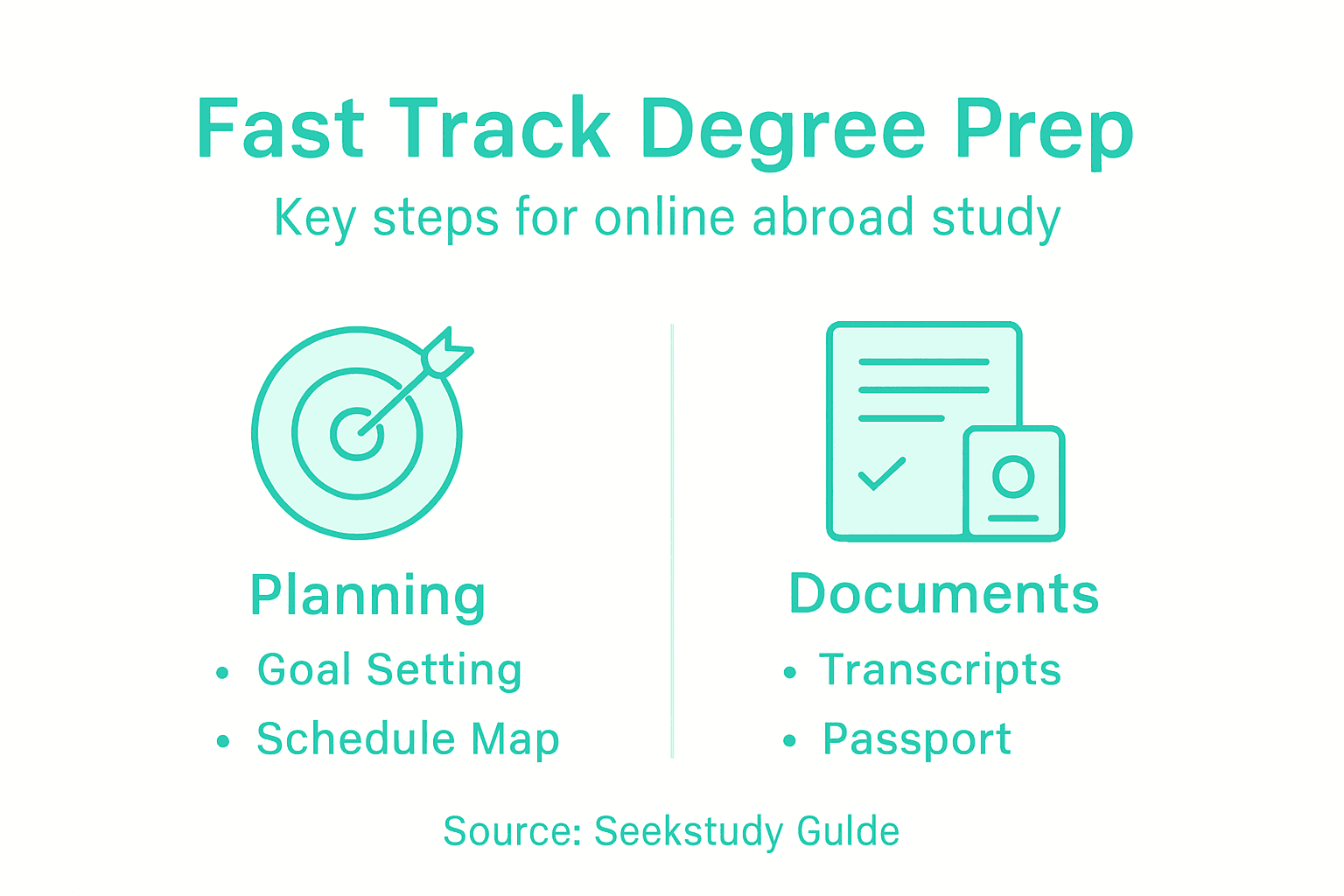
Creating an effective study timeline requires a systematic approach that integrates your academic goals with existing work and personal responsibilities. Professional learners must develop a flexible yet structured planning strategy that accommodates the unique demands of accelerated online degree programs.
Consider these essential scheduling strategies:
- Block dedicated study hours in your weekly calendar
- Identify and minimize potential time-wasting activities
- Utilize digital planning tools and productivity apps
- Create buffer zones for unexpected work or personal commitments
- Establish realistic weekly learning objectives
- Develop contingency plans for potential schedule disruptions
Prioritize your time management by treating your academic commitments with the same level of professionalism you apply to your work responsibilities. Some professionals find success by allocating specific time blocks for studying, which helps create a predictable and sustainable learning routine.
A well-planned schedule transforms academic challenges from overwhelming obstacles into manageable, strategic milestones.
Remember that your study schedule is not static. Regular assessment and adjustment are crucial, especially when balancing work, personal life, and academic pursuits. Be prepared to recalibrate your approach as your professional and academic landscapes evolve.
Pro tip: Conduct a weekly review of your study schedule, identifying productivity patterns and adjusting your time allocation to maximize learning efficiency and minimize burnout.
Step 5: Verify readiness with self-assessment checks
Successfully navigating an international fast-track degree demands more than academic ambition – it requires a comprehensive understanding of your personal learning capabilities and potential challenges. This critical self-assessment step helps you proactively identify strengths and potential areas for improvement before embarking on your educational journey.
Evaluating online learning readiness involves a holistic examination of your personal and professional preparedness. Professional learners must conduct an honest, multi-dimensional assessment that goes beyond surface-level self-reflection.
Key dimensions to assess include:
- Time management proficiency
- Digital technology comfort level
- Self-motivation and discipline
- Communication and collaboration skills
- Learning environment stability
- Technical resource accessibility
- Stress management capabilities
Conduct a systematic self-evaluation by critically examining each of these dimensions. Some professionals find value in creating a personal readiness scorecard that objectively tracks their preparation level across different competency areas.
Self-awareness is the most powerful tool in transforming potential obstacles into strategic opportunities for growth.
Remember that self-assessment is not about perfection but understanding your current capabilities and developing strategies to address potential limitations. Be honest, realistic, and compassionate with yourself during this process.
Pro tip: Utilize online self-assessment tools and consider discussing your readiness with a academic advisor who can provide personalized insights into your preparation level.
Accelerate Your Global Career with Fast-Track Degrees from Seekstudy
Navigating the challenges of obtaining an international fast-track degree requires clarity, flexibility, and accredited programs tailored to your career goals. Whether you want to bridge your skills gap or embrace an intensive study schedule, Seekstudy specializes in fast-track degree programs designed specifically for professionals like you. With internationally recognized bachelor’s and master’s degrees in Business Management and Accounting, our programs offer a perfect balance between rigorous academics and flexible online learning.
Take control of your academic and professional future by choosing a program that fits your unique lifestyle and ambitions. Visit Seekstudy now to explore how our two-year bachelor’s degree, one-year MBA, and international study opportunities in Singapore and the UK can help you meet your educational deadlines with confidence. Do not wait — take the first step to transform your career with an accredited degree that opens doors worldwide.
Frequently Asked Questions
How do I assess my academic and career goals for a fast-track degree online abroad?
Start by conducting a self-assessment of your current job role and desired career path. Identify skills gaps and research necessary qualifications to align your educational choices with your career aspirations.
What factors should I consider when selecting my fast-track degree pathway online?
Evaluate aspects like program duration, credit transferability, geographical options, and type of learning model (online or hybrid). This ensures you choose a pathway that complements your professional commitments and academic goals.
What essential documents do I need to organize for applying to an international fast-track degree?
Prepare documents such as academic transcripts, language proficiency test scores, letters of recommendation, and financial statements. Create a dedicated folder system to manage both digital and physical copies of these essential documents.
How can I effectively plan my study schedule while pursuing a fast-track degree online?
Block out dedicated study hours in your weekly calendar and set realistic learning objectives. Regularly review and adjust your schedule to accommodate work and personal commitments, ensuring a balanced approach to your studies.
What should I include in my self-assessment to verify my readiness for an online fast-track degree?
Assess your time management skills, digital technology comfort, and self-motivation levels. Consider creating a readiness scorecard to track your preparedness across these key areas and identify where you may need improvement.
Recommended
Tag:Course

You may also like


Step-by-Step Guide to Online MBA for Professionals